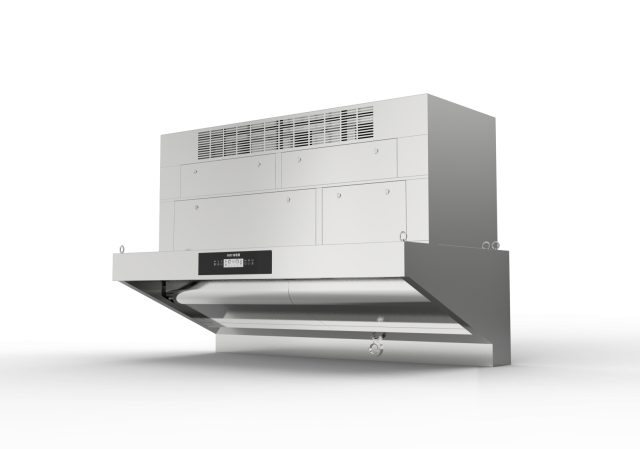
A takeaway counter is the smallest commercial kitchen format there is — and, square meter for square meter, the one where ventilation decisions bite hardest. There is no dining room to dilute cooking smells, no back corridor to hide a duct riser, and no spare budget to build one. The kitchen may be six square meters; the pickup counter may sit a meter and a half from the fryer. Yet this is the format the food delivery boom has made dominant: single-operator shops on high streets, delivery-only counters behind a service window, and compact kitchens built entirely around what the order apps sell. This guide covers how to ventilate one properly — how the menu decides the equipment, why ducted exhaust usually loses in this format, how a ventless range hood solves the geometry, and what real takeaway buyers are asking for right now.
What Makes a Takeaway Counter a Special Ventilation Case
Three constraints define the format. First, footprint: a typical takeaway shop runs between 10 and 40 m², and the kitchen claims 25 to 40 percent of it. That leaves no room for the ductwork shafts, access panels and maintenance clearances a conventional exhaust system assumes. The fryer, the griddle and the prep surface share air with the counter, the packaging station and the queue.
Second, there is no buffer zone. In a full-service restaurant, cooking effluent passes through a dining room that absorbs residual odor before anyone complains. In a takeaway counter, the customer stands at the point of cooking. Every gram of vapor that escapes the hood lands directly on the customer experience — and on the packaging, where fried-food smell soaks into bags and boxes that customers carry away.
Third, demand is spiky in a way sit-down dining is not. Delivery platforms compress orders into sharp lunch and dinner windows, so a single fryer can cycle continuously for ninety minutes at a time. A ventilation system that copes with gentle background cooking fails exactly when the platform queue peaks. Undersized capture shows up immediately: smoke past the canopy edge, a greasy film on the counter glass, odor settling into the waiting area.
The Menu Decides the Load
Takeaway menus cluster at the two ends of the fume spectrum, and the equipment choice follows the heavier end. Fried and griddled menus dominate the format: fried chicken, burgers and smash patties, kebabs and doner, fish and chips, churros, spring rolls, hash browns. Deep fryers and flat-top griddles throw dense grease-laden vapor continuously — this is heavy-fume work, and it belongs on the ND-series heavy oil-fume all-in-one, whose capture canopy and multi-stage purification train are sized for exactly this duty cycle.
The light end is smaller but real. Boba and milk tea shops with a snack toaster, coffee counters with a panini press, steamed bun and dim sum windows, soup and noodle counters running broth kettles — these produce steam and light aerosol, not dense grease smoke. The N-series light oil-fume all-in-one covers them with a lower-profile unit, quieter operation and lower running cost. A surprising number of takeaway operators run both profiles under one roof — fried snacks at lunch, drinks all afternoon — and the practical answer is one ND-series hood over the fry line and an N-series over the light station, rather than one oversized hood straining to cover everything.
For the smallest end of the format — a single counter fryer for churros, fried snacks or pressure-fried chicken in a space of a few square meters — the Snack Cart Purifier class integrates a compact fryer station with its own ventless purification, which is often the cleanest fit of all when there is no room for even a compact canopy.
Why Ducted Exhaust Fails the Small-Shop Format
Conventional ducted exhaust assumes three things a takeaway counter rarely has: a vertical path to the roof, landlord permission to build one, and a budget that survives the build. Small shop units sit in terraces and strip malls under occupied floors, behind residential neighbors, or in leaseholds where the landlord will not grant a roof penetration for a tenant on a short lease. On a high street, the neighboring windows and residences above are close enough that any ducted discharge becomes a shared problem within weeks.
The economics are just as decisive. A grease duct is not a one-time cost: it needs professional cleaning on a schedule, access panels at every turn, and documentation for the fire inspector and the insurer. For a sit-down restaurant, that recurring cost spreads across a full kitchen brigade and a large menu. For a takeaway counter running one fryer and a griddle, duct cleaning and fabrication can rival the cost of the cooking line itself — a wildly disproportionate burden on the thinnest margins in foodservice.
And there is the fire-load argument. Grease condenses inside every ducted run, building flammable deposits in a concealed shaft above a tiny shop that may have no sprinkler coverage. Removing grease from the exhaust stream before it can settle anywhere is not just cleaner — it is a materially safer building.
The Ventless Architecture, Applied to a Micro Kitchen
A ductless all-in-one range hood solves the takeaway problem by refusing to create it. The purification train is packed into the unit itself: the canopy captures rising grease-laden vapor at the fryer and griddle; a pre-filter strips larger droplets; an electrostatic precipitator (ESP) cell charges sub-micron particulate and collects it on washable plates; and an activated-carbon stage adsorbs the residual volatile organic compounds that carry smell. Cleaned air returns to the room.
For a takeaway counter, each stage of that sentence is worth money. No duct means no fabrication, no shaft, no landlord negotiation and no roof — the unit installs against the wall over the cookline and connects to a standard single-phase supply, which in most countries is the same 220-240 V outlet powering the fryer. No duct also means no recurring cleaning contract and no hidden grease buildup overhead. Recirculation means the shop does not exhaust air it has paid to heat in winter or cool in summer — a real line item for a 20 m² shop where the door opens fifty times an hour at peak.
Installation time matters too. A ventless unit typically goes from delivery to cooking in hours, not weeks — which is exactly how takeaway operators think. The shop signs the lease on Monday and wants the fryer running by the weekend; a ducted build-out cannot compete with that calendar.
Odor Control Where the Customer Stands
In a takeaway counter, odor is not a compliance nuisance — it is merchandising gone wrong. The right amount of cooking aroma makes customers order more; the wrong amount clings to their clothes, soaks into the packaging station, and drifts out the door to the neighbors. The difference between the two is a functioning deodorizing stage behind the ESP cell.
The activated-carbon stage built into the all-in-one units handles most menus. When the counter sits in an enclosed arcade or food hall, when the apartment upstairs has already complained once, or when the menu is odor-heavy — fried chicken, curry, doner kebab, churros in volume — add a dedicated Odor Removal Tower as a second deodorizing stage in line with the hood. It extends the dwell time of the cleaned airstream through carbon media, which is what removes the sour and fried notes that particulate filtration alone never touches.
A practical test used by experienced operators: stand at the pickup counter during the peak window, then check the packaging stack. If the top boxes smell of the fryer from a meter away, the odor stage needs upgrading before the reviews say it for you.
Sizing a Micro Kitchen
The sizing arithmetic for takeaway counters follows the same rules as any commercial kitchen, compressed. Plan roughly 2,000 m³/h of airflow per meter of range hood for a conventional cookline, and about 2,500 m³/h per meter where the customer watches an open display line. Working appliance-first, allocate around 4,000 m³/h per open burner or fryer pit.
Most takeaway kitchens resolve to a compact hood: a single fryer plus a griddle on a 1.2–1.5 m counter is the classic configuration, and a two-appliance line lands on 1.8–2.4 m at most. Follow the capture rule — the hood should overhang the cooking surface by 100–150 mm on each open side — and keep at least one meter of working clearance in front of the appliances, because in a micro kitchen the operator is also the dishwasher and the packer. Height matters: check the ceiling and the unit’s service access before ordering, especially in converted shopfronts with bulkheads and signage fascias that eat ceiling height.
The most common sizing mistake in this format is the opposite of what people fear: operators do not undersize the airflow, they undersize the capture. A small hood hung high above a busy fryer spills vapor past the canopy edges no matter how powerful the fan. Fit the hood to the appliances, low and wide, and let the purification train do the rest.
What Takeaway Buyers Are Actually Asking For
Aggregated inquiry patterns across recent months sketch the typical buyer precisely. The dominant profile is the small takeaway or fried-snack shop asking about a ventless hood for a compact kitchen — one fryer and a griddle, a kitchen of six square meters inside a 40 m² shop. Next come delivery-only counters: operators building kitchens with no customer seating at all, optimized for pickup and rider handoff, who need full cooking capability with zero exhaust infrastructure. A steady third stream is the replacement pattern — an existing hood flagged by a landlord, an inspection, or simple under-performance, to be swapped for a self-contained unit without construction.
The geography is broad and instructive. The United Kingdom and Ireland generate a constant flow of high-street takeaway and chip shop questions; Australian regional towns — Geelong and similar — ask about compact fried-food counters; Southeast Asian markets, led by the Philippines, ask about delivery-only counters in dense urban districts; and Malaysian and Gulf inquiries cluster on kebab, shawarma and fried-snack menus. The common thread across every one of these markets is the same: the smaller the kitchen, the more decisively the answer tilts toward ductless.
One more pattern deserves note: franchise and multi-site operators. Once a takeaway brand proves a format in one unit, it replicates the same kitchen ten or fifty times. A ventless specification replicates without renegotiating ductwork with fifty landlords — which is why franchisors increasingly write ductless hoods into their standard fit-out kits.
Running a High-Turnover Counter
Ventless purification shifts maintenance from the building to the appliance, where the operator can actually manage it. For a busy fryer-led counter, a realistic cadence is: wash the ESP cell and aluminum collector plates monthly, replace or wash the mesh pre-filter on the supplier’s interval, and inspect sealing strips and ceramic insulators at every wash — they are consumable wear items, not defects. A counter running multiple fryers through continuous platform peaks should shorten the wash cycle rather than wait for the odor test to fail.
Keep the log from day one. A dated record of cell washes and filter changes answers the landlord, the fire inspector and the insurer in one email — and for operators planning a second site, the log is the operating manual the next shop inherits. Twelve-month whole-unit warranty terms apply to the hardware; the consumables are the operator’s routine, and shops that treat it that way run for years without a service call.
A Fit-Out Checklist for a Takeaway or Delivery-Only Counter
- Define the menu and its fume class: fried and griddled menus are heavy-fume and point to the ND-series; steamed, brewed and toasted menus are light-fume and point to the N-series.
- Measure the kitchen, not just the shop: cookline length, appliance count, ceiling height under bulkheads, and the space the hood can occupy over the fryer and griddle.
- Size the capture: roughly 2,000 m³/h per meter of hood, hood wider than the appliances by 100–150 mm per open side, mounted low over the cookline.
- Add the odor stage when the counter is enclosed, the menu is odor-heavy, or neighbors have complained before — an Odor Removal Tower is cheaper than a lease dispute.
- Confirm the electrical: single-phase 220-240 V is standard for these units; verify the shop’s circuit can carry fryer plus hood together.
- Document the package — spec sheets, CE certification, layout drawing — and start the maintenance log on day one so the landlord and inspector conversations stay short.
The takeaway counter rewards operators who respect how small it is. Menu-sized ventilation — a ventless hood matched to the fryer and griddle, with odor control at the counter — turns the format’s biggest liability into a non-issue, and lets the shop spend its space and budget on food, speed and signage instead of ductwork it was never going to get permission to build.