Open a restaurant in Vietnam and the ventilation question arrives early, usually before the menu is final. A narrow shophouse in Ho Chi Minh City with four meters of frontage and a family home above it. A basement unit in a shopping mall where the landlord allows no new shaft. A five-burner kitchen planned for Indian or Western food in a district where the neighbors are close, the air is hot and humid year-round, and the cooking runs from morning coffee to late-night grilling. Vietnamese food service is one of the most dynamic dining markets in Southeast Asia, and its kitchens face a specific combination of constraints that make imported assumptions about ductwork fail. This guide sets out how the market actually works: the cooking load from pho broth to charcoal grill, the building types that decide the architecture, the fire and emission approvals that drive replacement, the hot-humid variable, and how ductless purification fits — with the ND-series and N-series all-in-one hoods and the Odor Removal Tower doing the heavy lifting.
Why Vietnamese Cities Are Their Own Ventilation Case
Three features set Vietnam apart from the generic Southeast Asian kitchen picture, and each one changes what can be installed.
Density and vertical living. Vietnamese urban dining is stacked. A restaurant typically occupies the ground floor of a building whose upper floors are apartments, offices, or the owner’s family home. Every cooking smell that leaves the kitchen has somewhere to go that somebody else lives or works in. This is why odor control in Vietnam is not a premium add-on but a condition of staying open.
Narrow, deep building plots. The tube house and shophouse forms that define streets in Ho Chi Minh City, Hanoi, and Da Nang are typically four to six meters wide and much deeper. There is often no rear yard, no side access, and no plant room at the back. Horizontal duct runs of any length are difficult, and vertical discharge usually means crossing someone else’s floor area to reach the roof.
A street-food culture meeting a modern dining boom. Vietnam has one of the strongest street food traditions anywhere, much of it cooked from carts and pavement stalls, and simultaneously one of the fastest-growing modern restaurant, cafe, and mall F&B sectors in the region. Kitchens therefore span an unusual range: a rolling cart or a two-burner frontage counter on one hand, and a full five-burner kitchen with imported combi ovens on the other. Both ends get asked the same ventilation question, and the answers are different.
Add the tropical climate — high humidity, high temperatures, monsoon downpours — and the design envelope narrows further: equipment must handle moisture, condensation, and steep cooling loads while being serviced by staff with high turnover. Vietnam is not a market where a complicated system succeeds.
The Vietnamese Cooking Load: From Phở Broth to Charcoal Grills
Sizing starts with an honest read of the menu, because Vietnamese food service spans a wider fume spectrum than a single phrase like “Vietnamese cuisine” suggests.
Phở, bún, and broth lines. Long simmering produces large volumes of steam and heat but surprisingly little grease. A broth-focused line is a light-fume load: capture and removal of moisture and heat matters more than grease filtration, and an N-series all-in-one handles it without ductwork.
Fried food and fast food. Fried chicken, fries, spring rolls (chả giò), and the fried components of combination rice plates are heavy fume: grease-laden vapor in high volume, with the sub-micron particulate that coats walls and carries odor. This is ND-series territory.
Charcoal grilling. Bún chả, bò lá lốt, and the backyard grill culture that runs through Vietnamese dining produce visible smoke with high-temperature grease aerosol, the load class that heavy-duty ESP purification is designed around, plus carbon monoxide and particulate from the fuel itself. Charcoal is a special case in every market: it demands more airflow than its burner count suggests, and it needs its own approved arrangement — solid-fuel cooking should never be treated as equivalent to an electric griddle in the same hood.
Vietnamese coffee and bakeries. Roasting and brewing is a light-to-medium load with a strong, persistent aroma. Bánh mì counters and bakery ovens are light fume with heat. Both sit comfortably on light-duty equipment, but the aroma load means carbon finishing earns its place.
Selection guides built for the region typically classify Vietnamese menu items that involve frying or charcoal as heavy-fume work; the practical rule is simple. If the menu fries, woks, or burns charcoal, size for heavy duty. If it simmers, steams, brews, or bakes, size for light duty and put the money into odor control instead of raw airflow.
Where the Duct Cannot Go
Vietnam’s building stock makes conventional exhaust design awkward in ways that surprise importers who have only worked in markets with low-rise commercial parks. Retrofits here usually land on ductless all-in-one purifiers, because there is no shaft to use and no permission to create one.
Tube houses and shophouses. A typical restaurant occupies the front portion of a deep, narrow building with residential floors above. A duct routed vertically to the roof passes through bedrooms and bathrooms — structurally intrusive, frequently unacceptable to the building’s other occupants, and expensive to make fire-compliant. Many owners discover this after they have signed a lease.
Mall and basement units. Vietnam’s shopping mall F&B sector has expanded rapidly, and the most desirable and least expensive units are often on lower levels. These units usually have no dedicated kitchen exhaust riser available for a new tenant, or the riser is fully committed by the building’s original design. The landlord’s fit-out conditions typically prohibit modifying the facade and the shaft.
Hanoi’s Old Quarter and heritage streets. The dense historic fabric of central Hanoi adds facade restrictions on top of everything else. Where the streetscape is protected, a new external duct or a visible discharge point is simply not on the table.
Rented premises. A large share of Vietnamese food service operates on leases of a few years. Anything that requires structural alteration does not amortize and does not get approved. Equipment has to be installable, movable, and resalable.
The cumulative effect is direct: for a large share of Vietnamese venues, the duct question is already answered before the equipment list is written. The answer is no.
What Drives Replacement: Approval, Emissions and Landlords
Where a duct is unavailable, an operator has two options: struggle against the building, or specify recirculating purification. The second option has become more attractive because three separate approval pressures keep pointing the same way.
Fire safety review. Vietnam operates a fire-safety approval and inspection regime that business owners know as PCCC, covering prevention and fire-fighting requirements. Ventilation is part of that review for any cooking operation — grease accumulation in a hood and duct is a recognized fire load, and inspectors look at how the kitchen manages it. A system that keeps grease inside washable, inspectable components, and that removes the long duct run altogether, presents a materially simpler compliance story than a grease-lined duct crossing several floors. Requirements vary by locality and by building class, so confirm the current rules with the responsible local authority before specifying — but expect ventilation condition to be examined.
Emissions and neighbor complaints. Vietnamese cities enforce visible smoke and nuisance complaints through a mix of environmental and municipal channels, and in a dense neighborhood a complaining neighbor can effectively close a kitchen’s evening trade. Operators who have been through one complaint cycle tend to specify odor control up front the second time.
Landlord fit-out conditions. Mall landlords and commercial building owners increasingly write ventilation specifications into the tenancy agreement: no facade discharge, no use of the existing riser without written consent, and — in some buildings — a requirement for odor treatment where the unit sits above or adjacent to food retail or residential floors. Meeting those conditions with recirculating equipment is straightforward; meeting them with a duct is often impossible.
Notably, property-related approvals are not the only driver. A large share of the inquiries from Ho Chi Minh City and other Vietnamese cities come from operators opening a new restaurant or upgrading an existing one: a Western restaurant needing a full multi-burner line, or an Indian restaurant specifying a five-burner hood for tandoor and curry production. These are not marginal replacements — they are kitchens being built from scratch with no duct rights at all.
The Hot-Humid Variable
Vietnam’s climate does more to ventilation economics than most operators expect.
Cooling load. A kitchen that exhausts treated air at high volume forces the air-conditioning system to replace not just the air but the cooling energy in it. In a city where the cooling season effectively never ends, a restaurant running a large exhaust volume pays for that continuously. Recirculating purification removes grease, smoke particles, and odor, then returns the air, so the cooling energy stays in the building — one of the quietest financial arguments for the ductless approach in tropical Vietnam. (Heat and moisture are not removed by purification; a broth line still needs general ventilation and the cooling system sized for it.)
Corrosion and moisture. High humidity year-round, combined with grease-laden vapor, is aggressive to electrical components. Specification priorities shift accordingly: stainless housing as the baseline, a sealed or potted power supply, ingress-protected control compartments, and easy access for cleaning so that moisture is not left standing in the unit. Coastal Vietnam, from Da Nang to Phú Quốc, adds salt air to the mix and makes fresh-water rinsing of the cell and pre-filters part of the maintenance rhythm rather than an optional extra.
Monsoon interruptions. Heavy seasonal rain affects delivery schedules, staff attendance, and equipment left idle in humid air. Equipment that survives a slow month switched off — with clean, dry internals, sealed electronics, and easily replaced wear parts — protects its owner’s investment. Buy consumables ahead of the monsoon season rather than during it.
Architecture Choices for Vietnamese Venues
With the constraints established, the specification writes itself, and it is worth being explicit about the logic because it is the same logic a distributor should run with every new customer.
Where ductwork exists and is usable — typically a purpose-built commercial building, a hotel, or a factory canteen — a ducted train of capture hood, in-line ESP Purifier, and Centrifugal Fan remains efficient and appropriate, especially for high-volume heavy fume. Verify the riser capacity and the discharge position before committing.
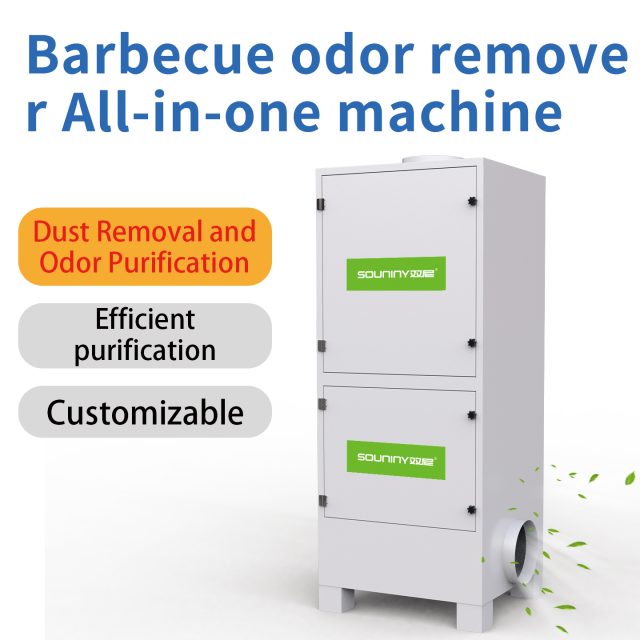
Where no duct is available — the majority of Vietnamese city venues — the ductless all-in-one line takes over. For frying, grilling, and multi-burner production, the ND-series heavy-fume all-in-one provides capture, baffle pre-filtration, electrostatic precipitation, and carbon finishing in a single recirculating unit. For broth lines, bakeries, coffee, and light cooking, the N-series light-fume unit does the same at a lower duty and lower noise.
Wherever odor reaches people — which in Vietnam means nearly everywhere — the Odor Removal Tower belongs in the specification. Paired with the hood, its activated-carbon stage addresses the aroma compounds and VOCs that the electrostatic cell deliberately leaves behind. In a tube house with apartments above, or a mall unit next to a food court, this is the difference between a working kitchen and a running complaint file.
For street food, markets, festivals, and any operation that moves, the ventless carts step in: the CV-A ventless-hood cart and CV-C tempered-glass cart bring capture, purification, and a stainless worktop on wheels, needing nothing from the site except a socket. They are also the practical answer for front-of-house live cooking, where a permanent hood is not an option.
One market-specific rule worth repeating to every operator: a kitchen that can install a duct should still consider a purification train, and a kitchen that cannot install a duct must size its purification for the real menu — not for the smallest appliance on the line.
Sizing to the Vietnamese Menu
Ventilation sizing begins with the stations that fire at the same time, not with the floor area. The planning baselines used across Southeast Asian projects are a useful starting point: roughly 2,000 m³/h of airflow per meter of hood length for enclosed heavy-duty cooking, rising to about 2,500 m³/h per meter where the cookline is open to the dining room, on the order of 4,000 m³/h for a single solid-fuel or charcoal burner, and near 6,000 m³/h in total for a light-fume line.
Applied to a Vietnamese kitchen, the arithmetic usually resolves into one of three shapes.
A small frontage operation — two burners and a fryer, or a broth pot with light stir-frying — lands in the light-to-medium band and is served by a single N-series unit covering the work zone, with carbon finishing for the street-facing opening.
A full multi-burner kitchen — the five-burner hood requested by operators planning Indian, Western, or Chinese menus, or a Vietnamese restaurant running pho alongside frying — is heavy fume. A two-burner heavy line typically pairs with a 2.0–2.4 m hood, so five burners should be planned as a continuous capture run split across two or more purification units rather than one heroic unit at the end of a long run. Splitting the line also gives operational resilience: one unit down for cleaning does not shut the kitchen.
A grilling or charcoal kitchen — bún chả, bò lá lốt, barbecue restaurants — sits at the top of the range. Give the charcoal stations their own capture and their own airflow allowance, treat them as solid-fuel appliances in the approval paperwork, and do not size them by burner count alone. Where the grill sits in the dining room, as it often does in this market, the recirculating unit is the only architecture that works at all.
Two practical cautions finish the calculation. First, hood width should exceed the cooktop footprint with a comfortable overhang on each side — an undersized hood cannot be rescued by a larger fan downstream. Second, the planning figures above are for early selection only: final specification must match actual appliance duty, hood geometry, room volume, and, in ducted systems, the static pressure budget of the whole run. Sending a plan layout and menu to the manufacturer before ordering is the cheapest step in the project.
Odor Boundaries in Dense Neighbourhoods
In Vietnam the odor problem is not about a distant property line; it is about the room next door. Three layers keep the boundary intact.
Capture at the source. A hood sized to the actual cooking duty with proper overhang keeps the plume from escaping into the room in the first place. Every restaurant that has tried to solve a capture problem with an odor filter has learned the same lesson: filtration treats what it receives, and it receives very little of an escaping plume.
Finishing with activated carbon. A correctly sized carbon stage — the Odor Removal Tower is engineered for this role — removes the aroma fraction that electrostatic precipitation does not target. Its capacity is a consumable, sized to fryer hours and grill hours, and replaced on a schedule rather than after the first complaint.
Architecture and operation. Recirculating units remove the discharge point entirely, so there is no plume crossing a neighbour’s window or landing in a food court. On top of that, keeping kitchen doors closed during heavy frying, running the unit before and after service so the plume tail is cleared, and scheduling the most aromatic work away from the residential evening hours all reduce the odds of a complaint without spending money.
Where the kitchen sits directly under apartments — the classic Vietnamese configuration — the combination of source capture, carbon finishing, and no external discharge is not merely the best available option; it is effectively the only defensible one.
Maintenance in a Fast-Moving Market
Vietnamese food service expands quickly, staff turn over quickly, and units are often operated by people who were not present at installation. Maintenance has to be designed for that reality.
Daily: confirm the unit runs before the first pan, and that the baffle pre-filter is seated. This single habit prevents most grease carry-over into the cell.
Weekly: wash the baffle pre-filter — a hot soak or a dishwasher cycle, depending on the model — and inspect the grease tray. In coastal cities, add a fresh-water rinse to remove salt deposits.
Per interval: wash the ESP cell with a suitable degreaser, rinse thoroughly, and dry it completely before returning it to the power supply. Wet cells are the most common cause of nuisance arcing in humid climates.
Per calendar or pressure signal: replace the activated carbon. In a kitchen that fries daily, carbon life is measured in months, not years; odor returning while the cell looks clean is the signal.
Annually: a recommissioning check with airflow verification, a corrosion inspection of fasteners and compartment seals, and a written record. For a chain or franchise group, that record is the basis of standardization: identical units, identical consumable intervals, and one maintenance schedule across every outlet — which matters when the tenth branch opens in a new city with a new landlord and the same ventilation problem.
Scenario Quick Picks
A basement-unit Western restaurant in a Ho Chi Minh City mall, no riser available and a five-burner line planned: a heavy-fume ND-series installation split across the cookline, an Odor Removal Tower on the run nearest the common area, and carbon finishing sized to the mall’s tenancy conditions.
A Vietnamese restaurant in a Hanoi tube house, pho broth at the front, frying and grilling at the back, apartments above: N-series over the broth and light stations, ND-series over the fryers and grill, and no external discharge anywhere on the building.
An Indian restaurant in Ho Chi Minh City specifying a five-burner hood for tandoor and curry production: heavy-fume units planned as a continuous capture run across the line, with the tandoor treated as a high-temperature solid-fuel appliance and given its own airflow allowance.
A Da Nang beachfront grill bar with salt air and an evening-only service: ductless units specified with sealed electrical compartments and a fresh-water rinse in the maintenance rhythm, with CV-A and CV-C ventless carts covering the outdoor and pop-up stations.
A growing coffee and bakery chain rolling out identical stores: light-fume ductless units with carbon finishing, specified once and repeated — the same equipment, the same consumable list, the same commissioning sheet in every new location.
The pattern across all five is the same reasoning a distributor should carry into every Vietnamese quotation: ask first whether a duct is genuinely available, size by the real menu rather than the floor area, put carbon where people are, and choose equipment that can be cleaned by whoever is working that week. A market this fast-moving does not have time for systems that need specialists.