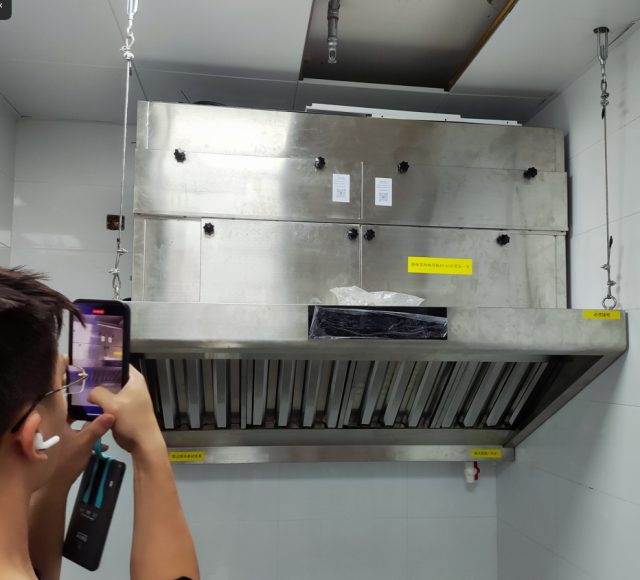
A commercial kitchen extraction system is a ten-year relationship compressed into one purchase order. The hood, the purification stages and the fan that ships this quarter will need ESP cells washed, carbon refilled, motors serviced and boards replaced for a decade. Most buyers price the equipment carefully and price the relationship not at all — until the company on the other side of the contract disappears. This playbook covers what actually happens when a kitchen exhaust supplier fails, which design and contract decisions decide the outcome, and what to do in the first thirty days.
Why Extraction Suppliers Fail More Often Than Buyers Assume
Commercial kitchen ventilation sits in an awkward commercial niche: volumes are modest, engineering content is high, and the product must satisfy a stack of overlapping standards — EN 16282 in Europe, NFPA 96 and UL 710B listings in North America, AS 1668.2 in Australia. That combination produces a supplier population with a distinctive risk profile. At the top sit manufacturers with their own factories, test laboratories and certification files. Below them sits a long tail of trading companies and assembly shops that buy canopies, cells, fans and controls from separate sources and bolt them together per order.
The long tail is where failures concentrate. A trading company that loses its factory partner, fails an audit, or simply sees margins compress can stop trading between one order and the next — leaving buyers with contracts that are legally sound but practically worthless. Even manufacturers fail in ways buyers do not expect: a certification file held in one legal entity may not follow the business into a new one, a component supplier (high-voltage power supplies, fan motors, control boards) can exit the market, or an export shock can shut a factory’s overseas desk while the domestic line keeps running.
None of this means buyers should avoid smaller suppliers — many of the best-value ductless systems come from focused specialists. It means the risk must be priced and contracted, not ignored. The sections below break the exposure into its three failure windows, map which parts actually lock a buyer in, and set out the clauses and payment structures that keep a failure survivable.
The Three Failure Windows, and What Each One Costs
Supplier failure is not one event but three, at different points in the equipment’s life, and each has a different cost structure.
Window 1: Money paid, goods not shipped
The most damaging window is between deposit and delivery. Deposits in this trade typically run 20–40% of contract value, and until the goods are completed and identifiable the buyer generally has no title to them — only a claim. In a formal insolvency, a buyer who has paid a deposit but received nothing stands as an unsecured creditor, and recovery rates for unsecured creditors in liquidation are commonly in the low single digits as a percentage of the claim. A 30% deposit on a mid-five-figure order can therefore effectively evaporate, with the practical outcome decided not by the contract’s warranty clause but by insolvency law in the supplier’s jurisdiction.
Window 2: Goods landed, project stuck
The second window opens when equipment arrives but the supplier collapses before installation, commissioning or controls integration. The hardware sits crated on site while the kitchen opening date slips. For a restaurant, delay is the dominant cost: a 60-cover venue planning roughly 150 covers a day loses the margin on every one of those covers for every week of slip, and a mall or food-hall unit with a fixed lease start date may face rent running on a kitchen that cannot legally trade. In this window the missing items are rarely the sheet metal — they are the high-voltage supplies, control programming, commissioning data and sign-off documents that only the supplier holds.
Window 3: The orphaned estate
The longest window is the parts era, which runs for the equipment’s remaining life — realistically five to ten years. This is where failure is quietest and most expensive, because the equipment keeps running while the parts position quietly decays. An electrostatic precipitation stage is the clearest example: cells are geometry-locked to a specific housing (rail width, cell pitch, collector plate spacing, insulator geometry and the paired high-voltage supply), so a cell from another brand almost never fits and almost never matches the electrical design. When the original source is gone, every consumable replacement becomes an engineering project instead of a purchase order. Sections below map exactly which parts behave this way and which do not.
What Actually Locks You In: The Bespoke-Parts Map
The practical question a buyer should ask is not “is this a good brand?” but “which parts of this system can only come from one company?” Audited honestly, a typical ductless or ducted extraction package splits into two groups.
Effectively single-source parts
ESP cells and their high-voltage supplies. The cell is the heart of the purification stage and the least portable part of any system. Cell pitch, plate spacing, insulator shape and the high-voltage supply’s output characteristics are designed together; a substitute cell with different geometry changes plate spacing and can destabilise arcing behaviour. If the supplier holds the tooling, the tooling may be sold in insolvency — sometimes recoverable, sometimes not.
Control boards and firmware-locked components. A board that pairs to proprietary firmware, or a sensor set the controller will not accept from another maker, converts a routine failure into an obsolete-parts hunt. Modern ventilation controls are the most frequent silent lock-in in the industry.
Impellers and hood-specific fabrications. A centrifugal fan impeller matched to a specific housing is balanced as a pair; a replacement from a different pattern needs re-balancing and re-testing. Custom canopy sections are re-fabricatable by any sheet-metal shop, but only if drawings exist.
Second-sourceable parts — if specified that way
Motors. Standard IEC-frame motors to IE3 efficiency class are procurable from a dozen manufacturers. The lock-in appears only when the supplier specifies a bespoke mount or an unusual duty point.
HEPA and fine filters. Standard envelope sizes under EN 1822 (H13/H14 grades) are commodity items. Specifying a standard size instead of an odd envelope makes the filter stage instantly survivable.
Activated carbon. Carbon itself is a commodity — pellet grades, impregnations and refill baskets exist across the industry. The lock-in is the basket geometry: a refill basket sized to the supplier’s own module is fine only while the supplier lives. Residence-time design (commonly 0.2–0.6 seconds through the carbon bed for odour control) should be documented so any competent contractor can rebuild the stage.
Variable-speed drives and electrical components. mainstream VFD brands and standard enclosure components are second-sourceable almost everywhere.
The design lesson cuts both ways: buyers should push bespoke content toward genuinely performance-critical parts (the ESP stage) and push everything else toward standard, documented, second-sourceable components. A supplier who resists that push is telling you something about the intended parts relationship.
Pre-Contract Due Diligence: Twenty Minutes That Prevent Years of Regret
Before signing, spend twenty minutes on checks that most buyers skip:
1. Who actually built it? Factory or trading company — verified, not asserted. A short video audit, a business licence scope check, or a third-party inspection booking will settle it. A trading company is not automatically bad, but the insolvency risk chain is one link longer.
2. Whose name is on the certification? CE conformity, UL 710B listings and test reports are issued to a legal entity. If the entity changes, the file may not follow. Ask which entity holds the report covering the exact model family quoted.
3. Component brand transparency. Ask for the makes of fan motors, high-voltage supplies, drives and filters. A supplier confident in its parts position names them; a supplier planning a captive parts business is vague.
4. Parts price list in the contract. The single most valuable clause costs nothing: an annex listing consumable part numbers (cells, carbon refills, filters, seals, boards) with fixed prices and a stated availability period — seven to ten years is normal for commercial HVAC equipment.
5. Reference customers older than three years. Any supplier can produce a recent installation. The informative reference is a customer who has bought consumables twice. Ask for one.
6. Export track record in your jurisdiction. Certification interpretation, spare-parts shipping and warranty response all behave differently across borders; a supplier who has already served your market has already paid those tuition fees.
Contract Clauses That Decide the Outcome
Most extraction purchase contracts are silent on supplier failure. These are the clauses that change the outcome, in rough order of value:
Spare-parts availability obligation. A contractual commitment to supply defined consumables for seven to ten years after delivery, with the price annex attached. Without it, “parts available” is a sales promise; with it, it is a debt.
Documentation pack as a deliverable. General-arrangement drawings, electrical schematics, the commissioning report, control parameters, and the O&M manual are contractual deliverables due at handover — not goodwill. This is the cheapest insurance in the entire transaction: with drawings in hand, any competent contractor can service or re-fabricate almost everything except the ESP cell.
Termination for insolvency events. Define the triggers precisely — the supplier ceases trading, appoints an administrator or liquidator, has a petition filed, or is de-registered — and give the buyer the right to terminate, recover the deposit for undelivered goods, and take delivery of completed, identifiable goods on payment of the balance.
Title and risk language. Understand who owns goods at each payment stage. Overly aggressive retention-of-title clauses protect the supplier in its own insolvency; buyers should ensure completed goods become the buyer’s property on payment, and that identifiable work-in-progress is covered by the step-in language above.
Warranty transferability. A 12-month whole-unit warranty is standard in this trade, with ESP cells, collector plates, sealing strips and ceramic insulators treated as consumable wear items. State in the contract that the warranty and the parts obligation run with the equipment and transfer to a subsequent owner — material for landlords, franchise groups and any multi-site operator.
Liquidated damages for late delivery. A modest, enforceable rate (for example 0.5% of contract value per week, capped) focuses a wobbling supplier on your order precisely when its finances are under strain — which is exactly when you need that focus.
Deposit security. For orders above a threshold the buyer sets, a bank guarantee, an escrow arrangement, or payment against shipping documents converts Window 1 from an unsecured creditor position into a secured one. Importers running letters of credit already have this; cash buyers usually do not, and should price it.
Structuring the Payment Schedule as Risk Control
The payment schedule is not a finance detail; it is the primary lever on Window 1 and Window 2. A defensible structure for a commercial kitchen extraction package:
Deposit: 20–30%, capped. Enough to commit the supplier, small enough to survive total loss. Anything above 30% for a standard package should be secured.
Factory acceptance test (FAT) milestone. A witness inspection at the factory before shipment — airflow check on the assembled unit, ESP stage energised, controls demonstrated — with the second payment falling due on completion. The FAT is also the moment to receive nameplate photographs, serial numbers and the first half of the documentation pack.
Major payment against shipping documents. Bill of lading or equivalent, tying the largest payment to goods that physically exist and are identifiable.
Retention: 5–10% until commissioning acceptance. Released against measured performance — typically airflow within ±10% of design, duct static pressure within ±5%, purification stages verified energised and functioning. Retention is the buyer’s only leverage during the commissioning window where Window 2 opens.
Final payment against the complete documentation pack. Drawings, schematics, commissioning data, O&M manual, warranty certificate. Withholding the last tranche until paperwork lands costs almost nothing and guarantees the handover pack exists.
Never pay 100% before delivery, regardless of the discount offered for doing so. The discount is priced against exactly the risk the buyer is absorbing — and in a failure, the buyer has exchanged a claim for goods into an unsecured claim for money.
Design Decisions That Make Equipment Survivable
Some survivability is bought in the specification, before any contract exists:
Buy the spare parts with the machine. A spare ESP cell set, one high-voltage board and a set of sealing strips purchased with the original order are at their cheapest and most available at that moment — typically adding low single-digit percentages to package cost. Stored on site, they carry the equipment through the most dangerous parts years, years one to three.
Specify standard envelopes. Standard motor frames, standard filter sizes, carbon in reloadable baskets with documented residence time, drives from mainstream brands. Every standardised component is a component any contractor can replace.
Keep an analog path to the BMS. Specify that fan status, run command and fault signals are hardwired (or industry-standard protocol) rather than living only inside the supplier’s proprietary controller. A hood that can run from the building management system is a hood that survives a dead control board.
Store the documentation on site. Drawings and parameters in the plant room, not in an email thread with a company that may not answer next year.
Train two people, not one. The O&M routine for a ductless system — cell washing cadence, carbon refill cadence, filter checks — is simple, but institutional memory that lives in one staff member’s head leaves with them.
The First Thirty Days: A Recovery Playbook
When the failure actually happens, sequence matters more than speed. A disciplined first month:
Days 1–7: assert and assemble. Send written notice of the insolvency event to the supplier and, where one exists, the administrator or receiver, asserting rights to paid-for, undelivered goods and invoking the termination clause. Assemble the contract, payment evidence, correspondence and any photographs of completed goods. Freeze further payments — including “almost finished, just release the final tranche” requests, which in an insolvency are exactly the wrong moment to release them.
Days 8–14: measure, do not brand-match. For equipment already on site, commission an independent HVAC contractor or commissioning agent. Measure the ESP cell (pitch, plate spacing, rail width, connector type) rather than trying to match a brand; measure the carbon basket; list which components are standard. This converts an emotional crisis into a bill of materials.
Days 15–30: re-quote and negotiate the residue. Re-quote long-lead items (cells, boards, impellers) against the measured list. Simultaneously, approach the insolvency practitioner: liquidators often prefer to sell completed goods or even complete a part-finished build at a discount over scrapping work-in-progress. Buyers have recovered goods this way — but only from a documented, asserted claim position. Where controls are the blocker, switch operation to the hardwired BMS fallback specified years earlier.
Throughout, keep expectations realistic: as an unsecured creditor the recovery on money already paid is often small. The playbook’s real value is that most of it — documentation, measured parts lists, standard components, the BMS fallback — works regardless of whether any money is ever recovered.
Portfolio Strategy: Dual Award and Split Scopes
For multi-site operators, franchisors and groups building several kitchens a year, supplier failure risk is a portfolio problem, and two structural answers exist.
Dual award. Splitting a multi-site programme between two qualified suppliers halves the concentration and keeps both commercially hungry. The cost is duplicated engineering effort and two spares inventories — real, but usually smaller than the concentration risk it retires.
Integration versus lock-in. A single supplier with full integration responsibility delivers one accountable throat to choke, but maximises lock-in. Splitting scopes (canopy fabrication locally, purification stage from a specialist, fan from a fan house) reduces lock-in and increases the buyer’s own coordination burden. There is no universally correct point on that spectrum — what matters is choosing it deliberately, with the bespoke-parts map above in hand, rather than drifting into maximum lock-in by default.
The same logic extends to the smallest formats: ventless catering carts and mobile units used for street and event cooking are independent micro-kitchens whose purification stages follow the same geometry-locking rules as full-size hoods, so the same spare-parts discipline applies at a smaller scale. And for fixed installations where a duct run is possible, a ducted ESP filter arrangement keeps the purification stage inline in the ductwork — the cell-locking analysis in this article applies identically to that architecture.
For the majority of venues where the roof cannot be penetrated or ducting is simply not available, a ductless range hood system with a multi-stage purification train is the workable route — and because those systems concentrate bespoke content in the ESP stage and carbon stage, the documentation and spare-parts clauses above matter proportionally more. Where cooking happens with no fixed cookline at all — market stalls, pop-ups, front-of-house live stations — ventless catering carts carry the same purchasing logic into a smaller envelope.
How This Is Solved in Practice
The design response to everything above is a system whose bespoke content is concentrated where performance demands it and documented everywhere else. In heavy-fume ductless applications — fryers, grills, charcoal-adjacent menus — the ND-series all-in-one hood pairs the electrostatic stage with an activated-carbon odour stage sized to the hood’s own airflow, and the parts list behind it is quoted per model. For lighter loads — cafés, steaming and boiling lines, open display cooking — the N-series carries the same architecture at a lighter duty point. Where odour rather than grease drives the specification, the Odor Removal Tower extends the carbon stage as a separate module. And where clear height rules out an overhead stack entirely, a floor-standing cabinet unit decouples purification from the canopy and joins it by a short duct.
The purchasing posture is identical in every case: the cell geometry, the carbon grade and the board firmware are the three questions to ask on day one; the documentation pack and the seven-to-ten-year parts annex are the two clauses to insist on; and the payment schedule above is the structure that keeps a supplier failure an operational nuisance instead of a capital loss.