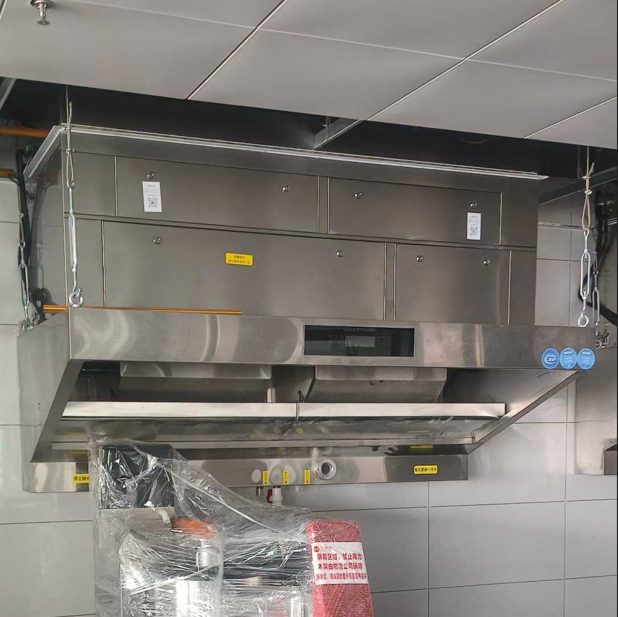
When a restaurant closes, its kitchen usually re-enters the second-hand market within weeks, and extraction equipment is part of that wave. A used range hood or electrostatic purifier can cost 30 to 60 percent less than an equivalent new unit, which is why refurbishers, equipment dealers and closing-out sales attract so much buyer attention. But extraction equipment hides its true condition in places a buyer never sees on a showroom floor: inside the canopy plenum, inside the ESP cell, in the fan bearings and in a carbon bed whose saturation cannot be judged by eye. This article is the pre-purchase checklist to print and take to the inspection, and the price logic to apply once the inspection is done.
Why Extraction Equipment Ages Differently From Ovens and Fridges
A cooking range, a freezer or a combi oven announces its age: dented doors, tired hinges, perished gaskets. Extraction equipment does the opposite. The parts that decide whether it still works are internal, greasy or invisible, and a cosmetic pressure-wash can make a tired unit look showroom-ready for exactly the length of one inspection visit.
Three things drive hidden wear. First, grease that was never properly removed polymerizes into a hard lacquer on canopy interiors, filter frames and fan impellers; once polymerized, it no longer dissolves in normal caustic washing, and it is both a fire load and a balance problem. Second, electronic and electrostatic components degrade with duty cycles: an ESP cell that ran fourteen hours a day over a charcoal grill has lived several lifetimes compared with the same model over a four-hour sandwich counter, even if both carry the same manufacture date. Third, consumables silently saturate. Activated carbon has no external indicator; an odour stage that stopped adsorbing two years ago looks identical to a fresh one.
So the question to ask at any second-hand inspection is never “does it look clean?” It is: which internal parts have reached the end of their service life, what do those parts cost to replace, and is the paperwork consistent with the story the seller tells?
What Actually Wears Out: Know the Parts Before You Look at the Unit
Buyers who understand the wear map negotiate from evidence instead of impressions. On a used ducted electrostatic unit or a ductless recirculating hood, the same seven components carry nearly all of the condition risk:
| Component | What degrades | Consequence if ignored |
|---|---|---|
| ESP cell | Collector plates bend, corrode or develop arcing tracks; wash cycles thin the coating | Repeated arcing, falling purification efficiency, eventual cell replacement |
| Ceramic insulators | Grease film carbonizes into a conductive tracking path | Voltage leaks to earth, unit trips or purifies poorly |
| High-voltage power supply | Capacitors and boards age; the weakest electronic link | Intermittent shutdowns; expensive to source for discontinued models |
| Activated carbon | Adsorption sites saturate; no visual indicator exists | Odour complaints return immediately after installation |
| Centrifugal fan | Bearing play, impeller grease loading, lost balance | Vibration, noise, premature motor failure |
| Seals and gaskets | Access-door and filter-frame seals harden and compress | Air bypasses the filtration stages; measured performance collapses |
| Pre-filters and baffles | Dents, missing baffles, warped frames | Grease reaches the ESP cell early; cleaning interval shortens sharply |
Notice what is missing from this list: the stainless skin, the canopy geometry and the light fittings. Cosmetic condition should carry almost zero weight in your price negotiation, because it is the one thing a seller can cheaply restore and the one thing that tells you least about remaining life.
The Pre-Purchase Inspection Checklist
Run this twelve-point list in order. The first three items decide whether the rest is even worth doing; the middle items are physical inspection; the last three are the questions sellers hope nobody asks.
| No. | Check | What to look for | Why it matters |
|---|---|---|---|
| 1 | Nameplate and serial date | Manufacture date, model code, electrical rating legible and original | Estimates duty age; a ground-off plate is a walk-away signal |
| 2 | Declaration and type-test report | CE declaration of conformity, performance or type-test report in the same model name | Insurance acceptance and any future tender both rest on these |
| 3 | Reason for sale, stated in writing | Closure, lease end, menu change; refusals or vagueness | A closure story is normal; a defect story must be priced, not forgiven |
| 4 | Canopy plenum interior | Open the access panels: hard polymerized lacquer versus washable grease film | Polymerized lacquer signals years of missed cleaning and fire load |
| 5 | Filter condition and fit | Baffles straight, no frame gaps, all filters present and original size | Gaps let grease bypass straight to the purification stages |
| 6 | ESP cell removed and inspected | Plates straight, no corrosion blooms, wash marks even, arcing tracks absent | The single most expensive wear item on any electrostatic unit |
| 7 | Insulators and tracking | Brown or black tracking lines down ceramic insulator surfaces | Tracked insulators leak voltage and are cheap parts but diagnostic gold |
| 8 | Access panels present | Every section reachable; panels not welded, riveted or painted shut | Closed sections cannot be cleaned; inspectors will fail them later |
| 9 | Fan bearings by hand | Rotate the impeller by hand: smooth spin, no rocking play, no rumble | Shaft play predicts bearing replacement within months |
| 10 | Impeller grease load | Blade surfaces thick with baked deposit; balance weights missing | Loaded impellers vibrate and kill motor bearings |
| 11 | Wiring and safety devices | Original glands, intact earth, door interlocks not bypassed with tape | Bypassed interlocks mean the unit failed somewhere and was silenced |
| 12 | Service and cleaning history | Dated invoices for cell washing, carbon changes, duct cleaning | History converts the seller’s story into evidence you can audit |
Points 4, 6 and 12 carry the most information. A plenum that opens to hard lacquer, a cell with corrosion blooms and a seller with no service invoices together describe a unit you should price as a shell, not as working equipment.
Bench Tests Worth Paying For
A visual inspection eliminates obvious wrecks; only a powered test separates the survivors. If the seller refuses a power-up test on premises, treat that refusal as the answer. The four tests below need nothing more exotic than a multimeter, an anemometer and a strip of incense or smoke pencil.
Power-up and arc behaviour
With the ESP section energized at rated voltage, listen. A healthy electrostatic stage hums; an unhealthy one snaps. Occasional single arcs during the first seconds of a cold start are normal condensation behaviour, but repeated snapping beyond the first minute means plate damage or insulator tracking. If a milliammeter is fitted, the current reading should settle steadily and hold; a reading that wanders or collapses indicates internal leakage. This one test catches the majority of fatally tired ESP cells.
Airflow against the rating
Measure at the hood face or, better, with a short traverse of the discharge. A capture-oriented hood should show face velocities in the region of 0.4 to 0.5 m/s over the cookline area at design duty; the total airflow should sit within plus or minus 10 percent of the nameplate rating. A unit delivering 30 percent below its plate is telling you about a loaded impeller, a slipping belt, blocked filters or a tired motor, and every one of those is a bargaining item. Write the measured number on the inspection sheet; vague impressions lose negotiations.
Capture check with a smoke pencil
At cold state with the fan running, release smoke at the front edge, the ends and the rear of the canopy. Smoke should pull cleanly into the hood across the whole perimeter. End spillage on a canopy that has been relocated, re-cut or fitted with aftermarket extensions shows up here immediately.
Static pressure and vibration
On ducted units, a manometer reading at the fan inlet compared with the published fan curve tells you whether the duct side has hidden restrictions or leaks. On any unit, a vibration check by hand and ear at the fan housing distinguishes a balanced impeller from one that will need immediate cleaning and re-balancing. Both tests take ten minutes and routinely reveal problems that justify a 20 to 30 percent price reduction.
Age, Certification and Insurance Acceptance
Second-hand does not mean non-compliant, but certification travels with paperwork, not with hardware. Three documents matter. The CE declaration of conformity belongs to the original manufacturer and should physically travel with the unit; a second-hand sale does not require re-certification, but a missing file makes future tenders and insurance renewals slow and argumentative. The type-test or performance report proves the unit ever met its claimed airflow and purification figures; without it, you are buying claims. The installation and wiring manual is what your electrician and your ducting contractor will need on day one.
Then ask your own insurer before you buy, not after a fire. Insurers handling restaurant policies increasingly ask for type-test documentation and cleaning evidence on kitchen extraction, and a used unit without paperwork is exactly the line item they contest. A written email from your insurer accepting the specific used unit, conditionally on a bench test and a post-installation clean, costs nothing and converts an argument into a formality.
For buyers weighing second-hand against new certification rather than repairing an old asset, it helps to know that the ducted ESP purifier range shipped today carries current-edition documentation as a standard deliverable, precisely because tender and insurance reviewers ask for it. That documentation burden is a real component of second-hand price, and sellers who cannot supply it should be discounted accordingly.
Pricing the Gap: Wear Items You Must Budget Anyway
The asking price is not the price. Build the effective price as a simple sum before you negotiate:
| Item | Budget logic |
|---|---|
| Activated carbon, full charge | Always replace on purchase; saturation cannot be verified. Treat as a sunk cost of any second-hand odour-stage unit |
| ESP cell replacement | Required if plates are corroded, bent or arc-tracking; confirm the cell is still manufactured for that model before you commit |
| Insulator and gasket set | Cheap and sensible to replace on any unit with visible tracking or hardened seals |
| Power supply | Only if the bench test shows instability; source availability for the exact model decides whether the unit is repairable at all |
| Fan clean and re-balance | Standard on any impeller with visible loading; factor a service visit |
| Freight and rigging | Canopies and cabinet units are heavy and awkward; obtain a quote before, not after, agreeing the price |
The working rule: if the mandatory wear items plus freight exceed 25 to 30 percent of the asking price, a new unit usually wins, because the new unit also brings full warranty, current documentation and a known history. Run the sum in writing; it turns a gut feeling into a negotiating position the seller can respond to with numbers.
Paperwork to Demand and How to Stage the Payment
Inspection tests the hardware; paperwork tests the seller. Ask for five things: the type-test or performance report, the declaration of conformity, the installation and wiring manual, the service and cleaning invoices, and a written statement of the reason for sale. A seller with genuine history produces these in a day. A seller who “will send them later” after you have paid is describing the rest of your relationship.
Stage the money the same way you would on a new purchase: a deposit of 20 to 30 percent to secure the unit, the balance released after the bench test passes, and for shipped deals a 5 to 10 percent retention held until the unit powers up and moves air at your own site. Sellers confident in their equipment accept staged payment without argument; the ones who resist are pricing in the defect you have not found yet. This is the same retention logic that protects buyers on new-installation contracts, and it works identically on the second-hand market.
Walk-Away Conditions
Some units are not bargains at any discount. Walk away when you find any of the following:
- Solid-fuel or charcoal units whose interiors carry baked-on lacquer. That deposit never fully leaves the metal, and the fire risk travels with the unit.
- Sections with no access panels, or panels welded and painted shut. What cannot be reached cannot be cleaned, and no cleaning contractor will certify it.
- Modified wiring, absent earth connections, or door and fan interlocks bypassed with tape or jumper wire. Someone silenced a fault instead of fixing it.
- A corroded or damaged ESP cell for a model whose replacement cells are no longer manufactured. Check spare availability for the brand before you buy the unit, not afterwards.
- Any refusal of a power-up test or an airflow measurement. Confidence submits to testing; everything else is a story.
One boundary case deserves its own note: fixed canopies bought for market pitches, festivals and pop-up cooking rarely suit those sites anyway, because power access, placement and wind conditions punish heavy fixed hardware. For that duty, purpose-built ventless catering carts are engineered from new for exactly the constraints that make second-hand canopies impractical, and they arrive with full documentation and warranty.
When New Costs About the Same
Complete the ledger honestly and the second-hand market sorts itself into two piles. The first pile: well-documented units, three to six years old, from kitchens with real cleaning invoices, selling at 40 to 60 percent below new with wear items inside the 25 percent budget. Those are genuine buys, and the checklist above is how you find them.
The second pile is everything else, and its true price quietly converges on new. Carbon, insulators, gaskets, freight, a bench test, a rigging crew and a certificate chase easily add half the asking price back, and the result still carries an unknown history and an expired or missing paper trail. For buyers who run this sum and land in the second pile, a new ductless range hood family pairing an electrostatic cell with an activated carbon odour stage frequently lands within a few percent of the fully-costed refurbished alternative, with warranty, current certification and a clean history included. Light-fume menus map to a compact all-in-one unit; heavy-fume fryers and grills call for the heavy-duty architecture, with a separate Odor Removal Tower where neighbour-sensitive odour compliance drives the specification, as in the N-series and ND-series line-up. A split floor-standing purification cabinet covers the low-headroom retrofit corner where a canopy stack simply has nowhere to go.
Whichever pile you end up buying from, the discipline is identical: verify the parts that wear, test the unit powered, demand the paper, and stage the payment against the tests. Extraction equipment rewards exactly one kind of buyer, and that is the one who arrives with a checklist.