
Overview
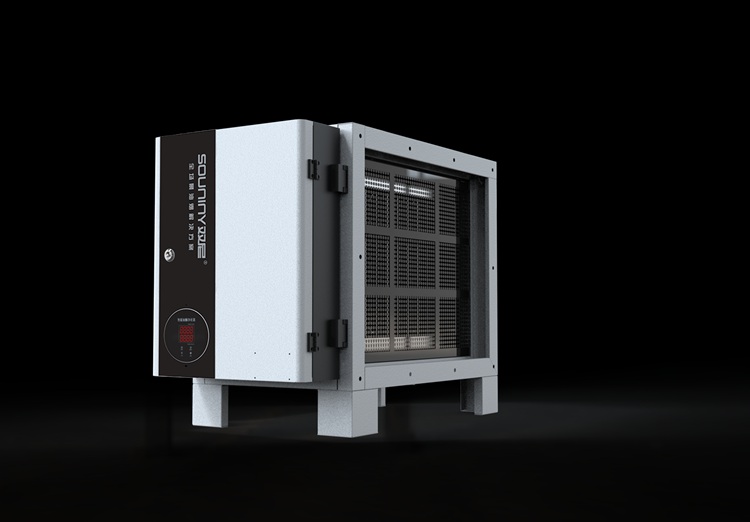
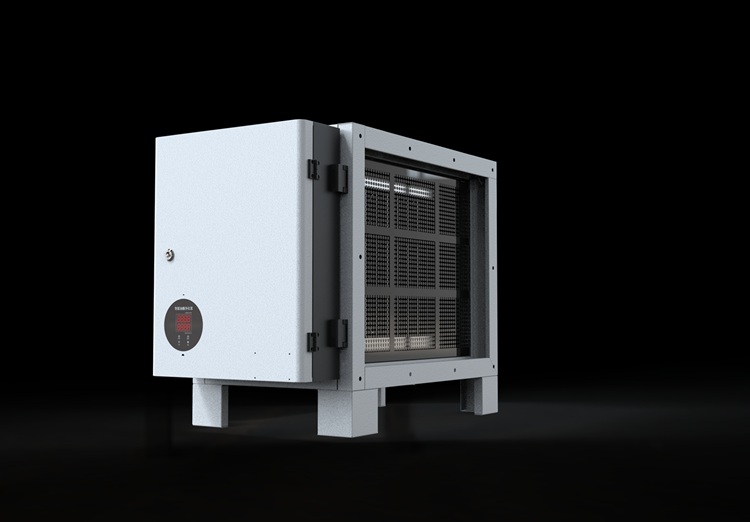
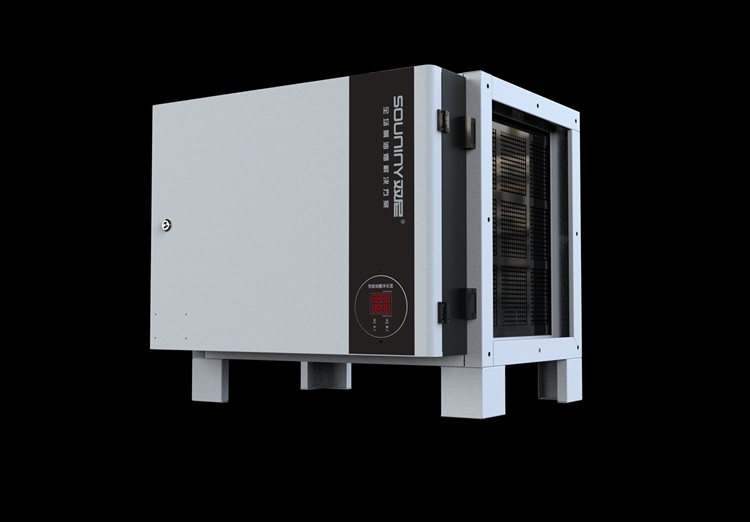
The KL-D-J series is an electrostatic precipitator line for low-level kitchen exhaust. Working on plate-type ESP cell collection, it charges fume particles by high-voltage ionisation and then captures them in a low-voltage collection zone, separating grease particulate from the airstream at high efficiency. Thirteen models cover 4,000 to 64,000 m³/h, which spans everything from a night-market stall or snack shop up to a large restaurant chain or a food court.
The cabinets are modular and can be stacked – single, double or triple – to suit the space and the airflow available. The range carries CEP environmental product certification, reaches purification efficiency of 95% or better, and brings outlet fume concentration down to 1-2 mg/m³, so the discharge is visibly smoke-free.
Core configuration: a 12-pass stainless-steel ESP cell, a dual-drive IoT constant-voltage power supply, high-voltage ceramic insulators and a digital display.
Problems It Solves
| Common Problem | How the KL-D-J Series Handles It |
|---|---|
| Fumes discharged untreated, complaints from neighbours | 95% or better efficiency with visibly smoke-free low-level discharge, cutting complaints from nearby residents and the risk of enforcement action |
| Failing environmental inspection | CEP-certified product whose outlet concentration meets food-service emission limits, accepted as compliance equipment |
| ESP Cell is hard to clean, maintenance is constant | Pull-out stainless-steel ESP cell that washes directly with water, every 2-3 months; a self-cleaning version is also available |
| No visibility of how the unit is running | Circular digital display shows high voltage and current in real time, with automatic reminders for contamination level and cleaning interval |
| High-voltage arcing and safety concerns | Eight power-supply protections, high-voltage ceramic insulators and door-open power cut-off remove the risk of leakage, arcing and electric shock |
| Limited installation space | Modular cabinet that can be stacked and installed horizontally, suiting ceiling voids, service corridors and plant rooms |
| Fast ESP cell deterioration under heavy grease | A pre-filter equalising screen intercepts large oil mist first, protecting the ESP cell and extending both ESP cell life and cleaning intervals |
How It Works
Four-Stage Purification
Fume-laden air passes through four stages in sequence:
- Pre-filtration: a high-density grease screen intercepts large oil mist and debris, protecting the ESP cell inside.
- Charging: particles pass through a 12 kV high-voltage zone where fine oil droplets are ionised and charged.
- Collection: the charged droplets enter a low-voltage collection zone and are captured on the oppositely charged plates by the electrostatic force of the ESP cell.
- Final filtration and discharge: a high-density screen filters the air a second time, and clean air leaves through the outlet.
Grease collected on the plates runs down the stainless-steel surface and gathers at the bottom drain for disposal in one place.
stainless-steel ESP cell – the Core Component
| Item | Specification |
|---|---|
| Structure | Plate-type pull-out ESP cell, two zones: ionisation and collection |
| Material | Corrosion-resistant stainless steel, washable repeatedly without distortion or rust |
| Plate Forming | 12-pass forming, four bends per plate, no burrs, rigid structure |
| Plate Spacing | 7.5 mm, with variation held within 0.8 mm for a larger collecting area |
| Cleaning | Pull the ESP cell out, soak in alkaline solution, then pressure rinse – every 2-3 months |
Dual-Drive IoT Constant-Voltage Power Supply
The power supply is the heart of an electrostatic precipitator. This series uses a dual-drive IoT constant-voltage supply driving a two-zone ESP cell: constant-voltage control that tracks the load on the ESP cell and holds the optimum purification voltage, so efficiency does not fall away as grease builds up; eight protection layers covering adaptive stepped supply, high-voltage short circuit, soft start, transformer over-temperature, constant-voltage control, overload, arc suppression and open circuit; an IoT interface for connection to a remote monitoring system; and fault self-diagnosis that identifies the fault type and shows it on the display, cutting troubleshooting time.
High-Voltage Ceramic Insulators
The insulator is the barrier between the high-voltage electrode and the earthed housing, and it sets the safety and stability of the unit: high-voltage ceramic for dielectric strength and heat resistance; isolation of the electrode from the earthed case to prevent high-voltage leakage and arcing; an oil-shedding shape that keeps grease off the insulating surface so performance holds in wet, greasy conditions; and removable design so it can be inspected and replaced on its own.
Digital Display
A circular digital display on the front shows high-voltage output and current in real time, so running status is clear at a glance. It carries automatic reminders for contamination level and cleaning interval, helping maintenance happen on time and avoiding the efficiency drop caused by an over-dirty ESP cell.
Construction
- Cabinet finish: electrostatic powder coating, corrosion and grease resistant for humid kitchen conditions.
- Cabinet structure: horizontal modular cabinet, stackable in single, double or three-layer configurations.
- Door panel: fitted from inside outward, flush and sealed against dust and water, with a reinforced hinge and lock.
- Inlet and outlet: standard flanged connections for direct coupling to the existing exhaust duct.
- Drainage: a drain port at the bottom lets collected grease out in one place instead of pooling inside.
- Pre-filtration: an equalising pre-filter screen at the inlet intercepts large oil mist first.
Specifications
| Parameter | Value |
|---|---|
| Airflow Range | 4,000 – 64,000 m³/h |
| Purification Efficiency | ≥ 95% |
| Outlet Concentration | 1 – 2 mg/m³ |
| Ionisation Voltage | 12 kV |
| Plate Spacing | 7.5 mm (variation within 0.8 mm) |
| Total Power | 300 – 2,400 W (model dependent) |
| Pressure Drop | 107 – 176 Pa |
| Protection Rating | IP65 |
| Installation | Horizontal, modular stacking (single / double / triple) |
| Certification | CE certified; CEP environmental product certification |
Model Range
| Model | Airflow (m³/h) | Dimensions L×W×H (mm) | Inlet / Outlet W×H (mm) | Total Power (W) | Pressure Drop (Pa) |
|---|---|---|---|---|---|
| KL-D-J40 | 4,000 | 470 × 850 × 690 | 610 × 490 | 300 | 107 |
| KL-D-J60 | 6,000 | 770 × 670 × 690 | 420 × 490 | 300 | 113 |
| KL-D-J80 | 8,000 | 770 × 856 × 690 | 610 × 490 | 300 | 133 |
| KL-D-J100 | 10,000 | 770 × 1000 × 690 | 760 × 490 | 600 | 124 |
| KL-D-J120 | 12,000 | 770 × 1170 × 690 | 925 × 490 | 600 | 131 |
| KL-D-J160 | 16,000 | 770 × 1570 × 690 | 1325 × 490 | 600 | 125 |
| KL-D-J200 | 20,000 | 770 × 1000 × 1270 | 760 × 1070 | 1200 | 129 |
| KL-D-J240 | 24,000 | 770 × 1170 × 1270 | 925 × 1070 | 1200 | 125 |
| KL-D-J320 | 32,000 | 770 × 1570 × 1270 | 1325 × 1070 | 1200 | 121 |
| KL-D-J400 | 40,000 | 1540 × 1000 × 1270 | 760 × 1070 | 2400 | 153 |
| KL-D-J480 (double stack) | 48,000 | 1540 × 1170 × 1270 | 925 × 1070 | 2400 | 173 |
| KL-D-J480 (triple stack) | 48,000 | 770 × 1570 × 1870 | 1325 × 1670 | 1800 | 152 |
| KL-D-J640 | 64,000 | 1540 × 1570 × 1270 | 1325 × 1070 | 2400 | 176 |
Quick selection: 4,000-8,000 m³/h suits stalls and small shops; 10,000-16,000 suits mid-size restaurants; 20,000 and above suits large restaurants, food courts and centralised exhaust systems. Figures are taken from the official product specification sheet; the shipped configuration of each unit is final.
Selection Guide
By Cooking Method
| Cooking Method | Fume Load | Recommended Airflow | Selection Note |
|---|---|---|---|
| Steaming, boiling, stewing, holding | Light | 4,000 – 6,000 | A small electrostatic unit is enough; consider a condensing type where steam is heavy |
| Pan-frying, everyday stir-fry | Medium | 6,000 – 12,000 | Select by burner count, roughly 2,000-3,000 m³/h per burner |
| Wok bursts, Sichuan and Hunan style | Heavy | 12,000 – 20,000 | Allow extra airflow margin and add pre-filtration to protect the ESP cell |
| Deep frying, fryers | Heavy plus high temperature | 16,000 and above | Size airflow at 1.5x; a water-spray pre-treatment ahead of the electrostatic stage is recommended |
| Grilling, charcoal | Very heavy plus odour | 20,000 and above | Electrostatic handles the smoke; odour needs a separate treatment stage |
Estimating Airflow from Burner Count
- Each Chinese wok burner: approximately 2,000-3,000 m³/h
- Each metre of hood length: approximately 2,000-2,500 m³/h
- Grilling and frying: base airflow x 1.5-2
- Allow a 20% margin so adding a burner or changing the menu later does not mean replacing the unit
By Site Conditions
| Site Condition | Recommended Configuration | Note |
|---|---|---|
| Existing ductwork and fan in place | Purifier only, stand-alone | Connects straight to the existing fan and duct; lowest cost |
| No fan, want a simple install | Unit with integrated fan (small airflow range) | 4,000 / 6,000 / 8,000 available, runs on 220 V mains |
| Restricted space | Stacked configuration | Double or triple stacking saves floor area |
| Heavy grease, want fewer cleanings | Pre-filtration plus larger airflow | Extends cleaning intervals and protects ESP cell life |
Application Scenarios
- Small Food Service: stir-fry shops, noodle houses, fast-food outlets, malatang and rice-noodle shops, food court stalls and coffee shops with light-meal service.
- Heavy-Grease Restaurants: Chinese restaurants, Sichuan and Hunan kitchens, grill and charcoal BBQ shops, frying and fried-chicken shops, canteens and staff restaurants.
- Commercial Complexes: centralised exhaust for mall restaurant floors, food courts, shopping-centre dining zones and retail-street food units.
- Stalls and Mobile Setups: night-market stalls and snack carts, pancake and skewer stands, teppanyaki and mobile units, small street-front counters.
Reference Cases
- Low-level discharge retrofit at a community stir-fry shop: a street-front shop with three wok burners, discharging untreated fumes and drawing repeated complaints from residents above, under an order to rectify. A KL-D-J120 (12,000 m³/h) was coupled to the existing centrifugal fan and installed in the kitchen plant space. Result: no visible smoke, outlet concentration within limits, complaints stopped, and the compliance re-inspection passed.
- Centralised exhaust for a food court: fifteen stalls discharging into one system, with total volume high and the original ducted exhaust out of compliance. A KL-D-J400 plus KL-D-J240 combination (64,000 m³/h total) was installed as a double stack on the roof plant deck. Result: one central treatment point discharging to low-level requirements, so individual stalls did not need their own units.
- Mobile purification at a night-market stall: a pancake and skewer stall with no fixed duct, concerned about complaints and being moved on. A KL-D-J40 with integrated fan (4,000 m³/h) was paired with a hood and ducting, running on 220 V mains or battery. Result: purification from the moment trading starts, no smoke on site, accepted by the market operator.
- Standardised maintenance across a restaurant chain: twenty branches of a Sichuan brand, heavy kitchen fumes, high manual ESP cell cleaning cost and no consistent maintenance standard between stores. The KL-D-J series was matched to burner count per store (8,000-16,000 m³/h each) and connected to IoT remote monitoring. Result: head office can check running status and cleaning reminders for every unit remotely, with one maintenance standard and lower inspection cost.
Installation and Maintenance
Installation Notes
- Leave at least 1 m of service space in front of and behind the unit so the ESP cell can be pulled out for cleaning.
- Install upstream of the fan, on the negative-pressure side, to keep grease off the fan.
- For outdoor installation, protect against rain and make the power connections waterproof.
- Keep bends and diameter changes in the ductwork to a minimum to hold down resistance.
- Earth the cabinet reliably.
Maintenance Intervals
| Task | Interval | What to Do |
|---|---|---|
| ESP cell cleaning | Every 2-3 months (monthly for heavy grease) | Isolate power, pull out the ESP cell, soak in alkaline solution for 15 minutes, pressure rinse, dry and refit |
| Bottom drain | Monthly | Open the bottom drain port and release accumulated grease |
| Pre-filter screen | Monthly | Remove the equalising pre-filter and rinse off the heavy oil mist |
| Insulator inspection | Quarterly | Check for grease build-up and cracks; clean or replace |
| Power indicator | Daily visual check | Confirm the run light is normal; if a fault light is on, follow the prompt |
If Performance Drops, Check in This Order
- Is the ESP cell overdue for cleaning and heavily greased – the most common cause.
- Is the door closed properly – the door-open cut-out stops the unit working.
- Is the power indicator normal, with no fault alarm showing.
- Does the fan airflow match, and is there any duct leakage.
- Is inlet fume concentration above the design figure (20 mg/m³) – heavy grease needs pre-treatment.