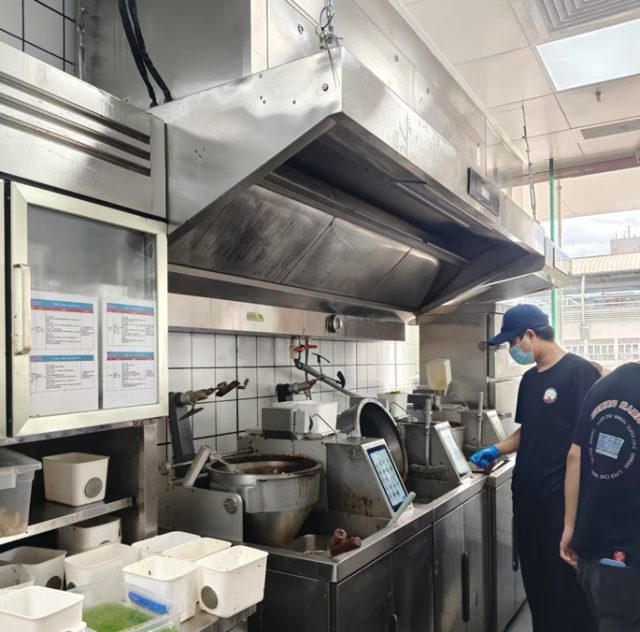
A charcoal rostilj in a Serbian residential block is governed by two gates that sit in different ministries. Article 54(4) of the Air Protection Law (Official Gazette of the Republic of Serbia, No. 51/2025) obliges the operator of a stationary source to apply odour-reduction measures even when the measured pollutant concentrations in its waste gases remain below the prescribed emission limit values. Separately, a purification unit manufactured outside the EU or EFTA cannot simply be sold in Serbia on a CE declaration: the Serbian 3A conformity mark is a separate legal step with its own local representative and documentation rules. The first gate decides how many treatment stages the extract system needs; the second decides whether the shipment is admissible at all. Neither is answered by a datasheet quoting a single filtration efficiency, so this guide turns both into airflow figures, document lists and clause wording a buyer can take into a tender.
1. Two gates, two different kinds of failure
The two risks fail at different moments. A well-built system without 3A paperwork is stopped at import or market surveillance, months before opening. A system with perfect paperwork but no odour stage is stopped later by an inspector, after the fit-out money is spent. Quotations routinely treat the second as optional and omit the first.
| Gate | Legal basis | What it controls | Typical failure |
|---|---|---|---|
| Odour duty | Law on Air Protection, Sl. glasnik RS 51/2025, Art. 4(2), 54(4), 75(32) | Treatment stages and the operating record, regardless of measured concentration | Inspector finds no odour-reduction measure after a neighbour complaint |
| Product conformity | Law on Technical Requirements and Conformity Assessment, 36/2009; regulations 98/09, 23/17, 25/10 | Whether the equipment may be placed on the Serbian market at all | 3A mark missing, or declaration references only the exporter’s national standards |
| Fire category | Law on Protection from Fire, Sl. glasnik RS 111/2009 | Fire-danger classification and fixed extinguishing provision | Charcoal grill not covered by the extinguishing zone |
| Local operating conditions | Law on Hospitality; municipal rules; minimum technical and sanitary regulations | Where the duct may discharge, and what the premises must be equipped with | Lease signed before the discharge route is confirmed |
The first two rows are what make Serbia different: in an EU member state a CE declaration ends the product-conformity conversation, while in Serbia it is only the input to a national conversion — and meeting an emission limit is explicitly not a defence.
2. What the 2025 Air Protection Law actually requires
Serbia adopted a new Zakon o zaštiti vazduha, published as Sl. glasnik RS No. 51/2025. Three provisions matter to anyone buying a kitchen extract system, and they should be quoted by article number in the specification rather than paraphrased as “meets Serbian air regulations”.
Article 4(2) covers companies, other legal entities and entrepreneurs whose activity affects or may affect air quality. They must provide technical measures to prevent or reduce emissions, monitor the impact of their activity and implement other protective measures. Activities carried out for national defence are exempt. A restaurant kitchen with a charcoal grill falls squarely inside this class.
Article 54(4) is the decisive one. Operators of stationary point sources that may emit gases with unpleasant odours must apply odour-reduction measures even when the concentrations of pollutants in the waste gases remain below the prescribed emission limit values. Meeting the limit does not, by itself, remove the obligation. The same duty existed under the previous law as Article 55(4), in the framework of Sl. glasnik RS Nos. 36/2009, 10/2013 and 26/2021. That continuity is commercially useful: a supplier who says “this is a new rule and nobody enforces it yet” is describing a renumbered obligation that has been in force for years.
Article 75(32) gives inspectors the right and the duty to check whether operators apply those odour-reduction measures. Note the object of the check: it is the application of measures, not the result of a single concentration measurement. Article 84 requires implementing regulations to be adopted within three years of the law’s entry into force, so some detailed subordinate rules are still settling. Article 74 of the Constitution of the Republic of Serbia guarantees the right to a healthy environment, which is the background against which complaints from residents are handled.
Procurement consequence: the compliance evidence is a measure plus a record, not a pass certificate. Write three clauses into the supply contract — (a) the odour stage is a specified component with a stated residence time and media mass, not an optional accessory; (b) the supplier provides a commissioning record and a replacement-log template; (c) if a competent inspector requires an additional measure, the variation is priced against a pre-agreed schedule rather than negotiated from scratch.
3. Odour measurement: what SRPS EN 13725:2022 does not give you
Serbia has adopted the dynamic olfactometry standard as SRPS EN 13725:2022. It specifies how odour concentration is determined for stationary sources, and is the right method when a dispute needs a defensible figure in European odour units per cubic metre.
The standard does not, by itself, establish a statutory odour limit. This is the trap in a specification that says “odour emissions shall comply with SRPS EN 13725:2022”. There is no threshold in that sentence to design against, and nothing for a commissioning engineer to sign off. Combined with Article 54(4), the honest position is that a buyer cannot discharge the legal duty by pointing to a measurement result; the buyer has to show that a measure exists, that it is sized for the airflow, and that it is maintained.
For a charcoal grill the practical, checkable surrogate is the activated-carbon stage. Residence time and media mass can be calculated from the design airflow and verified on the delivered unit with a tape measure and a weighbridge ticket. The figures below are engineering conventions used for specification, not Serbian statutory values — say so explicitly in the tender so nobody mistakes them for a legal threshold.
| Design airflow | Residence time | Bed volume | Carbon mass | What to check on delivery |
|---|---|---|---|---|
| 4,500 m³/h = 1.25 m³/s | 0.2 s | 0.25 m³ | about 116 kg | Bed depth and face area |
| 4,500 m³/h = 1.25 m³/s | 0.4 s | 0.50 m³ | about 233 kg | Weighed media, not “one box” |
| 4,500 m³/h = 1.25 m³/s | 0.6 s | 0.75 m³ | about 349 kg | Fan static pressure allowance |
The mass figures assume a bulk density near 465 kg/m³. A quotation saying only “carbon filter included” is not comparable with one stating 233 kg. Request a seven-column log: date, operating hours, airflow, pressure drop across the bed in Pa, media mass installed, media mass removed, and the signature of the person who did it. That log is the evidence for Article 54(4), and it costs nothing to keep.
4. Sizing a rostilj cookline the harmonised standard excludes
A Serbian rostilj or ćevabdžinica cooks ćevapi, pljeskavica and ražnjići over a charcoal bed, with lepinja bread warmed at the edge and a small amount of frying and soup work alongside. The pollutant stream is not a standard range-hood load: it carries grease-laden vapour, sub-micron particulate, polycyclic aromatic hydrocarbons and volatile organic compounds from the coals, plus sparks and ash that no ordinary grease filter is designed to receive.
Serbia’s standards body, the Institut za standardizaciju Srbije (ISS), publishes SRPS EN 16282-1:2017, the commercial-kitchen ventilation standard covering general requirements and a method for calculating airflow rates. It was published on 30 November 2017, confirmed on 4 May 2023 with a review date of 4 May 2028. The revision project dnaSRPS EN 16282-1:2024, which closed its voting stage on 12 March 2026, states its exclusion plainly: the document does not apply to solid fuel appliances such as charcoal grills. Neither version applies to domestic kitchens.
So the grill has no harmonised calculation route. A specification that says “hood designed in accordance with SRPS EN 16282-1” is incomplete on its own terms, and the designer must build a first-principles case and record which method was used. Two independent routes are worth putting in the tender, with the larger result taken forward.
| Method | Calculation | Result |
|---|---|---|
| Face velocity | 1.8 m x 0.9 m hood opening = 1.62 m²; charcoal plume taken at 0.5 m/s rather than the 0.4 m/s used over a pan range, because the plume leaves the coals with upward momentum | 0.81 m³/s = 2,916 m³/h |
| Hood length | 1.8 m hood at 2,000 to 2,500 m³/h per metre for an open display cookline | 3,600 to 4,500 m³/h |
| Design selection | Take the larger; state both methods in the submittal | 4,500 m³/h |
| Duct | 1.25 m³/s at 10 m/s = 0.125 m²; round duct of 400 mm gives 0.126 m² | 400 mm diameter |
| Make-up air | 80 percent of extract, heated in winter: 0.34 Wh/(m³·K) x 3,600 m³/h x 40 K | about 49 kW of heat |
The 49 kW is winter heat to replace the air the hood removes, from minus 20 °C to plus 20 °C — a heating-plant question that belongs in the lease negotiation. Five further items belong in the grill specification: a dedicated hood separate from the general canopy; a spark arrestor and ash trap ahead of filtration; ductwork rated for the higher exhaust temperature; an access door at every change of direction; and the capture velocity with its calculation attached, without which the ventilation report has nothing to defend.
5. Where the extract can go in a Belgrade residential block
Serbia’s Protector of Citizens has recorded the pattern directly. Citizens’ appeals to inspection bodies in the City of Belgrade about smoke, steam and odours from catering facilities — especially those operating inside residential buildings — were frequent enough that the Ombudsman issued an Opinion to the city. The Opinion noted that the requirements for carrying out such activities were not specified in sufficient detail, and recommended that the city regulate further the equipment conditions relevant to smoke, steam and odour exhaustion, using the powers delegated to local self-government units by the Law on Hospitality (Zakon o ugostiteljstvu).
That is a distinctly Serbian risk profile: in a Polish tenement the constraint is a shared residential shaft, while in Serbia it arrives as an odour complaint and a municipality with room to add conditions. Two national regulations sit underneath — the 2010 rule on minimum technical and sanitary-hygienic conditions for premises serving food, and the 2012 rule on catering classification and minimum technical equipment requirements, both catalogued in FAOLEX. Both make the premises equipment a licensing question rather than a private design choice.
Check seven things before the lease is signed, in this order: who owns the roof and whether a penetration needs a co-owner resolution; whether the façade is in a protected zone; the horizontal distance from the proposed discharge to the nearest opening window, and the height relative to the ridge; whether the municipality has already issued supplementary equipment conditions under the Law on Hospitality; whether any existing shaft is shared with dwellings; the position of the make-up air intake relative to the discharge; and the location of the nearest noise-sensitive receptor for the night-time test. Each is cheap to establish at this stage and expensive to discover after the duct is fabricated.
Clause boundary worth writing down: obtaining the operating licence and any municipal consent is the buyer’s responsibility; supplying the calculations, drawings, test reports and declarations that the application needs is the supplier’s. Splitting it that way prevents the familiar stand-off where each side waits for the other to produce a document that neither has commissioned.
6. Fire category and the 2026 extinguishing standard
The Zakon o zaštiti od požara (Sl. glasnik RS No. 111/2009) entered into force on 6 January 2010 and applied in full from 6 October 2010. It sets general fire-prevention duties and specific duties by category of fire endangerment. A charcoal grill is not an ordinary occupancy: the fuel is solid, embers can enter the duct, and grease deposits share the same path.
ISS published SRPS EN 16282-7:2026 on 30 June 2026, replacing the withdrawn 2021 edition. It covers the configuration, installation, testing, maintenance and safety of fixed fire extinguishing systems within commercial kitchen ventilation design, including appliance-specific protection and overlapping zone protection, and it is written specifically to protect against grease fires on cooking appliances and in the extract ventilation system. For a rostilj, the point is that the charcoal bed and the hood above it must be inside a defined extinguishing zone, not merely somewhere near a nozzle protecting the fryer.
Five hold points cover it at acceptance: nozzle coverage drawn on a plan that shows the grill as a separate zone; interlock proving that the extract fan and any gas supply shut down on system activation; physical separation between the coal store and the electrical cabinet; an access panel that lets a cleaner reach the duct upstream of the first bend; and a dated test certificate with a named responsible person. These are design and acceptance clauses, not product certification, and they should be priced as part of the installation package rather than discovered during the fire inspection.
7. The 3A mark: the gate most quotations omit
Serbia is not an EU member, but most of its technical standards adopt European harmonised standards, and the Low Voltage, EMC and Machinery directives have been transposed nationally. That creates a useful shortcut and a common misunderstanding in equal measure.
The Serbian conformity mark — usually called the 3A or AAA mark, three capital A letters arranged as an equilateral triangle — is the statutory conformity mark for products placed on the Serbian market. The framework is the Law on Technical Requirements for Products and Conformity Assessment (Sl. glasnik RS No. 36/2009), the conformity assessment regulations Nos. 98/09 and 23/17, and the rule on the manner of affixing and using the conformity mark, No. 25/10. The Ministry of Economy supervises the system, ISS maintains the standards, and accredited conformity assessment bodies issue the certificates.
The shortcut is real: CE test reports, risk assessments, drawings, declarations of conformity and quality-system documents from a CE file can be used directly as the technical dossier for a 3A application, usually avoiding repeat testing. The misunderstanding is to stop there. A CE mark is not automatically effective in Serbia; a national application still has to be made and a Serbian declaration issued. Four conditions are the ones that catch exporters from outside the EU.
- A local authorised representative. A manufacturer outside Serbia cannot submit the application itself. A legally established Serbian entity — commonly the importer, or a compliance service company under a formal authorisation agreement — acts as representative, holds the technical file, deals with market surveillance and handles recall coordination.
- Language. The instruction manual must be available in Serbian. For imported products, an original copy of the declaration of conformity, or its copy, must be accompanied by a Serbian translation; market surveillance may request it at any time, and the supplier must ensure availability.
- What the declaration references. For goods produced in the EU or EFTA, a declaration may reference the relevant New Approach directives. For goods originating elsewhere, the declaration must reference the Serbian technical regulations setting out the essential requirements, or the corresponding European New Approach directives. A declaration that cites only the exporter’s own national standards is not acceptable in the Serbian legal system. This single line is the most common reason a technically sound file is sent back.
- The mark and the file. The 3A mark is black, at least 5 mm high, with the issuing body’s number at the lower left and the last two digits of the year of issue at the lower right. The technical documentation must be retained for at least ten years after the last batch was produced. Low-risk products may proceed by self-declaration; higher-risk categories require testing by a designated laboratory and, in some cases, a factory audit.
Until an ACAA is signed or Serbia joins the EU, the national mark remains mandatory; “CE certified, ready for Serbia” is a starting point, not a finished compliance position.
| Deliverable | Who provides | Who signs or holds | When it is needed |
|---|---|---|---|
| CE test reports, risk assessment, drawings, parts list | Manufacturer | Manufacturer | Before the 3A application |
| Serbian-language manual and label set | Manufacturer, translated locally | Authorised representative | Before first shipment |
| Authorisation agreement with a Serbian entity | Importer or compliance agent | Both parties | Before the application is lodged |
| Declaration referencing Serbian technical regulations or New Approach directives | Manufacturer or representative | Manufacturer or representative | At placing on the market |
| 3A certificate and mark artwork with 5 mm minimum height | Accredited body | Authorised representative | Before affixing the mark |
| Technical file retained ten years after the last batch | Manufacturer | Authorised representative | Continuously |
| Original declaration plus Serbian translation available on request | Supplier or importer | Supplier or importer | At market surveillance |
| Confirmation that the specific product is on the mandatory list | Importer, checked against the HS code | Buyer countersigns | Before the order is placed |
Put eight questions on the enquiry form: Is the model on the mandatory 3A list? Who is the Serbian authorised representative, and is the agreement signed? Which Serbian technical regulations does the declaration cite? Is the manual translated? Is the CE test report being reused, and does the issuing laboratory’s scope satisfy the Serbian body? What is the 3A certificate number and year? Where is the ten-year file held? Who answers a market-surveillance request, and within how many working days?
8. A specification checklist to hand to a bidder
Everything above collapses into one sheet. Ask for each line to be filled in with a number or a document reference; a tick in a box is not a specification.
| # | Item | Verifiable figure or document | Accepted by |
|---|---|---|---|
| 1 | Grill hood face velocity and calculation method | 0.5 m/s; both face-velocity and hood-length methods attached | Designer |
| 2 | Design extract volume | 4,500 m³/h, larger of the two methods | Designer |
| 3 | Duct diameter and transport velocity | 400 mm at about 10 m/s | Installer |
| 4 | Make-up air and winter heat | 3,600 m³/h; about 49 kW at 40 K rise | Heating engineer |
| 5 | Spark arrestor and ash trap position | Upstream of the first filtration stage, shown on the drawing | Fire inspector |
| 6 | Particulate stage | ESP cell with collector plates, access door, drain and interlock | Commissioning engineer |
| 7 | Odour stage | Residence time stated; carbon mass weighed, for example 233 kg at 0.4 s | Commissioning engineer |
| 8 | Odour measure record for Art. 54(4) | Seven-column replacement and pressure-drop log, signed | Operator |
| 9 | Fixed extinguishing coverage | SRPS EN 16282-7:2026 zone drawing with the grill as a separate zone | Fire inspector |
| 10 | Fire classification | Category stated under 111/2009 and reflected in the fire plan | Fire inspector |
| 11 | Product conformity | 3A certificate number, authorised representative, declaration references | Importer / buyer |
| 12 | Discharge route and municipal conditions | Roof or façade consent, co-owner resolution, distance to nearest window | Buyer / landlord |
9. How the configuration follows from the constraints
Once the airflow, the odour duty and the fire classification are fixed, the equipment arrangement is fairly determined. A charcoal grill cannot sensibly be served by a recirculating hood: sparks, carbon monoxide from the coals and a high exhaust temperature all argue for a real discharge to outside. The main cookline therefore belongs on a ducted system, with the particulate stage ahead of the gas-phase stage so that grease-laden vapour does not blind the carbon bed. An electrostatic stage built around an ESP cell with collector plates removes the sub-micron fraction; the activated-carbon bed behind it handles the odorous VOCs, and the ducted ESP purifier range covers this high-volume end where a full duct run is possible. The order of those two stages is not a preference — reverse them and the carbon is consumed by grease rather than by odour.
The remaining, non-charcoal part of the kitchen is a different problem. Warming lepinja, holding soup and reheating side dishes produce light fume with no ember load, and here a ductless range hood family can keep a satellite preparation point off the main duct entirely, which reduces the design airflow and the make-up air heat in one move. A heavy-duty all-in-one unit of the ND-series suits that secondary zone, while a dedicated Odor Removal Tower provides the measurable carbon mass that the Article 54(4) record needs. Keeping the two zones separate is also what makes the ventilation report writable: one calculation for a solid-fuel grill with no harmonised method, and one for a conventional canopy that does have one.
Summer changes the layout again. A bašta or pavement terrace often adds a small live grill for a few months, and a permanent duct extension to a seasonal station is rarely worth the disruption to a protected façade. Mobile food carts with self-contained capture are the usual answer for that temporary cookline, and they should be listed separately in the fire plan so the seasonal equipment does not appear after the inspector has signed off.
The engineering conclusion is narrower than a product recommendation. Article 54(4) means that a system which merely meets emission limit values can still be non-compliant, because the law asks for a measure and for evidence that the measure is maintained. The 3A regime means that a system which is technically complete can still be unsellable, because the declaration, the local representative and the ten-year file are separate deliverables. Put both requirements into the same acceptance schedule, with named owners and dates, and the grill kitchen can be procured and licensed without discovering either gate at the worst possible moment.