
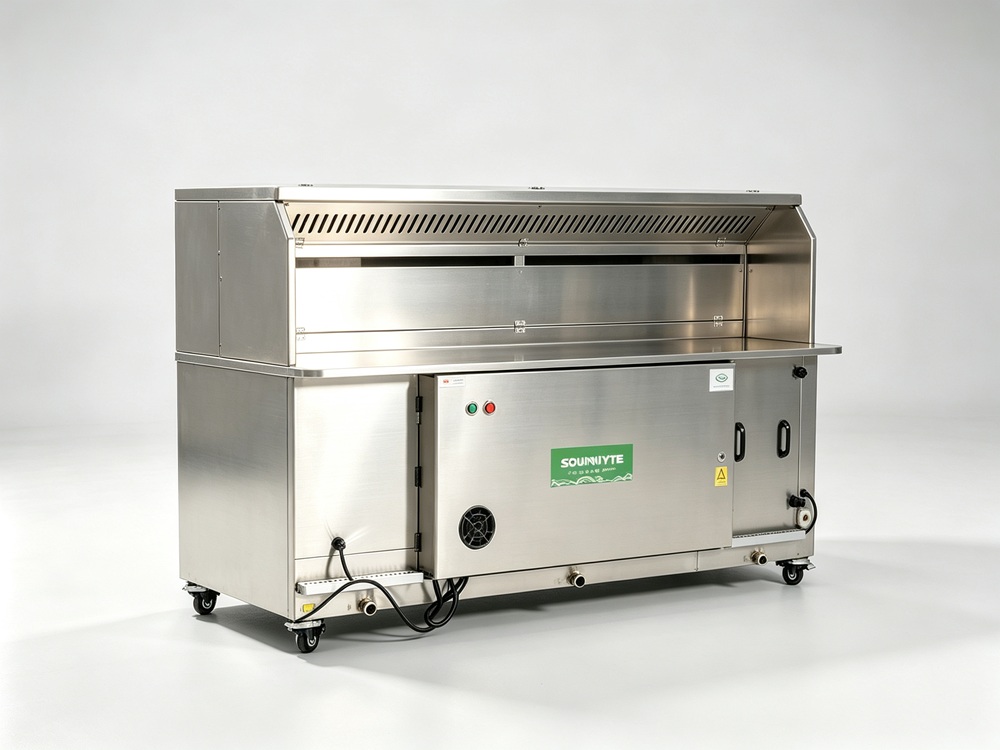
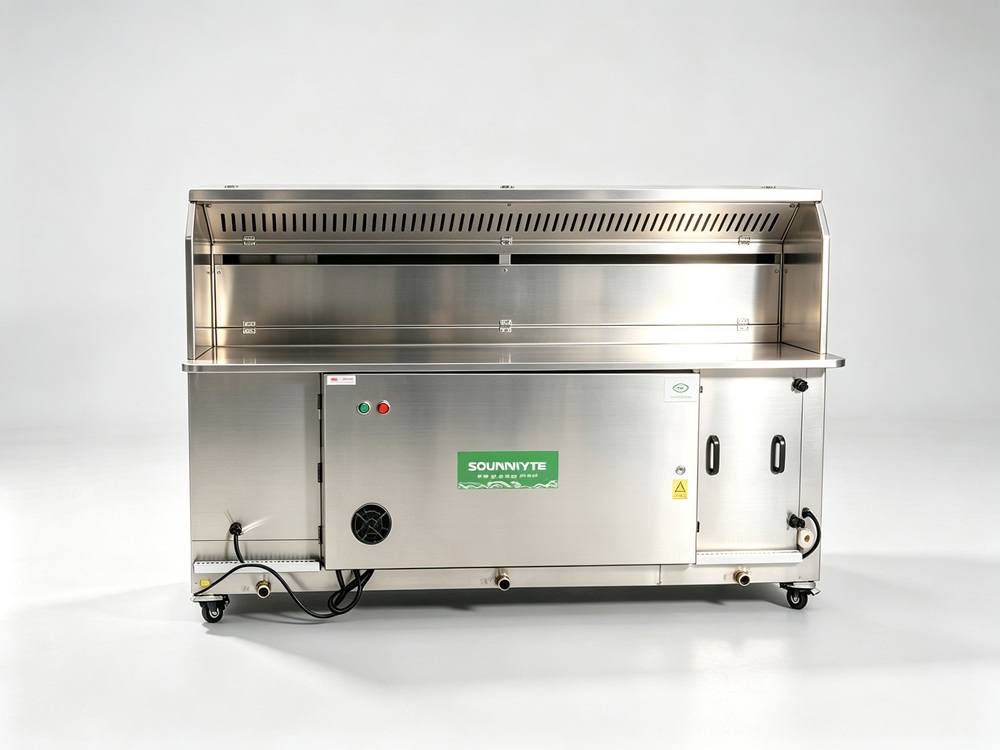
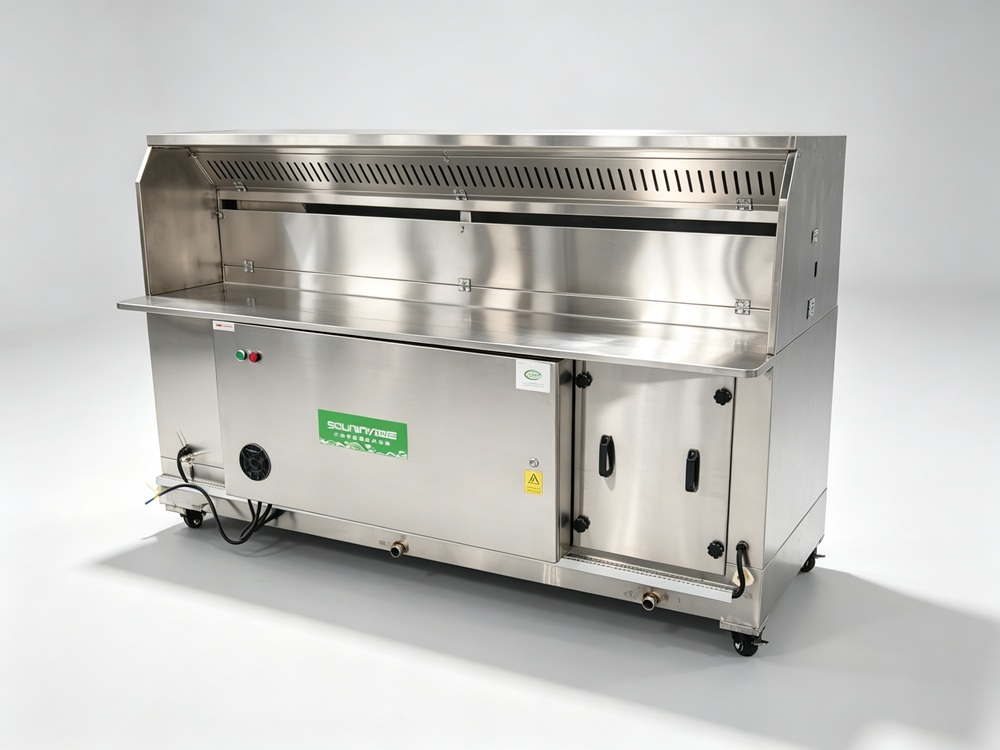
Overview
The water-cycle smoke-removal barbecue cart (KL-D-SMK series) is the water-based route in SOUNINY’s ventless barbecue range. It is built for charcoal grilling: heavy grease load, live embers, and positions where odour and sparks have to be handled before the air ever reaches the filter. Where a pure electrostatic cart collects grease only, this one puts a circulating water stage in front of the electrostatic stage, so the coarse fraction – ash, spice particles, oil droplets, sparks – is knocked out of the airstream first and the electrostatic section is left to deal with the fine sub-micron smoke that actually carries the visible plume.
The process runs in two stages. A 60-litre water circuit sprays across the inlet and forces the plume through a turbulent liquid film, where hydraulic impaction captures coarse droplets and scrubs water-soluble odour molecules. The remaining fine aerosol then passes a high-voltage ionising section and a low-voltage collection section, where charged grease particles are held on stainless-steel plates. Grease particulate purification efficiency is 98 percent. Treated air is returned to the room, so the cart needs no wall penetration, no roof duct and no exhaust riser.
Four body lengths from 1,650 mm to 3,000 mm cover a single-burner street pitch through to a multi-station chain outlet, with a tempered-glass display version and custom lengths available for shopfronts that need a specific footprint. Stainless steel throughout, 1.0 mm sheet, 350 kg load rating per castor, plugged into a standard 220 V single-phase supply. In one line: a charcoal barbecue position indoors, in a mall, under a residential block or on a night-market pitch, running without a flue.
Problems It Solves
Barbecue is the hardest cooking format to site indoors. Charcoal produces more grease aerosol per burner than any other method, the plume is visible, the odour travels further than the smoke does, and burning embers are a fire risk inside a capture hood. The result is the familiar loop: a unit is installed, the neighbours complain, the property manager asks for the duct to be extended, and the operator is told to stop grilling on site.
The water-cycle cart breaks that loop at the front end. Because the coarse grease, ash and sparks are removed by water before they reach the plates, the exhaust leaving the cart is both lighter in smoke and lower in odour, and the fire risk inside the cabinet is reduced. The table below sets out what the two-stage arrangement changes in practice.
| Constraint | With a conventional cart | With the water-cycle cart |
|---|---|---|
| Odour complaints from neighbouring units | Grease is collected, odour passes through; the smell is what triggers the complaint | The water stage scrubs water-soluble odour molecules before the electrostatic section, so the exhaust is both cleaner and less pungent |
| Embers and sparks inside the hood | Sparks are drawn straight into the filter bank – a fire risk in a grease-laden cabinet | Water spray and hydraulic impaction intercept sparks and ash at the inlet |
| No external flue available | Requires a wall or roof penetration, or the unit cannot be sited at all | Closed-loop indoor recirculation; no external duct, no coring, no riser |
| Inspection and local emission limits | Efficiency drops as plates load, and readings drift | 98 percent grease particulate efficiency with a front stage that keeps the electrostatic section lightly loaded |
| Equipment life under heavy grease | Thin aluminium plates deform and lose collection area within a season | 26 kg stainless-steel ESP cells, 12-fold formed, washable and reusable |
| Cleaning frequency | Frequent full teardown of the filter bank | Daily drain-down is the routine; the ESP cell is cleaned every one to three months |
How It Works
Stage 1 – Front water spray and hydraulic impaction
The plume enters the front water-spray chamber first. A 60-litre circulating system, driven by a 304 stainless-steel pump, draws from a tank moulded into the cart body and sprays across the inlet. An oversized turbulence device breaks the spray into a dense liquid film, and the airstream is forced through it, so coarse oil mist, charcoal ash and spice particles are captured by hydraulic impaction rather than by a dry filter.
Two side effects matter commercially. Water is an effective scrubbing medium for the water-soluble fraction of barbecue odour, so part of the smell is removed at the front of the cart instead of being left to the carbon stage. And because the same water film intercepts embers and sparks, the fire risk carried into the grease-laden cabinet behind it is reduced – a real consideration for charcoal and wood-fired formats.
Stage 2 – Rear high-voltage electrostatic collection
What leaves the water stage is a fine aerosol: sub-micron grease and combustion particulate that water alone cannot capture. It enters the ionising section, where the high voltage charges the particles, and then the collection section, where the charged droplets are held on stainless-steel plates at low potential.
The division of labour is the point of the design. Water removes the coarse mass cheaply and continuously; the electrostatic stage removes the fine fraction that makes smoke visible. Grease particulate purification efficiency is 98 percent, and because the front stage shields the plates from the heaviest loading, that figure holds over long operating periods rather than degrading within weeks.
Core Components
| Component | Configuration | What it contributes |
|---|---|---|
| Water-cycle system | 60 L circuit, 304 stainless-steel pump, high-precision liquid-film filtration, tank moulded into the body, oversized turbulence device, modular assembly | Front-end odour scrubbing; intercepts coarse particles, ash and sparks; captures water-soluble odour molecules |
| Stainless-steel ESP cell | Bipolar stainless construction, 12-fold formed, 7.5 mm plate spacing, 26 kg per cell, three cells on the 2 m body, 13,000 V high-frequency discharge | High-voltage collection with a large plate area; efficiency does not decay with age |
| High-voltage power supply | Seventh-generation digital constant-voltage supply, in-house designed; arc suppression, multiple automatic protections, digital constant-voltage display, IoT interface reserved, cleaning reminders | Stable output under continuous duty; operating state visible on the panel |
| Ceramic insulators | 99 porcelain, elliptical, dry-pressed in one piece, rated to 1,800 degrees C, 38 kV creepage resistance | Stable insulation under grease and moisture; fewer breakdowns |
| Fan | External-rotor double-inlet centrifugal fan, 385 mm impeller, 135 grid spokes, copper-wound motor (19.8 kg per motor) | High airflow and pressure, low resistance, 100 degrees C motor rating, sealed against moisture and grease |
| Sealing structure | Automotive-grade sealing strip on doors and joints | Seals the cabinet against leakage; operating settings stay stable |
High-voltage ceramic insulators
The insulator is the barrier between the high-voltage electrode and the metal cabinet. Cell voltage runs into the tens of thousands of volts, so if insulation fails the result is leakage, arcing, and in the worst case a fire inside a cabinet full of grease. Three details distinguish the insulators used here from the plastic parts common at lower price points:
- Insulation strength and heat resistance: porcelain does not age or track in the way plastic does under a hot, grease-laden kitchen environment.
- Grease-shedding geometry: the profile is shaped so that grease does not settle directly on the insulating surface, which keeps insulation resistance up even in a persistently damp, oily atmosphere.
- Individual replacement: each insulator can be changed on its own, so a single failed part does not mean replacing a whole cell bank.
Stainless-steel ESP cell, 12-fold formed
The cell is where the smoke is actually removed: particles are ionised, charged and collected on the plates, so plate workmanship sets both efficiency and service life. The plates here are stainless steel, each formed through 12 folds.
- More collection area: the folded profile carries noticeably more surface than a flat plate of the same footprint, so particles spend longer in the collection zone and are captured more completely.
- More even discharge: fold accuracy and consistent plate spacing keep the electrical distribution uniform, which avoids weak zones and untreated corners.
- Stainless steel resists grease and corrosion: unlike aluminium plate, it does not oxidise or deform under hot grease, and it can be removed, washed and refitted for years of service.
Copper-wound centrifugal fan
The fan has to lift the plume from the grill, push it through a water film and a cell bank, and return it to the room. If it is under-specified, the best cell in the world is bypassed. The motors here use copper windings rather than aluminium, driving a 385 mm impeller with 135 grid spokes.
- Airflow: up to 5,500 CMH per fan – enough for heavy grease formats such as barbecue and deep-frying.
- Low resistance: a resistance coefficient below 5 percent means the same motor power moves more air, and less energy is lost across the cabinet.
- Heat tolerance: the motor is rated to 100 degrees C, so it tolerates the radiant heat of a position close to the grill.
- Lower noise: centrifugal construction matched to an integrated cabinet avoids the resonance that comes from assembling separate fan and housing parts on site.
Digital constant-voltage power supply with eight protections
The supply converts mains power into the high-voltage DC the cell needs. An unstable supply makes the cell behave erratically; inadequate protection invites arcing. This is an in-house designed unit built around a control chip:
- Adaptive stepped supply with constant-voltage control: output adjusts to the contamination level of the cell, rising as the cell loads so that efficiency is held rather than allowed to fall away.
- Soft start: voltage ramps up at switch-on instead of hitting the cell with an instantaneous surge.
- Eight-fold protection: high-voltage short circuit, transformer overtemperature, supply overload, arc suppression, high-voltage open circuit and further interlocks, all aimed at removing the ignition path inside a grease-laden cabinet.
- IoT interface reserved: an optional 4G module reports faults and allows operating state to be monitored remotely.
A round digital display on the front of the cart shows high-voltage output and current in real time, so whether the unit is running normally and whether the cell needs washing are answered on the panel rather than by guesswork. The controller carries its own contamination-level and cleaning-interval reminders, which keeps the cell from being run far past the point where efficiency starts to slide.
Water-Cycle or Pure Electrostatic
The range offers two technical routes that share the same in-house component set – power supply, insulators, ESP cells, fan – but differ in what happens before the air reaches the cell. The choice is decided by the fuel, the grease load and whether the site has water.
| Consideration | Water-cycle series | Pure electrostatic series |
|---|---|---|
| Purification route | Front water spray plus rear high-voltage electrostatic – two stages | High-voltage electrostatic collection only |
| Water required | Yes – fill and drain daily | No water at any point |
| Front-end treatment | Intercepts coarse particles, ash and sparks; captures water-soluble odour | None |
| Odour control | Water scrubbing contributes directly; strong on odour | Smoke removal is the primary function |
| Routine work | Drain and flush daily | Periodic cell cleaning |
| Best fit | Charcoal grilling, heavy grease, sites needing odour control and spark interception | Street pitches and units with no water supply or drain |
In practice the qualifying question is simple: does the site have a water tap and a drain? If it does and the fuel is charcoal, the water-cycle cart is the better match. If it does not, the pure electrostatic cart avoids a dependency the operator cannot service.
Models and Selection
Three capacity classes cover the usual range of outlets, and each can be specified with a tempered-glass display front or built to a custom length or width.
- Entry class, 4,000 m³/h: small night-market pitches, roadside shops and single-burner operations, where a compact body and easy movement matter more than capacity.
- Mainstream class, 6,000 m³/h: the volume model – community barbecue restaurants and standard charcoal outlets, sized for daily heavy-grease duty at a sensible cost per position.
- Long-body class, 8,000 m³/h: large barbecue restaurants, chain outlets and multi-burner lines running high covers, where airflow has to keep up with continuous grilling.
- Custom: tempered-glass display fronts for mall and food-hall positions, and extended or widened bodies to suit a specific shopfront.
| Model | Dimensions L x W x H (mm) | Efficiency | Power | Voltage | Weight | Panel | Body material |
|---|---|---|---|---|---|---|---|
| KL-D-SMK165 | 1,650 x 840 x 1,300 | 98% | 1,250 W | 220 V | 200 kg | Digital display | 201 stainless steel |
| KL-D-SMK200 | 2,000 x 840 x 1,300 | 98% | 1,750 W | 220 V | 259 kg | Digital display | 201 stainless steel |
| KL-D-SMK250 | 2,500 x 840 x 1,300 | 98% | 2,250 W | 220 V | 309 kg | Digital display | 201 stainless steel |
| KL-D-SMK300 | 3,000 x 840 x 1,300 | 98% | 2,950 W | 220 V | 360 kg | Digital display | 201 stainless steel |
Selection note: match the body length to the burner line rather than to floor area – a cart that is short for the grill will pull smoke past the inlet at the far end. For charcoal formats, plan a water supply and a floor drain before delivery; for glass-front mall positions, confirm the stall’s power allocation, since the display version draws more than a plain body of the same length.
Structural and Installation Parameters
| Item | Specification |
|---|---|
| Body construction | Stainless steel throughout |
| Sheet thickness | 1.0 mm |
| Mobility | Four swivel castors with brakes |
| Load rating per castor | 350 kg |
| Structural load | Reinforced frame; stable under sustained commercial use without deformation |
| Overall dimensions (L x W x H) | 1,650 / 2,000 / 2,500 / 3,000 x 840 x 1,300 mm – width and height common to the range, length by model |
| Clean-airflow class | 4,000 m³/h (entry) / 6,000 m³/h (mainstream) / 8,000 m³/h (long body) |
| Rated power | 1.25 – 2.95 kW, by model |
| Operating voltage | 220 V / 50 Hz |
| Water inlet | 1/2 inch |
| Water drain | 1 inch |
| Grease particulate efficiency | 98% or better; odour removal substantially improved by the water stage |
| Air path | Closed-loop indoor recirculation; no external exhaust duct required |
Maintenance
The daily routine on a water-cycle cart is a drain-down, not a teardown. That single difference is what makes the format workable in a busy shop.
- Daily: drain and flush the water circuit so the spray stage keeps running at full effectiveness; the water is doing the coarse-fraction work, and dirty water stops doing it.
- Front stage: the spray and liquid film carry most of the heavy grease, which is why the electrostatic section does not need repeated washing down.
- ESP cell: clean every one to three months depending on duty – lighter grease load and lower daily hours extend the interval. The controller raises its own cleaning reminder as contamination builds.
- Core components: if the cell or the power supply behaves abnormally, stop using the unit and go through the after-sales route rather than running it while arcing.
Note: never run the cart dry. The spray stage is a working part of the purification path, not a convenience, and the front chamber will load heavily within days if the water circuit is left empty.
Where It Fits
| Setting | What characterises it | What the cart contributes |
|---|---|---|
| Charcoal barbecue restaurants | Heavy grease, live sparks | Water spray intercepts ash and sparks; electrostatic stage removes the fine smoke |
| Fruitwood and wood-fired ovens | High particulate load, high temperature | Hydraulic impaction takes out the coarse fraction; two-stage purification stays stable |
| Barbecue shops under residential blocks | Complaint-sensitive, odour travels | Water scrubbing captures water-soluble odour, reducing friction with neighbours |
| Malls and ductless commercial counters | No exhaust shaft, strict property requirements | Integrated indoor purification that satisfies the property review |
| Night markets and street pitches | Mobile operation, frequent set-up | Braked castors for repositioning; water-based purification suited to charcoal |
| Chain barbecue brands | Standardisation, volume purchasing | Factory-direct supply, uniform configuration, after-sales support |
Why Fewer, Heavier ESP Cells
Specification sheets in this category are usually compared by counting cells, and the count flatters thin equipment. Ten sets of thin aluminium plate look like more filtration than three stainless cells – until the mass and the collection area are compared, which is what actually determines how long efficiency holds.
Each cell here weighs 26 kg, is formed through 12 folds and runs at 7.5 mm plate spacing; a 2 m cart carries three of them. Thin aluminium plates in a ten-set stack are light per set, deform under hot grease and lose collection area quickly, so the count falls away in service while the number on the sheet stays the same. The comparison that matters is material, mass and collection area per cell, not the number of cells in the cabinet.
- Mass and area: 26 kg of folded stainless steel per cell presents substantially more collection surface than a light flat plate of the same envelope.
- Insulation: 99 porcelain insulators rated to 38 kV creepage, dry-pressed and individually replaceable, against plastic parts that track and fail as a set.
- Supply: the seventh-generation digital constant-voltage unit is designed and built in-house, so a replacement behaves like the original rather than like an approximation of it.
- Traceability: core parts are tooled and produced in the Dongguan factory, which also means the parts supply behind a unit bought this year still exists in five years.