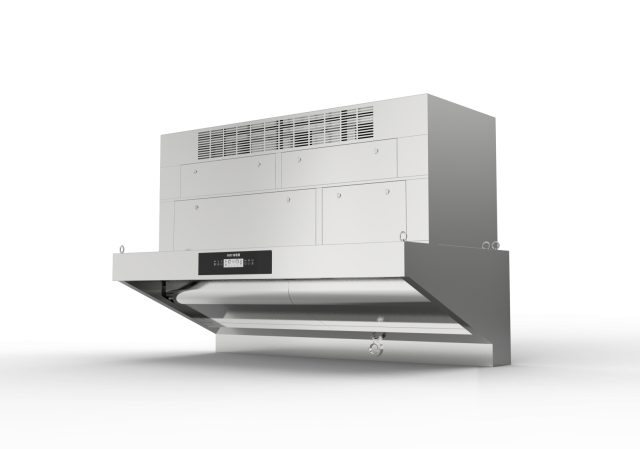
The vertical rotisserie is the heartbeat of every kebab and shawarma house. Whether it is a compact doner shop on a busy high street or a full-service Lebanese grill room with charcoal mangals and open-flame bread ovens, the cooking process generates a distinctive blend of grease-laden vapor, sub-micron particulate, and aromatic smoke that conventional canopy extraction struggles to capture. Souniny’s ductless N-series (light-duty all-in-one) and ND-series (heavy-duty all-in-one) range hoods, paired with the Odor Removal Tower, offer a purpose-built, no-duct solution that removes airborne contaminants at source and recirculates cleaned air back into the kitchen or dining area.
Why Kebab and Shawarma Kitchens Present Unique Ventilation Challenges
Unlike standard line-cooking restaurants, kebab houses rely on three simultaneous heat and emission sources that each demand targeted capture:
Vertical rotisserie (doner / shawarma spit): As the outer layer of marinated lamb, beef, or chicken is shaved and seared, rendered fat drips onto the heating element below. The resulting plume is rich in grease-laden vapor and polycyclic aromatic hydrocarbons (PAHs) produced by pyrolysis of meat juices at high temperature.
Charcoal or gas mangal grills: Open-grill cooking of kofte, shish taouk, and mixed grills releases sub-micron carbon particulate, volatile organic compounds (VOCs), and strong odor compounds. Charcoal combustion adds fine ash and carbon monoxide risk if not properly ventilated.
Flatbread ovens (tandoor, saj, or stone hearth): High-temperature baking of lavash, pita, and manakish generates flour dust and intermittent bursts of steam and smoke when dough contacts hot stone or metal.
The cumulative load is high in both particulate mass and odor intensity. In many urban locations—particularly in Europe, the Middle East, and dense Asian cities—kebab shops occupy narrow storefronts with no rear access, no roof penetration rights, and strict municipal odor-emission limits. Installing traditional galvanized ductwork up through multiple floors is often structurally impossible or prohibitively expensive. This is precisely where ductless purification becomes the only viable path to compliance and operational comfort.
How Ductless N-series and ND-series Handle the Rotisserie Load
The N-series light-duty all-in-one range hood is engineered for moderate fume loads typical of smaller kebab counters, takeaway shops, and front-of-house carving stations. Its multi-stage filtration train begins with a stainless-steel mesh pre-filter that intercepts large grease droplets and food debris from the spit. Downstream, the electrostatic precipitator (ESP) section charges and collects sub-micron grease and smoke particles with high efficiency. A final activated-carbon deodorization layer neutralizes the aromatic compounds that would otherwise migrate into customer seating areas.
For high-output operations—busy late-night doner shops, multi-spit grill houses, or venues with simultaneous charcoal and rotisserie service—the ND-series heavy-duty all-in-one steps up the airflow capacity and ESP cell size. The ND-series is built with reinforced collector plates and wider ionization zones to handle the heavier grease-laden vapor produced when multiple spits run continuously during peak service. Both N-series and ND-series return thermally conditioned air to the room, eliminating the energy penalty of 100-percent exhaust systems and removing the need for complex make-up air ducts.
Odor Removal Tower: Neutralizing Char-Grill Aromatics
Charcoal-grilled meat is delicious to the diner but problematic for neighbors. Municipal authorities in Germany, France, the United Kingdom, and the Gulf states have tightened odor-emission thresholds for foodservice premises in mixed-use buildings. The Odor Removal Tower (除味箱) is a standalone deodorization unit that bolts onto the discharge side of the N-series or ND-series hood. It extends the standard carbon stage with additional chemical-media trays targeting sulfur compounds, ammonia derivatives, and long-chain aldehydes typical of grilled lamb and spiced marinades.
Because the tower operates on the cleaned air stream after the ESP has already removed grease and particulate, the deodorizing media lasts longer and maintains consistent performance. For kebab houses located above residential apartments or in shopping-mall food courts, the Odor Removal Tower is often the difference between a granted operating license and a forced closure.
Front-of-House and Street-Food Applications: CV-A, CV-B, and CV-C
Many successful kebab brands began as street carts or market stalls. Souniny’s mobile cart line—CV-A (ventless hood cart), CV-B (countertop cart), and CV-C (tempered-glass display cart)—brings the same ductless purification technology to outdoor and semi-outdoor settings. A CV-A cart fitted with an ND-series hood module can operate on a pedestrian plaza or festival ground without any fixed infrastructure, capturing spit-roast and grill emissions and returning clean air to the surrounding public space. The tempered-glass CV-C variant adds visual appeal for front-of-house carving demonstrations in hotel lobbies and catering events.
Regulatory Context: European, Middle Eastern, and Global Standards
Kebab houses in the European Union must comply with EN 16282 (commercial kitchen ventilation design) and local EPA odor-limit regulations. In the United Kingdom, the Environmental Protection Act 1990 requires that foodservice operators use “best practicable means” to prevent statutory nuisance from cooking odors. German TA Luft guidelines set specific emission limits for organic carbon and odor units per cubic meter.
In the Middle East, where shawarma is a staple of the foodservice economy, many Gulf municipalities now require grease-extraction certification for new restaurant licenses. Souniny’s CE-certified N-series and ND-series systems meet the mechanical and safety requirements of EN 16282, while the optional Odor Removal Tower helps operators satisfy odor-control clauses that are increasingly written into lease agreements and municipal bylaws.
For operators in North America, UL 710B and NFPA 96 govern the fire-safety aspects of grease-extraction systems. The stainless-steel construction and automatic fire-suppression compatibility of the ND-series align with these standards, and the absence of grease-laden ductwork removes one of the highest fire-risk elements in traditional installations.
Installation and Maintenance in Tight Urban Kitchens
Kebab shop kitchens are often long and narrow, with the rotisserie positioned against a side wall and minimal ceiling height. The N-series and ND-series are designed for ceiling-suspended or wall-bracket mounting with low overall height, fitting into spaces where a traditional canopy plus duct riser would be impossible. Because there is no exhaust duct, landlords and building managers typically raise no objections—an important consideration for lease negotiations in city centers.
Maintenance is straightforward. The stainless-steel pre-filter slides out for daily dishwasher cleaning. The ESP cells lift out for weekly immersion washing in warm degreasing solution. The Odor Removal Tower media trays are replaced on a schedule determined by cooking volume—typically every six to twelve months for a busy spit-roast operation. Souniny provides a 12-month whole-unit warranty, with ESP cells, collector plates, sealing strips, and ceramic insulators treated as consumable wear items.
Energy and Cost Benefits of Ductless Operation
A conventional ducted extraction system in a kebab house can exhaust 2,000 to 4,000 cubic meters of conditioned air per hour. In climates with cold winters or hot summers, the HVAC load required to heat or cool replacement make-up air represents a significant operating cost. By recirculating cleaned air, the N-series and ND-series eliminate this penalty. Operators in Northern Europe have reported seasonal heating-bill reductions of 30 to 50 percent after switching from ducted canopy to ductless recirculation.
Additionally, the absence of ductwork means no duct-cleaning contracts, no access-panel inspections, and no grease-buildup fire-risk mitigation. The total cost of ownership over a five-year period typically favors ductless systems by a wide margin, particularly in leased premises where capital investment in building infrastructure is not recoverable.
Conclusion
Kebab and shawarma houses occupy a demanding niche in the foodservice world: high heat, high grease, high odor, and often very little space. Souniny’s ductless N-series and ND-series all-in-one range hoods, reinforced by the Odor Removal Tower, provide a complete ventilation and air-quality solution without the structural and financial burden of traditional ductwork. For street-level operators, mobile vendors, and established grill rooms alike, the path to compliance, comfort, and cost control is ductless.