
Overview
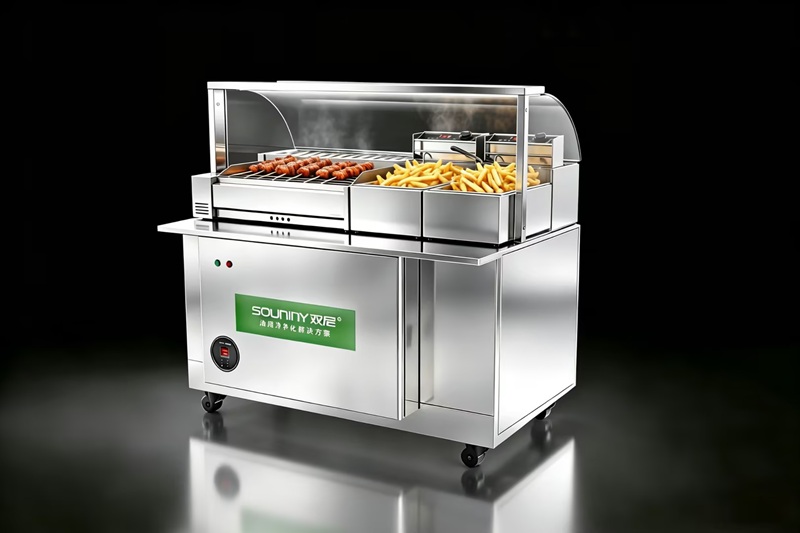
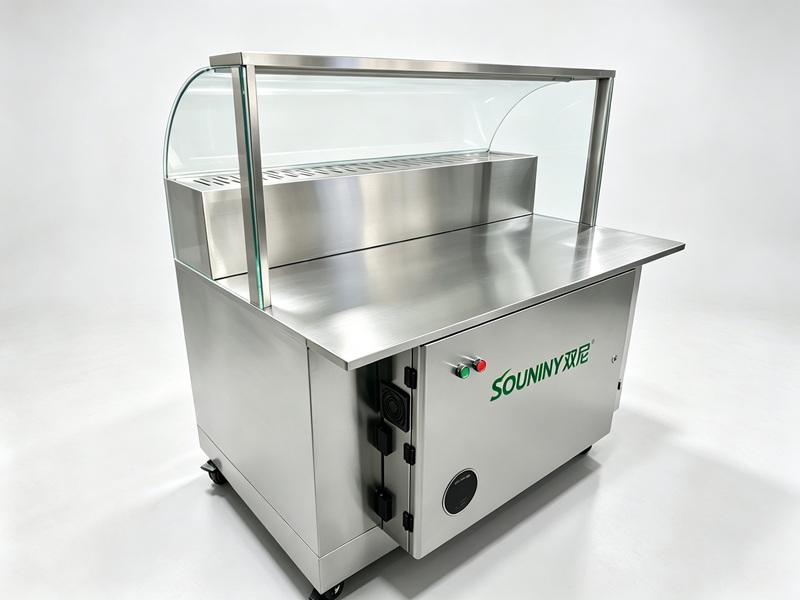
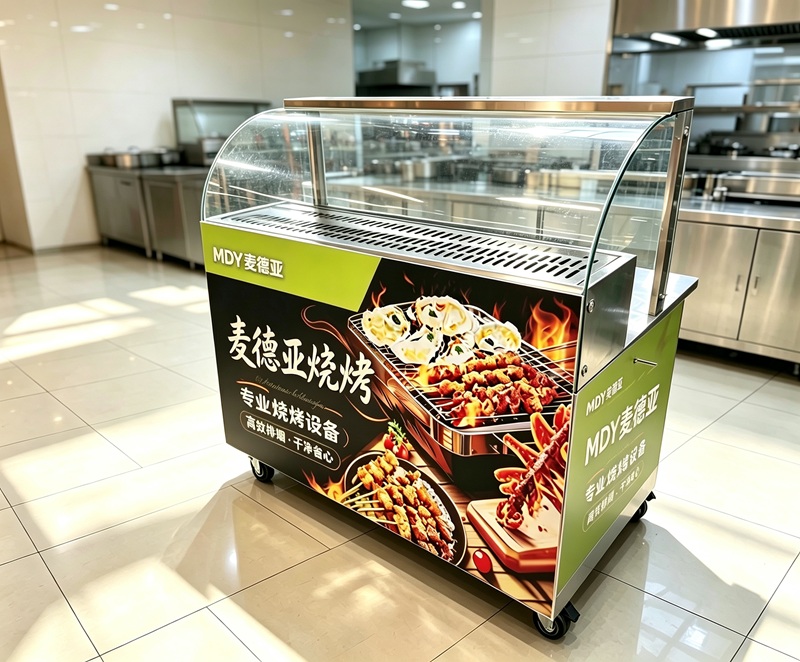
The KL-D-CV-C Tempered-glass Display Cooking Cart brings the cooking counter, a transparent tempered-glass enclosure, multi-stage fume purification and braked castors together in one mobile unit. It is not the conventional barbecue cart with a large chimney – it is a clean stainless-steel open counter with a ring of tempered glass above it. Standing at a supermarket deli counter, a mall atrium or a convenience-store entrance, the customer watches skewers being turned, teppan being pressed and fried items being flipped behind the glass, while the plume is drawn into the collection inlet above the enclosure, treated in the purification cabinet at the end of the cart, and returned to the room through the side of the body. No external wall connection, no ceiling duct, no coring, no exhaust pipe.
The body is stainless steel throughout, with a visible control panel at the front and four braked castors underneath. Push it into position, plug into a normal 220 V supply, and it trades. Three body lengths – 1.3 m, 1.6 m and 2 m – match different counter widths, from a narrow convenience-store counter through a mall island to a long food-court bay.
In one line: it turns indoor positions that could only carry pre-packed food, light meals or chilled cabinets – supermarket deli zones, mall islands, metro concourses, convenience-store entrances – into a tempered-glass open counter that grills, fries and teppans on the spot. No duct, no building work, wheel it in and trade.
Problems It Solves
The binding constraint on opening a grill or hot-food counter is rarely the equipment itself – it is the exhaust. No flue, a landlord who will not allow coring, a mall island with no exhaust shaft, a sealed metro space that cannot discharge outdoors, a temporary market pitch where no building work is permitted. These positions are often cheap and busy, yet they sit empty because the moment anyone grills, the smoke drifts, the complaints start, and the property review is failed.
The KL-D-CV-C integrates the cooking zone, capture hood, purification cabinet and recirculating air path inside one mobile cart. Fumes and steam are treated inside the unit and returned to the room – no external exhaust duct of any kind – so a position that could never carry grill or hot food becomes a workable open counter.
| Typical Blocker | Without This Cart | With the KL-D-CV-C |
|---|---|---|
| Mall island with no exhaust shaft | Only chilled cabinets, light meals and desserts – no grilling or frying on site | Run a glass-front grill or teppan counter in the island position without touching the fit-out |
| Enclosed B1 metro level | Hot food in a commuter concourse drifts smoke, draws passenger complaints, and the operator removes the tenant | Recirculates inside the enclosure – no fume spread, no effect on concourse air |
| Temporary market and pop-up pitches | No building work permitted, no flue to connect, rollout waits on approvals | Wheel the cart in, plug in and trade; move the whole unit out when the event ends with nothing left behind |
| Tight refit budget in older units | Running a flue, opening the ceiling and adding a fan is expensive and slow | No flue work – on site in a day, at a lower rent cost |
| Fumes escaping at an open counter | Customers get smoked where they stand – poor experience, unflattering photos | The glass enclosure keeps the plume inside the capture zone; the cooking itself becomes the draw |
How It Works
Internal Recirculation Path
- Capture above the cooking zone: fumes rise into the negative-pressure zone beneath the glass enclosure and are drawn into the collection duct at the top.
- Top collection duct: running the length of the cart, it gathers fumes from every burner position and carries them to the purification cabinet at the end.
- Multi-stage filtration: pre-filter screen → stainless-steel ESP filter → G4 pre-filter cartridge → high-efficiency composite cartridge (removes particles above 3 µm) → terminal deodorising unit plus odour adsorption carbon box.
- Clean-air return: cleaned air leaves at low velocity from the lower outlet at the side of the body, so it does not blow on customers or disturb the air layer in front of the counter.
Smoke purification efficiency is 99%, with odour removal of 92% to 95% depending on model.
Five Core Technology Modules
| Module | What It Does |
|---|---|
| Tempered-glass display enclosure | The cooking zone is enclosed in transparent tempered glass, so customers at a supermarket deli counter or a mall fresh-preparation counter watch the whole process – grilling, teppan, frying. The live counter is itself a draw, and the glass holds the plume inside the capture zone instead of letting it drift into the customer aisle. |
| Permanent-magnet variable-frequency fan | A permanent-magnet motor with variable-frequency speed control lets airflow be set to peak and off-peak trading. The stainless-steel ESP filter holds its purification rate over long service, unlike a conventional aluminium ESP cell that decays quickly. |
| Multi-stage filtration train | Pre-filter screen → stainless ESP filter → G4 cartridge → high-efficiency composite cartridge (particles above 3 µm) → terminal deodorising unit plus odour adsorption carbon box. Smoke purification 99%, odour removal 92-95%. |
| Ductless indoor recirculation | Fan, filtration stages and air path are all built into the cart body. The inlet sits above the glass-enclosed cooking zone and cleaned air leaves at the side – front-right on the 130CM model, right side on the 160CM and 200CM. No external wall connection, no ceiling duct, no coring. Wheel it into an existing mall, supermarket or convenience-store position, connect 220 V, and trade. |
| All-stainless body with front pull-out servicing | Stainless steel throughout and easy to wipe down at an open counter. Filter cartridges pull out from the front, so about 840 mm of clearance at the front is all that is needed – no access required behind or beside the unit, and it can sit flush against a wall. |
Key Structure
- Glass display enclosure: transparent tempered glass around the cooking zone – the customer sees the skewers being turned, and the plume stays inside the negative-pressure zone of the hood.
- Top collection duct: runs along the length of the cart and gathers fumes from every burner into the end purification cabinet.
- End purification cabinet: houses the pre-filter screen, stainless ESP filter, G4 cartridge, high-efficiency composite cartridge, fan, deodorising unit and odour carbon, all serviced from the front.
- Lower return outlet: cleaned air leaves at low velocity from the lower body, so it does not blow directly on customers or disturb the air layer in front of the counter.
- Mobile castors: braked castors let the cart move between positions, suiting market rotation and pop-up activity.
Specifications
| Parameter | Value |
|---|---|
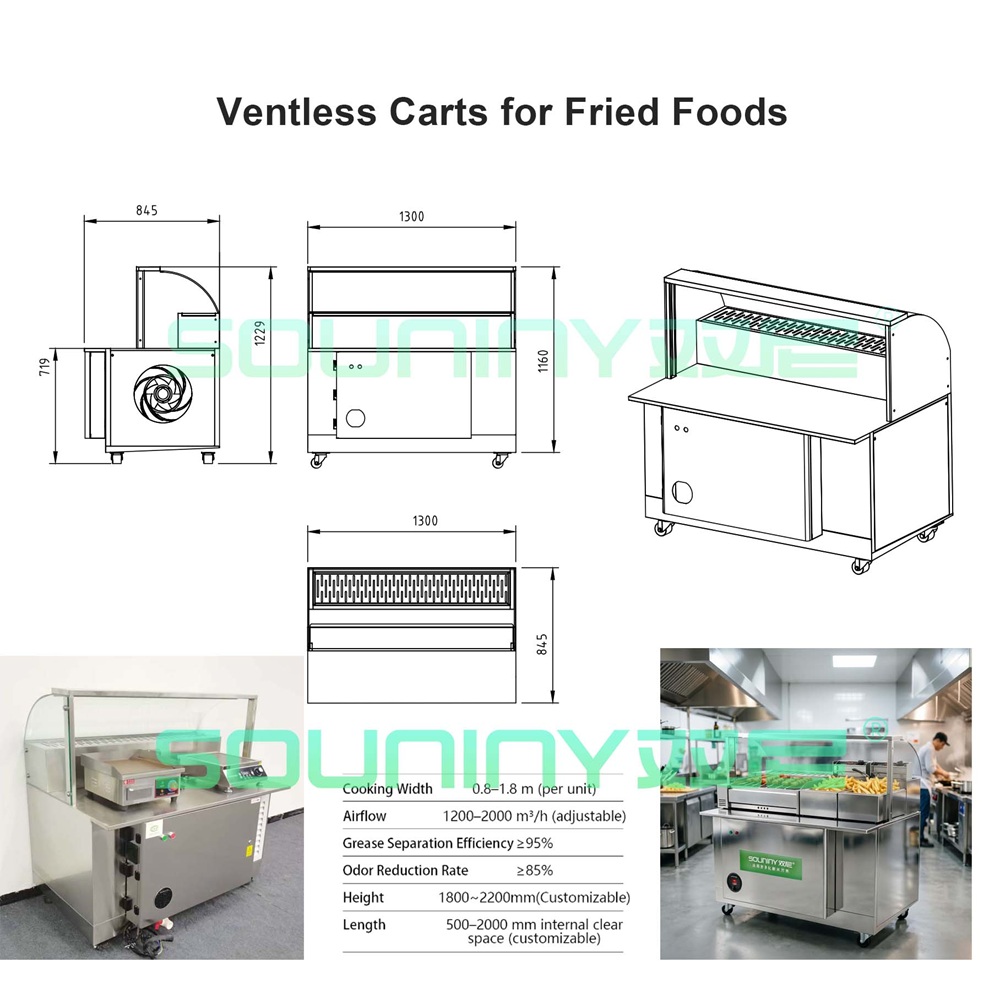
| Airflow | 1,500 – 2,000 m³/h (model dependent) |
| Smoke Purification Efficiency | 99% |
| Odour Removal Efficiency | 90% – 95% (model dependent) |
| Rated Power | 0.7 – 0.9 kW |
| Power Supply | 220 V / 50 Hz |
| Panel Socket Rating | 2,000 W (powers griddles, grills and other cooking appliances) |
| Filtration Stages | Pre-filter screen, stainless ESP filter, G4 cartridge, high-efficiency composite cartridge, deodorising unit, odour adsorption carbon |
| Outlet Direction | Front-right (130CM) / right side (160CM, 200CM) |
| Body Material | Stainless steel |
| Front Service Clearance | 840 mm |
| Mobility | Four braked castors |
Three Body Lengths
The same tempered-glass cart is offered in three lengths. Width and height are the same across the range; choose the length to suit the counter opening.
| Parameter | 130CM | 160CM | 200CM |
|---|---|---|---|
| Dimensions L×W×H (mm) | 1300 × 845 × 1230 | 1600 × 845 × 1230 | 2000 × 845 × 1230 |
| Airflow | 1,500 m³/h | 1,800 m³/h | 2,000 m³/h |
| Smoke Purification Efficiency | 99% | 99% | 99% |
| Odour Removal Efficiency | 90% (high-efficiency composite cartridge) | 92% | 95% |
| Rated Power | 0.7 kW | 0.7 kW | 0.9 kW |
| Power Supply | 220 V / 50 Hz | 220 V / 50 Hz | 220 V / 50 Hz |
| Outlet Direction | Front-right | Right side | Right side |
| Weight | To be confirmed on shipment | 180 kg | 150 kg |
| Filtration Configuration | Pre-filter + ESP + high-efficiency composite cartridge | Pre-filter + ESP + G4 + high-efficiency composite cartridge + deodorising unit + odour carbon | As 160CM, plus a 4V high-efficiency filter |
| Suits | Convenience stores, small counters, narrow metro positions | Mall islands, supermarket deli zones | Long food-court bays, main market stands |
Selection guide: choose 130CM (C130) for convenience stores and narrow metro positions where one person works the counter; 160CM (C160) for mall islands, supermarket fresh-prepared deli zones and standard food-court bays as the mainstream choice; 200CM (C200) for long food-court bays, main market stands and combination counters running several burners at once. All three lengths carry braked castors and run on a normal 220 V supply; the panel socket is rated at 2,000 W and can power grills, griddles and other cooking appliances at the same time. Figures follow the official product specification sheet; the shipped configuration of each unit is final.
Installation and Use Notes
- Leave roughly 840 mm clear at the front of the cart so filters can be pulled out for replacement and cleaning.
- Supply is 220 V / 50 Hz. The panel carries its own socket rated at 2,000 W for external cooking appliances.
- Clean the ESP filter periodically; replace the composite cartridges and odour carbon on a cycle set by how heavily the cart is used.
- The tempered glass above is a high-temperature surface – take care against burns during operation. Set the brakes on the castors once the cart is in position.
Application Scenarios
The picture to hold is a small open kitchen enclosed in glass: a customer standing in a supermarket deli zone, a mall atrium or at a convenience-store entrance watches the cook grilling skewers, pressing teppan and turning fried items behind the glass, while the plume is taken away by the inlet above the enclosure. No smoke in the aisle, no noticeable smell. This is not a market barrow – it is a fresh-preparation display counter for indoor commercial space.
| Scenario | What the Customer Sees / Why Recirculation Is Required | Typical Offer and Recommended Size |
|---|---|---|
| Supermarket deli and fresh-food zone | Set beside the produce and meat counters, sausages, skewers and teppan squid are cooked live inside the glass. Supermarket ceilings have no provision for deli exhaust, so a conventional heavy cookline cannot come in. | Grilled sausages, skewers, teppan squid, fresh fried chicken; 160CM recommended |
| Mall island and atrium | Placed on the main atrium circulation line, the glass counter is itself the visual focus. Mall islands have no exhaust shaft and the ceiling cannot be opened; property management has zero tolerance on smell. | Fresh-grilled skewers, teppan snacks, hot braised items, signature grills; 160CM / 200CM |
| Convenience-store and community-store hot counter | By the till or at the shop entrance, oden, grilled sausages and baked buns move up from reheating pre-packed product to a live counter. Convenience stores are low-ceilinged and small, with no duct possible. | Grilled sausages, baked buns, hand-pulled pastry, oden; 130CM recommended |
| Metro B1 multi-tenancy positions | Narrow positions in a commuter concourse where queuing passengers watch the food being cooked. In a sealed public space, any outdoor discharge goes straight into the passenger concourse, and operator approval is strict. | Commuter skewers, Chinese-style burgers, fresh hot food; 130CM / C160 |
| Long food-court bays in department stores | Large bays that must hold a grill, a work counter and a display position – needing a longer capture hood and more airflow. | Skewers, teppan and fried combination counters; C200 recommended |
| Markets, pop-ups and street events | Temporary pitches where no building work and no connection to a municipal flue are possible; at the end the whole cart is wheeled away leaving no trace. | Signature grills, limited-run counters, seasonal pop-ups; all three lengths |
Suitable Food Formats
The cart is designed to take several heat sources – grill, fry, griddle and braise – so the same unit can switch format, and the operator can change the offer to match footfall through the day.
- Grilled: charcoal skewers, electric-grilled skewers, teppan squid, grilled cold noodles
- Fried: crispy pork, chicken fillet and chicken cutlet, fried skewers, tempura
- Griddled and teppan: teppan steak, teppan fried rice, hand-pulled pastry, pan-fried buns and dumplings
- Hot braised and steamed: hot braised skewers, oden, steamed dim sum, freshly brewed hot drinks
Selection note: formats that generate a great deal of steam – large steaming pots, rice-noodle rolls – are better served by the version fitted with a compressor condensing stage. Charcoal skewering carries a heavy smoke smell, so the version with a water-spray deodorising stage is recommended. Match airflow to the number of burners and the counter length.
Reference Application Directions
The directions below reflect where this cart has proven itself. Customer names and positions are confirmed through the commercial team against the reference library; this page makes no unverified endorsement.
- B1 metro retail multi-tenancy position: a commuter concourse that could only carry pre-packed food now runs a fresh-grilled skewer and hot-braised counter, fully recirculating with no fume spread into the concourse.
- Ground-floor mall island: a fresh-grill snack counter built in the atrium position, using the visible glass enclosure as the draw, without connecting to the building exhaust system.
- City market and creative-park pop-ups: the whole cart is wheeled in for weekend markets and seasonal pop-ups and removed afterwards, leaving no construction trace.
- Old-town small-shop refit: premises with no exhaust provision moved up from a delivery-only drinks bar to a fresh grill and fry counter using this cart.