The cinema concession stand is the profit engine of every movie theater — popcorn and drinks routinely generate more margin than ticket sales themselves. Yet the equipment behind that counter produces a pollutant profile most operators underestimate: popcorn machines popping corn in hot coconut or butter-flavored oil, hot dog rollers, nacho cheese warmers, pretzel and pizza display ovens, all running continuous cycles in a fully enclosed, air-conditioned lobby that shares its air volume with eight to sixteen auditoriums. Ducted exhaust is often physically impossible — multiplexes sit inside shopping malls, heritage cinema buildings, and lease envelopes with no roof rights — and even where a duct exists, exhausting conditioned air all day is expensive. The ductless N-series all-in-one range hood, supported by the Odor Removal Tower and the mobile CV-B and CV-C catering carts for lobby kiosks, gives theater operators a ventless route to clean lobby air, protected auditoriums, and landlord-friendly compliance.
Why Cinema Air Is a Special Case
A movie theater is one of the few foodservice environments where the “dining room” is deliberately sealed. Auditoriums are enclosed, dark, and ventilated by recirculating air-handling systems tuned for acoustic isolation and thermal comfort — not for diluting cooking emissions. Whatever the concession stand releases into the lobby air eventually migrates through the HVAC return into the halls and auditoriums, where guests sit for two hours with no escape from it.
Three factors make this worse than the equipment list suggests. First, enclosure: lobbies are deep interior spaces with no operable windows, so odor has nowhere to go but into the return plenum. Second, duration: popcorn machines pop continuously from the first matinee to the last evening show — eight to fourteen hours a day, seven days a week. Third, sensitivity: butter-flavored cooking vapor is precisely the aroma moviegoers associate with cinema, but the same molecules that smell appealing in the lobby at minute one become cloying and fatiguing in a sealed auditorium at minute ninety — and they deposit as a persistent oily film on seats, carpets, and projector equipment over time.
The concession stand does not need to eliminate the popcorn aroma — it is a marketing asset at the counter. The engineering goal is controlled capture at source, so the lobby keeps a pleasant ambient note while auditoriums, corridors, and projection rooms stay free of oil mist and residue.
The Popcorn Machine: Small Footprint, Real Emissions
Commercial popcorn equipment is the dominant emission source behind the counter. A popping kettle holds coconut oil — or a butter-flavored topping oil — at 170–190 °C while kernels burst in repeated batches. Each batch releases a plume of oil fume: atomized oil droplets that cool into sub-micron particulate, plus volatile organic compounds (VOCs) from the flavoring system and steam loaded with fine salt and kernel-hull fragments.
Three characteristics define the pollutant stream. It is light but relentless — lower grease mass per hour than a fryer line, but delivered in continuous cycles across a full operating day, which accumulates meaningfully on surfaces and HVAC coils. It is odor-dominant — the butter-flavor VOCs travel far beyond the visible mist, so odor control matters as much as particulate capture. And it is deposited as film — the cooled mist condenses on popcorn-glass panels, light fixtures, ceiling tiles, and the HVAC return grilles directly above the stand, creating sticky, dust-holding surfaces that are expensive to clean and unpleasant for guests to see.
A baffle-filter canopy struggles with this profile because the challenge is not bulk grease — it is sub-micron particulate and gas-phase odor. That is precisely the pair of problems an electrostatic-plus-carbon architecture solves.
The Full Counter Emission Map
Popcorn is the anchor, but a modern concession stand runs a dozen light-cooking appliances side by side, each with its own signature:
Hot dog rollers. Franks rotate on heated rollers for hours, rendering fat that vaporizes as a light grease haze; drippings carbonize on the roller surface and add a burnt-note particulate.
Nacho cheese warmers and dispensers. Processed cheese held hot releases fatty-acid VOCs and a sticky film that settles nearby.
Pretzel and pizza display ovens. Continuous warming and occasional baking release browning aromatics, butter aerosol from brushed pretzels, and cheese volatiles.
Espresso and beverage stations. Increasingly standard in premium lobbies, they add milk-steam residue and coffee roasting-adjacent volatiles where beans are ground on site.
Individually each appliance is minor. Together, in an enclosed lobby with shared recirculating air, they define the theater’s entire olfactory identity — which is why capture-at-source beats lobby-level air freshening every time.
Ductless Capture at the Source: N-series and Cabinet Purifier
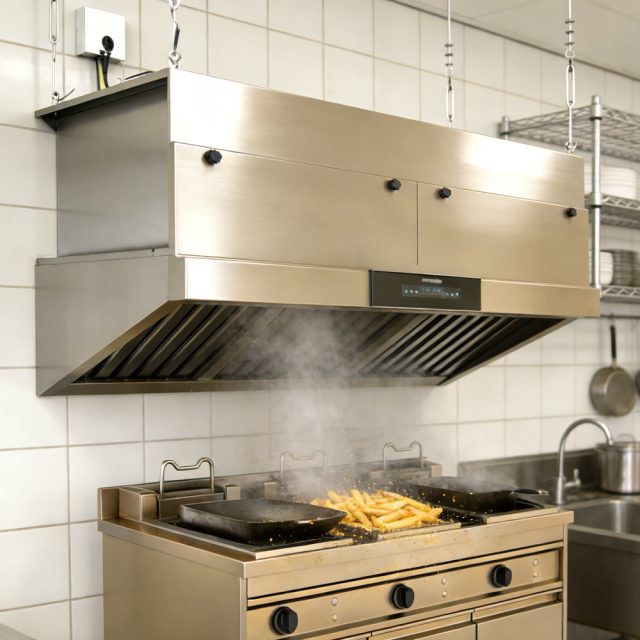
The N-series light-duty all-in-one range hood is engineered for exactly this load class. Mounted directly over the popcorn machine and hot-food line, it pulls the plume through a multi-stage purification train: a stainless-steel baffle pre-filter intercepts larger oil droplets, an electrostatic precipitator (ESP) cell charges and collects the sub-micron particulate that passes mechanical filtration, and an activated-carbon stage adsorbs the odor-active VOCs. The cleaned air returns directly to the lobby — no duct, no roof penetration, no exhaust-axing of conditioned air.
For compact concession counters in mall multiplexes — where the popcorn machine, warmer displays, and register occupy a single island — the Cabinet Purifier integrates purification into the counter furniture itself. The stand’s back-of-counter volume houses the ESP and carbon stages, keeping the clean-profile look architects specify for modern cinema lobbies while still capturing emissions within centimeters of the kettle.
Because there is no grease duct, there is nothing for a mall landlord to negotiate: no roof rights, no shared-riser agreements, no fire-rated shaft construction. A concession refresh that would take months of approvals with a ducted canopy becomes an equipment installation measured in days.
Odor Management: The Odor Removal Tower
Particulate capture alone will not protect the auditoriums. Butter-flavor molecules are gas-phase, and they are the reason a three-screen heritage cinema can smell like a popcorn machine on every floor. The Odor Removal Tower adds a dedicated gas-phase stage: air that has already passed particulate filtration flows through a deep activated-carbon bed that adsorbs aldehydes, ketones, and fatty acids — the molecules responsible for both the appealing counter-side aroma and the fatiguing auditorium-side accumulation.
In practice, theaters stage the solution: the N-series hood handles capture and particulate at the counter, while the Odor Removal Tower polishes the return stream for the lobby zone — or, in recirculating auditorium systems, treats the make-up stream serving the halls. The result is a lobby that retains a pleasant, subtle popcorn note and auditoriums that stay neutral for the full two-hour show.
Sizing rule of thumb: match the carbon bed to daily popping hours and oil throughput, and replace media on measured pressure drop and odor breakthrough rather than the calendar. Concession stands, with their light grease load upstream, typically see long, predictable carbon life.
Lobby Kiosks and Mobile Stations: CV-B and CV-C
Theater operators increasingly push foodservice out of the back counter and into the lobby itself — express popcorn kiosks near the entrance, hot-food carts for weekend peaks, and premium bars for special screenings. Every one of these front-of-house stations faces the same constraint: it sits in guest space, far from any duct, and it cannot vent.
The CV-B countertop cart is a compact ventless station with integrated electrostatic and carbon purification, sized for kiosk duty beside the ticket gates. The CV-C tempered-glass cart adds a showcase element — popcorn or hot-food preparation visible through glass — with the same built-in ventless capture, making it a natural fit for premium lobbies, festival screenings, and special events where the cooking itself is part of the draw. Both roll into position on standard power, operate all day without ductwork, and roll away for deep-clean nights or lobby reconfiguration.
For seasonal or off-site promotion — shopping-center popcorn stands, open-air summer screenings, premiere events — the same ventless cart platform moves with the brand, keeping air quality and landlord relations intact wherever the stand lands.
Codes, Landlords, and Insurers
Light-cooking concession equipment occupies a gray zone in many jurisdictions: popcorn machines and warmers may not always trigger the full Type I hood requirements that fryer lines do, but interpretations vary, and mall tenants are always bound by landlord engineering standards on top of local mechanical codes. The safe specification posture is to treat the stand as if it were regulated regardless.
The N-series, Cabinet Purifier, and CV-series carts carry CE certification and are designed around EN 16282 kitchen ventilation principles and the recirculating-hood concepts reflected in UL 710B, without relying on external ductwork. For operators, that translates into a documented, specifiable air-quality installation that satisfies landlord review, simplifies fire-marshal conversations (no grease duct means no duct-cleaning regime), and strengthens the underwriting file with insurers who increasingly ask about cooking-emission controls in entertainment venues.
Energy: Stop Throwing Away Conditioned Air
A ducted exhaust over a concession stand runs all operating hours, and every cubic meter it expels must be replaced by conditioned make-up air — heated or cooled at the theater’s expense, eight to fourteen hours a day. In climates with hot summers or cold winters, that thermal penalty runs quietly through the utility bill year-round.
Ductless recirculation eliminates the penalty by design. The N-series returns cleaned air to the lobby at near-ambient temperature, the Cabinet Purifier does the same inside the counter envelope, and the CV-series carts condition nothing because they exhaust nothing. For a multiplex chain standardizing across dozens of screens, the aggregate HVAC saving is a material line item — on top of the avoided cost of duct construction and ongoing duct cleaning contracts.
Maintenance Built for Theater Staff
Concession stands are staffed by the youngest, highest-turnover workforce in foodservice. Any maintenance routine that requires training, tools, or a contractor will not survive a summer staffing cycle. The N-series and Cabinet Purifier are designed accordingly: daily surface wipe-down, and a weekly slide-out of the ESP cell for a warm-water rinse — a ten-minute, no-tools task that fits between show changes. Pre-filters lift out for a wash in the same cycle.
For flagship locations that cannot schedule downtime, SOUNINY’s Self-cleaning ESP with the Smart Water Tank automates the wash cycle entirely — valuable in 16-screen megaplexes where the concession line never truly closes and the same crew is selling tickets, popping corn, and pulling espresso simultaneously.
Standardizing Across a Circuit
Cinema chains think in templates: the same lobby layout, the same counter footprint, the same equipment list repeated across every site. Ventilation should follow the same discipline. A standard package — N-series over the popcorn and hot-food line, Odor Removal Tower on the lobby return where auditorium protection matters, Cabinet Purifier for compact counters, CV-B and CV-C carts for kiosks and events — gives facility teams one installation manual, one maintenance routine, one spare-parts list, and one compliance story to present to every landlord in the portfolio.
Souniny supplies the full package from a single platform and works with theater operators to size the configuration per site — screen count, lobby volume, popping schedule, and lease constraints all factor in. Contact the Souniny engineering team to spec a circuit-wide standard or a single-site refresh.