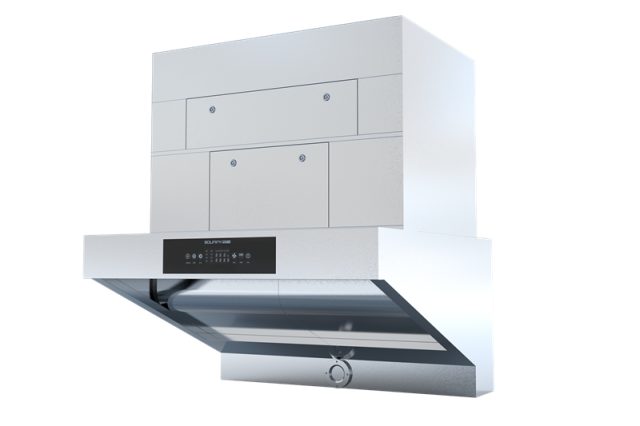
A wine bar’s worst engineering mistake is to let the kitchen reach the guest’s nose. The glass is the instrument, the sommelier is the reader, and the kitchen hood has to be silent, invisible, and utterly absent from the bouquet. Ductless ND-series heavy-duty all-in-one range hoods paired with an Odor Removal Tower clear the air at the point of cooking so that a Pinot Noir poured at table four still smells like Pinot Noir, not like last night’s pork belly. In a venue built around aroma, the ventilation isn’t a code requirement, it’s a product feature.
Why a Wine Bar Is a Different Ventilation Problem
Most foodservice ventilation briefs start with fire safety and grease extraction. A wine bar adds a third, often invisible constraint: olfactory fidelity. The International Sommelier Guild notes that retronasal aroma carries 70–80% of perceived flavor; the same chemistry that fills a glass of Syrah with blackberry and violet also fills the room with those volatiles when a brûlée torch runs ten feet away. In a fine-dining restaurant, the guest is forgiving because the food itself is the show. In a wine bar, the wine is the show, and every kitchen odor is contamination.
Three operational facts sharpen the problem. First, wine bars serve small plates that cook at high heat for short durations: cheese melted under a salamander, croquettes deep-fried to order, a single portion of beef tartare seared tableside on a hot stone. Each event is short, but each event produces an intense plume of grease-laden vapor and Maillard-reaction volatiles. Second, the dining room and the bar counter are usually the same room. There is no closed kitchen door to absorb the blast. Third, ventilation in a heritage building — which is where most successful wine bars live — is rarely ducted. Landlord restrictions, listed facades, low floor-to-floor dimensions, and shared flues with neighboring tenants make a rooftop exhaust impossible.
The traditional ductless response — a charcoal recirculating hood over a residential stove — does not work at commercial cooking load. Commercial charbroilers, induction planchas, and salamanders produce sub-micron particulate and condensable aerosols that pass straight through consumer-grade carbon. The result is a kitchen that looks clean but smells like a fryer, and a wine list that the sommelier has to defend against the kitchen.
The four metrics that actually matter
Replace the standard “CFM per linear foot” approach with the four metrics that drive wine bar decisions:
- Odor breakthrough at table distance. The air five meters from the cooking line should have no detectable character from the kitchen. This is tested by an odor panel, not by a particle counter — see the verification protocol below.
- Sound pressure at the bar. A wine bar averages 65–72 dBA ambient. A hood that pushes 70 dBA at three meters forces the sommelier to raise the voice, the guest to lean in, and the room to feel busier than it is. The standard says <55 dBA at three meters for hoods in tasting venues; this is achievable but only with low-speed blower geometry.
- Heat recovery for the bar’s HVAC. Most wine bars are cooled by mini-splits or small VRF. A ducted hood dumps 1,200–3,000 CFM of conditioned air out of the building every minute it runs, and the AC has to make it up. Ductless recirculating hoods return that air to the room — but at the cost of heating the room. Capture efficiency at the cooking line determines the actual heat load.
- Heritage compliance. No rooftop penetration, no exterior louver, no structural change to the facade. Many wine bars sit in 19th-century buildings where the local planning authority classifies any new roof opening as a “material alteration” requiring consent.
The Ductless ND-series + Odor Removal Tower Architecture
The architecture that fits a wine bar is a layered one: capture and removal at the cooking line, polishing in the room air, and zero exhaust to the outside.
Stage 1 — Capture at the cooking line
The ND-series heavy-duty ductless all-in-one hood sits directly over the cooking line. Its job is to capture grease-laden vapor before it spreads. Capture efficiency at the cooking line is dominated by geometry — overhang, side panels, and proximity — not by fan power. The ND-series uses a triple-stage internal filtration: a stainless mesh pre-filter for visible grease, a baffy cyclone stage for larger aerosols, and an ESP Purifier cell for sub-micron particulate. The ESP cell charges incoming particles, collects them on aluminum plates, and drains the captured grease to an internal tray that staff empty weekly. In a wine bar where the line runs a salamander and a plancha for eight hours, this stage alone removes 85–90% of the visible plume.
Unlike a ducted system that pushes everything out the roof, the ND-series recirculates the cleaned air back into the dining room. For a wine bar, that means the kitchen’s conditioned air stays in the room, and the sommelier doesn’t have to overcool the dining area to overcome the make-up air load.
Stage 2 — Odor polishing with the Odor Removal Tower
The volatile organic compounds (VOCs) and odor-active compounds — the molecules responsible for the actual “smell” of cooked food — pass through an ESP cell. They require a different technology. The Odor Removal Tower (除味箱) pairs with the ND-series to handle gas-phase contaminants. The tower is a vertical carbon and catalyst bed sized to the hood’s airflow; air from the hood passes through a fan box, then up through layered media, and returns to the room as polished air.
The pairing matters because carbon adsorbs organics (aldehydes, ketones, fatty acids), and the catalyst bed accelerates the breakdown of lighter molecules (alcohols, short-chain esters). Together they handle the wide volatile profile of a wine bar’s small-plates menu: the acrolein from a seared steak, the diacetyl from a butter-poached lobster, the pyrazines from a charred pepper.
Sizing note: pair the Odor Removal Tower to the hood’s nominal airflow, not to the room volume. A 2,000 CFM ND-series requires a tower rated for at least 2,000 CFM; undersizing bottlenecks the hood and pushes grease back into the room.
Stage 3 — Acoustic and lighting
The wine bar aesthetic demands low-profile equipment and warm lighting. The ND-series ships in matte black or brushed stainless with low-glare LED task lights, both specified to disappear against a timber ceiling or a velvet-lined bar surround. Acoustic ratings on the ND-series measure 58 dBA at one meter under full load — close to a quiet conversation. With the Odor Removal Tower sited away from the dining area (a back-of-house corner or under-counter mounting), the audible signature at table distance stays below the 55 dBA target.
Siting and Layout for Wine Bar Kitchens
Wine bar kitchen layouts are constrained by both the building and the menu. Two patterns dominate.
The visible open kitchen
The more common pattern in newer or purpose-built wine bars: a small open line, two to four cooks, a chef’s counter for four to eight seats, and a dining room for thirty to sixty. The kitchen is part of the experience. This is the harder case because the guest is at table four, three meters from the salamander, when the chef’s torch runs.
Recommended layout: a low partition (1.1–1.4 m) between the chef’s counter and the dining room, with the ND-series hood mounted flush with the partition’s top edge. The partition serves as a thermal and visual break; the hood captures the plume before it crests the partition and enters the guest zone. Pair the ND-series with an Odor Removal Tower mounted under the counter or in the back-of-house corridor, plumbed to drain. The result is a kitchen that the guest sees but does not smell.
The hidden kitchen
The more common pattern in heritage buildings: a fully enclosed kitchen behind a swing door or a hatch, with the bar counter and the wine storage in front. This is the easier case because the door absorbs much of the plume. The ventilation job shifts from capture to polishing: the hood still needs to remove grease before it deposits on the kitchen walls, but the room-air polishing is dominated by the dining-room-side air handling.
Recommended layout: a single ND-series over the main cooking line, sized to the line’s longest dimension, with an Odor Removal Tower mounted on the kitchen wall opposite the door. The tower pulls a side stream of kitchen air, runs it through the carbon and catalyst bed, and returns it to the kitchen. This keeps the kitchen walls clean and prevents the door’s opening from pushing a grease-and-odor plume into the dining room.
Standards, Compliance, and Heritage Constraints
Even ductless systems are subject to standards. Three apply most directly to wine bars.
NFPA 96 (Standard for Ventilation Control and Fire Protection of Commercial Cooking Operations) governs the fire-safety side of any cooking operation, ducted or ductless. For ductless hoods, the standard requires automatic fire suppression in the hood plenum, a cleanable grease tray, and listed construction of the internal filtration. The ND-series carries the necessary listings and ships with an integrated wet-chemical fire suppression bottle that discharges into the plenum on a fusible-link or thermal-sensor trigger.
EN 16282-1 (European standard for kitchen exhaust components) covers filtration efficiency, fire safety, and cleanability for ductless recirculating hoods used in commercial kitchens. For venues in the EU, the standard’s filtration efficiency class (typically B or A) and odor reduction class are the two ratings that matter. Pair the ND-series with an Odor Removal Tower rated for at least Class 4 odor reduction to meet the standard’s top commercial classification.
Local heritage and planning constraints often exclude rooftop penetrations entirely. In conservation areas, listed buildings, or shared-flue buildings, a ducted hood is structurally impossible. The ductless ND-series + Odor Removal Tower combination is not a compromise in these venues — it is the only architecture that satisfies both the conservation and the food safety requirements.
Menu Engineering for Ventilation Load
Wine bar menus cluster around five cooking methods, each with a distinct ventilation profile. Engineering the menu to the hood is the most underutilized lever in wine bar operations.
| Cooking Method | Plume Profile | Hood Load | Recommended Hood |
|---|---|---|---|
| Salamander / broiler | High heat, short duration, intense aerosol | Spike load (1–3 min events) | ND-series with full capture geometry |
| Plancha / griddle | Continuous medium heat, low aerosol | Steady load | N-series (light-duty) acceptable |
| Induction / sous-vide finishing | Negligible plume | Minimal | Cabinet Purifier or no hood |
| Deep fryer | Continuous high aerosol, fine particulate | Heavy steady load | ND-series + side panel capture |
| Tableside cooking (hot stone, guéridon) | Burst load in guest zone | Critical | CV-C cart with integrated capture |
For tableside service, a CV-C tempered glass cart with an integrated capture hood is the most reliable architecture. The cart’s hood is sized to the single portion; the cart returns its air through a built-in carbon stage; the cart moves with the service. The dining room’s main hood is unaffected.
Verification: The Blind Odor Panel
An instrumented verification of a wine bar’s ventilation requires more than a particle counter. The right protocol is a blind odor panel, run during service, that measures breakthrough at the guest’s seat.
- Run service normally for at least thirty minutes before the test.
- Pull a four-person panel of non-staff into the dining room for ten minutes of acclimation. Use guests, friends, or external sommeliers — anyone who isn’t working the kitchen.
- During the next high-load cooking event (a salamander sear, a deep fryer drop), ask the panel to record what they smell at their seat, in their own words, blind to the cooking schedule.
- Repeat across at least five events of different types (sear, fry, char, simmer, brûlée).
- A passing system produces no kitchen-related descriptors in any panelist’s notes. A failing system produces kitchen descriptors (butter, char, oil, fried) at the seat.
This protocol is more sensitive than a VOC monitor because human noses are tuned to the same aroma-active compounds that drive wine perception — and the wine bar’s failure mode is sensory, not regulatory.
Capital Cost and Operating Economics
A ductless ND-series hood with an Odor Removal Tower has a higher unit cost than a ducted hood of equivalent capture area — typically 1.4x to 1.8x the price. The economic case rests on three offsets:
- No rooftop work. A ducted installation in a heritage building may require structural reinforcement, a new roof penetration, weatherproofing, and conservation sign-off. These costs routinely run five to ten times the hood itself.
- Lower make-up air load. A ducted hood dumps 1,500–3,000 CFM of conditioned air. The wine bar’s HVAC has to cool or heat replacement air every minute. In a cooled venue, this can double the summer’s electrical bill.
- Faster install, no permit delay. A ductless install runs two to four days from delivery to commissioning. A ducted install in a heritage venue can run six to twelve weeks of permit, structural work, and conservation review.
For a typical 80 m² wine bar with a 4-meter cooking line, the ductless ND-series + Odor Removal Tower architecture pays back the premium over a ducted system within 18–30 months, even before counting avoided permit costs.
What Souniny Provides for Wine Bar Projects
Souniny has supplied ductless kitchen ventilation to wine bars, tasting rooms, and heritage hospitality venues since 2015. The relevant product mix for a wine bar:
- ND-series heavy-duty ductless all-in-one range hood for the main cooking line — paired with an Odor Removal Tower sized to the hood’s airflow.
- N-series light-duty ductless hood for the plancha or auxiliary line — sufficient where cooking load is medium and continuous.
- Cabinet Purifier for finishing stations and induction work — minimal-load capture with the lowest visual profile.
- CV-C tempered glass catering cart for tableside cooking, guéridon service, and sommelier-led pairings.
- ESP cell cleaning, carbon replacement schedules, and annual commissioning through Souniny’s service network in the EU, North America, and Asia-Pacific.
All Souniny commercial products are CE certified and built to NFPA 96, EN 16282, and equivalent regional standards. ESP cells, aluminum collector plates, sealing strips, and ceramic insulators are consumable wear items covered by the standard warranty with replacement parts available globally.
Common Mistakes in Wine Bar Ventilation
Specifying a residential recirculating hood. Residential hoods are not rated for commercial cooking load and will fail NFPA 96 in most jurisdictions. The visible plume may be small; the grease deposition on the walls will not be.
Undersizing the Odor Removal Tower. A tower rated below the hood’s airflow bottlenecks the system and forces the hood’s ESP cell to capture odor-active volatiles it wasn’t designed for. The result is faster cell fouling and a kitchen that smells like the hood instead of the food.
Mounting the hood too high. Capture geometry is dominated by the gap between the hood face and the cooking surface. A hood mounted at 1.4 m instead of 0.9 m over a salamander loses 30–40% of its capture. Wine bar ceilings are often lower than commercial kitchen standards — use the available height aggressively.
Ignoring the tableside event. A guéridon trolley with a hot stone or a torch is the wine bar’s signature event — and the most likely moment for a guest to smell the kitchen. The CV-C cart with integrated capture is a one-piece solution; don’t try to solve tableside service with the main hood.
A wine bar is the rare venue where the guest judges the kitchen with the same instrument they use to judge the wine. Engineering the kitchen so that the instrument reads only the wine is the job. The ductless ND-series + Odor Removal Tower architecture is the most reliable way to make sure that the guest at table four smells Pinot Noir, not the chef’s torch.