Malaysia’s tropical climate, high-rise urban density, and layered regulatory framework make commercial kitchen ventilation one of the most technically demanding building services disciplines in Southeast Asia. An exhaust system that merely removes heat is no longer sufficient. Under the Uniform Building By-Laws (UBBL), the Fire and Rescue Department (BOMBA), and the Department of Environment (DOE), a kitchen extraction path must be inspectable, fire-resilient, grease-tight, and environmentally compliant. This article explains how Malaysian F&B operators, mall developers, and hotel engineers can design, maintain, and retrofit kitchen ventilation systems that satisfy all three gatekeepers while controlling capital and operating costs.
The Three Gatekeepers: UBBL, BOMBA, and DOE
Unlike jurisdictions where a single national code governs kitchen exhaust, Malaysia operates a three-layer compliance model. Each layer has a different objective, a different inspector, and a different penalty for non-compliance. Understanding the overlap is essential because a system that passes BOMBA’s fire audit may still fail DOE’s emission check, and a duct that meets UBBL structural rules may lack the access panels BOMBA now demands.
UBBL 1984 (and state amendments) is the building-code foundation. It sets the fire-resistance rating for ducts that penetrate fire compartments, the minimum dimensions for kitchen spaces, and the structural requirements for exhaust risers in multi-storey buildings. Under UBBL, any duct carrying grease-laden vapour through a fire-rated wall or floor slab must maintain its integrity for the duration specified in the building’s fire-safety schedule, typically two to four hours. The by-law also underpins the requirement for a Fire Certificate (FC) before a commercial kitchen can operate, making the building’s M&E design submission the first compliance checkpoint.
BOMBA (Jabatan Bomba dan Penyelamat Malaysia) enforces the life-safety layer. BOMBA inspectors focus on whether the exhaust system is a “grease fuse” waiting to ignite. Their audit protocol, tightened significantly under 2024-2026 enforcement guidance, checks for inspectability, grease load, fire-damper function, and access-panel placement. A failed BOMBA inspection can result in the immediate suspension of the annual Fire Certificate, effectively shutting the kitchen until remediation is complete. In Kuala Lumpur and Selangor, where high-rise F&B density is greatest, BOMBA has prioritised kitchen exhaust paths during FC renewal audits.
DOE (Department of Environment) administers the Environmental Quality Act 1974 and its subsidiary regulations. For kitchen exhaust, DOE’s primary concern is nuisance: visible smoke, odour, and particulate matter that affect neighbouring properties. While Malaysia has not codified a single national odour concentration limit, DOE can impose site-specific emission conditions through licensing, and complaints from nearby residents or office tenants can trigger enforcement action. The standard technical reference for odour measurement is MS 1963:2007, aligned with EN 13725:2003, which expresses results in odour units per cubic metre (OU/m³). In practice, DOE expects “clear stack” discharge and demonstrable odour control, especially in dense urban centres like Kuala Lumpur, Petaling Jaya, and Shah Alam.
Duct Construction and Fire Compartmentation
Under UBBL and BOMBA, kitchen exhaust ducts are treated as high-risk fuel lines, not ordinary HVAC conduits. The construction standard most frequently referenced is MS 1472, which governs the materials, sealing, and fire-rating of grease-carrying ductwork. Standard galvanised or spiral-wound ducts are unsuitable because they are neither liquid-tight nor fire-resistant once internal grease ignites.
MS 1472-compliant grease ducts are fabricated from heavy-gauge carbon steel (1.2 mm to 1.6 mm) or stainless steel (typically SS304), with continuous TIG or MIG welds at all longitudinal and circumferential joints. Riveted, gasketed, or slip-joint construction is prohibited because liquid grease can weep into ceiling voids, creating a secondary fire hazard and violating DOSH hygiene expectations. The duct must slope toward the hood or a grease drain to prevent pooling, and all horizontal runs require fire-rated access panels at every change of direction and at intervals not exceeding three metres. These panels must be UL-listed or SIRIM-certified and must not compromise the duct’s fire rating when closed.
Where the duct penetrates a fire-rated wall or floor slab, intumescent fire-stopping is mandatory. The seal must expand under heat to close the annular gap between the duct and the structure, preventing flame and smoke bypass. Fire dampers with fusible links are required at compartment boundaries; BOMBA inspectors physically test these dampers during FC audits to confirm they close when the link temperature is exceeded. In high-rise buildings, the vertical riser is the most critical element: a grease fire at ground-floor level can travel upward through an unprotected riser with terrifying speed, which is why BOMBA classifies the kitchen exhaust path as a priority inspection zone.
Capture Geometry and Airflow Design
Malaysian kitchen ventilation design draws on the same trade heuristics used across tropical Asia, but with additional humidity and heat-load considerations. The hood canopy must overhang the cooking equipment by at least 150 mm on the sides and 300 mm at the front to prevent spillage of grease-laden vapour into the breathing zone. The lower edge of the hood is typically set 600 mm to 800 mm above the cooking surface, balancing capture efficiency with chef ergonomics. Face velocity across the hood aperture should be maintained at 0.25 m/s to 0.35 m/s; lower values allow smoke escape, while higher values increase energy consumption and can disturb gas-flame stability on wok burners.
For sizing, the industry rules of thumb are: approximately 2,000 m³/h per metre of hood length for light-duty cooking, rising to 2,500 m³/h per metre for open-display or heavy-fume lines; roughly 4,000 m³/h per gas burner; and 0.4 m/s to 0.5 m/s as the target capture velocity. These figures are starting points, not substitutes for a proper load calculation that accounts for the specific menu, appliance wattage, and duct resistance. In Malaysia’s climate, where ambient kitchen temperatures already exceed 30 °C, the exhaust fan must also overcome the additional latent load from steam-heavy cooking such as dim sum, noodle broth, and Southeast Asian curry preparation.
Make-up air is frequently overlooked in Malaysian shop-lot and mall installations, yet it is essential for system performance. Every cubic metre of air extracted must be replaced to avoid negative pressure, which collapses suction, makes doors difficult to open, and allows grease and odour to migrate into dining areas. The make-up air supply should be tempered because introducing 33 °C, 80 % RH outdoor air directly into the kitchen adds a massive cooling load. Pre-cooled make-up air, delivered through a dedicated fan or an energy-recovery ventilator, improves comfort and reduces the burden on the kitchen’s air-conditioning system.
Pollutant Control: The Two-Phase Sequence
Kitchen exhaust contains two distinct pollutant phases that require different treatment technologies. The particulate phase consists of sub-micron grease droplets, carbon particles, and condensed organic aerosols generated by frying, grilling, and wok cooking. The gaseous phase comprises volatile organic compounds (VOCs), nitrogen oxides, sulphur compounds, and odour molecules. The sequence in which these phases are treated matters: particulate must be removed before gas-phase treatment, because grease particles will blind activated carbon beds and reduce their adsorption capacity.
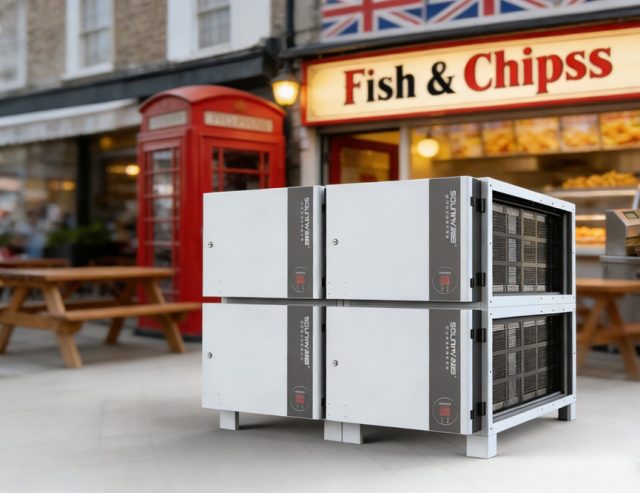
For the particulate phase, the most common approach in Malaysian commercial kitchens is the electrostatic precipitator (ESP). ESP cells ionise grease particles, causing them to adhere to collector plates. A well-maintained ESP can achieve 95 % or greater capture efficiency for sub-micron particulate, producing a visible “clear stack” discharge that satisfies DOE inspectors. ESP units are typically installed in the duct path between the hood and the exhaust fan, or as part of an integrated ecology unit that also includes odour treatment. For the gaseous phase, activated carbon adsorption is the standard secondary treatment. High-iodine carbon media, refreshed on a scheduled basis, traps odour molecules and VOCs before the air is discharged. In high-density locations such as Bukit Bintang or KLCC, where neighbouring tenants are sensitive to cooking smells, this two-stage sequence is often a licensing condition imposed by the local council.
Some Malaysian operators, particularly in shopping malls with shared risers, are now exploring ductless range hoods that integrate both particulate and gas-phase treatment within the hood canopy itself. These systems recirculate treated air back into the kitchen or adjacent space, eliminating the need for a vertical duct run to the roof. While this approach is not suitable for every application, it offers a compelling alternative when the building lacks a dedicated grease-rated riser, when the landlord prohibits roof penetrations, or when the kitchen is located in a heritage shop-house where structural modification is restricted.
BOMBA Inspection Protocol and the Fire Certificate
The annual Fire Certificate renewal is the moment of truth for Malaysian F&B operators. BOMBA’s inspection protocol has evolved from a visual walk-through to a forensic audit of the exhaust system’s mechanical integrity. The inspector’s primary question is simple: can you prove that the duct is free of combustible grease throughout its entire run? If the answer is no, the FC is suspended until the system is cleaned, re-inspected, and documented.
The key checkpoints are: (1) access-panel frequency and placement, fire-rated and located every three metres and at every change of direction; (2) the “bare-metal” visual test, where inspectors open random panels and expect to see clean metal with no liquid grease or carbonised cake exceeding 0.05 mm thickness; (3) fire-damper and fusible-link testing, verifying that dampers close when the temperature threshold is exceeded; and (4) documentation, including service history, cleaning logs, material certificates, and pressure-test records. Operators who cannot produce this dossier face not only FC suspension but also increased insurance premiums and potential liability if a fire occurs.
Professional cleaning intervals follow NFPA 96 guidance, adapted to Malaysian cooking intensity. A typical schedule is monthly for heavy-grease operations (24-hour hawker stalls, deep-fryer kitchens), quarterly for moderate-grease restaurants, and semi-annually for light-grease cafés. These intervals are minimums; BOMBA inspectors can demand more frequent cleaning if grease accumulation is evident. The cleaning must be performed by competent technicians using food-safe alkaline degreasers and high-pressure steam, and the work must be documented with before-and-after photographs and a signed service report.
DOE, Local Council, and Odour Nuisance
While BOMBA guards against fire, DOE and the local council (DBKL, MBPJ, MBSA, or the respective state authority) guard against environmental nuisance. The Environmental Quality Act 1974 empowers DOE to investigate complaints about odour, smoke, and particulate emissions from commercial kitchens. In practice, enforcement is often triggered by neighbour complaints rather than routine monitoring, which means that a single dissatisfied tenant in a mixed-use building can initiate a costly investigation.
The technical basis for odour assessment is MS 1963:2007, which uses dynamic olfactometry with a trained human panel to determine odour concentration in OU/m³. While Malaysia has not set a universal ambient odour limit, site-specific licence conditions may impose thresholds, and DOE expects operators to demonstrate that they have applied “best practicable means” to minimise nuisance. For kitchen exhaust, this typically means a two-stage treatment train (ESP plus carbon) and a discharge stack positioned to avoid re-entrainment into the building’s air intakes or neighbouring windows. Stack height is usually determined by the local council during the licensing process, with taller stacks required in dense urban areas to achieve adequate dispersion.
Noise is another local-council concern. Exhaust fans, particularly centrifugal units running at high speed to overcome duct resistance, can exceed permissible boundary noise levels, especially during late-night operations. Acoustic silencers, variable-speed drives, and fan selection based on specific speed rather than brute capacity can keep noise within limits while maintaining required airflow. In mixed-use developments where residential units overlook the kitchen discharge point, noise control is often as critical as odour control.
Building Constraints: Tropical Climate and Urban Form
Malaysia’s built environment imposes constraints that are rarely found in temperate climates. The tropical combination of high temperature and high humidity accelerates corrosion in ductwork, particularly where acidic condensate from grease scrubbers attacks mild steel seams. Stainless steel 304 or 316 construction, while more expensive upfront, pays back through extended service life and reduced leak risk. Humidity also affects filter performance: baffle grease filters must be cleaned more frequently in humid conditions because moisture coalesces with grease, increasing pressure drop and reducing capture efficiency.
Urban form is another constraint. Kuala Lumpur’s commercial core is dominated by high-rise towers with shared services risers. A kitchen on the tenth floor of a mixed-use tower may not have a dedicated grease duct to the roof; instead, it must share a riser with other tenants, which raises cross-contamination and fire-spread risks. In these cases, ducted ESP purifier installations with individual pre-filtration and fire-damper isolation are often the only compliant solution. At the other extreme, heritage shop-houses in George Town, Malacca, and Kampong Bharu have low ceilings, timber structures, and strict conservation rules that prohibit new roof penetrations. For these buildings, a recirculating ductless hood that treats air at source and returns it to the room can satisfy both conservation officers and BOMBA inspectors, provided the unit’s treatment capacity matches the cooking load.
Shopping malls present a third constraint. Mall management typically requires that all tenant exhaust discharge through designated risers, with no individual roof penetrations. The riser must be sized for the aggregate load of all F&B tenants, and each tenant must install pre-treatment (usually ESP) before connecting to the shared duct. Mall leases often include clauses that make the tenant responsible for odour complaints, which creates a strong incentive for robust emission control. In some newer malls, central ecology units treat the combined exhaust before final discharge, but the tenant is still responsible for pre-treatment to protect the central plant.
Mobile and Temporary Catering
Malaysia’s vibrant street-food culture, night markets (pasar malam), and festival catering (Ramadan bazaars, Chinese New Year fairs) create demand for mobile kitchen ventilation that is light, quick to deploy, and compliant with temporary-event regulations. BOMBA’s requirements for temporary structures are less prescriptive than for permanent buildings, but the fundamental principles remain: the cooking area must be ventilated, grease must be contained, and fire-suppression equipment must be present.
For mobile carts and temporary stalls, ventless catering carts with integrated filtration offer a practical solution. These units combine a compact hood, ESP particulate capture, and carbon odour treatment in a single mobile enclosure that requires no duct connection. They are particularly useful for front-of-house live cooking stations, hotel buffet live stations, and event catering where a fixed exhaust duct is impossible. The same technology scales down to countertop units for café kiosks and dessert bars where the cooking load is light but the odour identity is strong.
Maintenance, Documentation, and Compliance File
Compliance in Malaysia is not a one-time event but a continuous documentation exercise. The operator must maintain a compliance file that includes: the building’s Fire Certificate and BOMBA approval drawings; the kitchen exhaust system design, including duct routing, material specifications, and fire-rating certificates; access-panel location drawings; ESP and carbon-filter service records, including voltage audits, cell-cleaning dates, and carbon-replacement schedules; professional duct-cleaning reports with before-and-after photographs; fire-damper test logs; and DOE/local-council correspondence, including any emission-monitoring results or complaint resolutions. This file is the first thing an inspector requests, and its absence is treated as evidence of non-compliance.
Preventive maintenance should be scheduled around cooking intensity rather than calendar convenience. A 24-hour nasi kandar restaurant in Penang generates more grease in a week than a boutique café in Damansara generates in a month. Maintenance intervals must therefore be tailored to the menu, the hours of operation, and the type of cooking equipment. Operators who treat maintenance as a cost to be minimised often face higher costs later, in the form of emergency cleaning, FC suspension, or fire damage.
Honest Boundaries: When Ductless Is and Is Not Suitable
Ductless and recirculating kitchen ventilation has gained attention in Malaysia as a solution for buildings without grease-rated risers, but it is not a universal replacement for ducted exhaust. The honest boundary is determined by cooking load, pollutant type, and regulatory context. Light-duty cooking (steaming, boiling, light sauté) with moderate grease and odour generation is well within the capability of a high-quality ductless hood with ESP and carbon stages. Heavy-duty frying, charcoal grilling, and wok cooking at high heat produce particulate and VOC loads that exceed the treatment capacity of most recirculating units; these applications still require ducted exhaust to atmosphere, with pre-treatment where necessary.
Regulatory context also matters. BOMBA’s primary concern is fire safety, and a ductless hood that captures grease at source and prevents it from entering a building riser can actually reduce fire risk compared to a poorly maintained shared duct. However, DOE and local councils may still require discharge to atmosphere if the kitchen is large or if neighbouring properties are close. The correct approach is to assess each project individually, match the technology to the load, and document the rationale in the compliance file. A blanket preference for either ducted or ductless systems ignores the engineering reality that the best solution depends on the specific constraints of the building, the menu, and the regulatory environment.