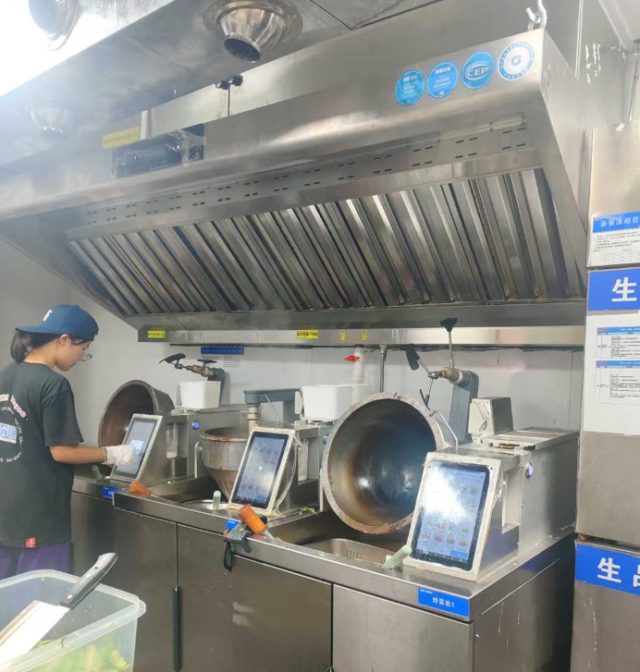
India may be the most layered ventilation market in Asia. A restaurant opening in Pune or west Delhi answers to a fire authority reading the National Building Code, a food safety officer reading FSSAI’s licensing regulations, a state pollution control board issuing consent conditions on its chimney, a municipal trade-licensing department, and in the capital, a pollution committee that has now taken direct aim at the tandoor itself. Each body looks at the same cookline and asks a different question. Getting an exhaust system approved in India therefore means learning to answer all of them at once, without letting one requirement quietly defeat another.
Four Regulators, One Exhaust Route
The first layer is building and fire. The National Building Code of India 2016 (SP 7:2016) is a model code adopted by states and local bodies; Part 4 covers fire and life safety and, following a series of kitchen fire incidents, was strengthened with informative provisions specifically for commercial kitchens, covering hood construction, duct protection, detection and fixed suppression in the hood plenum. Part 8 covers building services, with recommended ventilation rates and contaminant limits, and mechanical ventilation provisions that apply to kitchens as much as to industry. A Fire NOC, and for larger buildings an occupancy certificate, depends on the design being traceable to these provisions.
The second layer is food safety. The Food Safety and Standards Authority of India licenses establishments under the Food Safety and Standards (Licensing and Registration of Food Businesses) Regulations, 2011, and Schedule 4 of those regulations sets out hygiene and sanitary practice requirements that include explicit ventilation duties. The wording is direct: there must be no smoke nuisance in the food preparation area, and wherever cooking or frying takes place, a chimney of appropriate suction capacity for the size of the kitchen must be installed before business starts. Ventilation must be designed so that air does not flow from contaminated zones into clean zones, and the whole system must be maintained so that condensation, dirt and grease do not accumulate. The licensing tier depends on turnover, basic registration up to twelve lakh rupees, a state licence between twelve lakh and twenty crore, and a central licence above that, but the ventilation duty applies at every tier.
The third layer is environmental. Section 21 of the Air (Prevention and Control of Pollution) Act, 1981 requires the consent of the State Pollution Control Board to operate, and that consent carries conditions on control equipment and on chimney or stack characteristics. Boards classify food and hospitality units by pollution category, and the consent conditions are where stack height, discharge location and, increasingly, odour complaints become enforceable rather than advisory.
The fourth layer is municipal: trade licence, zoning (commercial or notified mixed-use, with change-of-land-use documentation where the premises were residential), and in many cities a eating-house police licence. A restaurant in the wrong zone can be sealed regardless of how well its kitchen is engineered, which is why the ventilation design should be fixed only after the premises use is confirmed.
Delhi’s Clean-Fuel Order and What It Changes
The most consequential recent shift came from the Delhi Pollution Control Committee. In December 2025 the DPCC directed a complete ban on coal and firewood in tandoors at hotels, restaurants, dhabas and open eateries across the capital, issued under Section 31(A) of the Air Act and tied to Stage-I of the Graded Response Action Plan, the CAQM approved fuel list of June 2022 and the revised GRAP order of November 2023. Only electric, gas or other approved clean-fuel appliances are permitted, enforcement sits with the Municipal Corporation of Delhi’s commissioners and chief engineers, and violations attract fines and closure notices.
This is a ventilation story, not only a fuel story. A coal or wood tandoor dumps its particulate load up the chimney; an electric or LPG tandoor removes the solid-fuel smoke at source but leaves the kitchen with the same, or higher, burden of grease vapour, volatile organics and spice-laden odour inside the room. Operators who switched fuel and assumed the air problem was solved discover the opposite: with the visible smoke gone, the exhaust system now has to carry a hotter, greasier, more odorous airstream, and the neighbours’ complaints arrive through the same window as before. Clean fuel shifts the duty from dispersion to capture and treatment.
The Fire Side Deserves Its Own Design Conversation
Indian restaurant fires follow an international pattern: the ignition is at the appliance, the propagation is in the duct. A grease-laden duct is a horizontal chimney full of fuel, and once a flame front enters it, the fire travels to the roof or the shaft before the kitchen staff know it has started. The NBC provisions address this through hood and duct construction requirements, protection of duct penetrations, and suppression arranged for the appliance and the plenum. What the code cannot do is clean the duct, and Indian enforcement increasingly pairs the fire NOC with maintenance evidence, cleaning records and, in newer buildings, insurer requirements.
The practical rules that Indian projects converge on are consistent with international practice: grease ducts of welded or flanged steel with access doors at every change of direction, a duct velocity high enough to keep grease entrained (around eight to ten metres per second in the grease duct), slope toward a drain or collection point where geometry allows, clearance from combustibles, and no shared shaft with other tenants. Fans should sit outside the grease duct run, or be rated for the grease load, and every penetration through a fire-rated element needs a fire damper or an equivalent tested arrangement. For a tandoor or a charcoal sigri line, the appliance itself is a high-temperature source, so the canopy must be arranged so that flue gases enter the hood rather than spill around it, and the hood must be built of materials that tolerate that heat.
Sizing for Indian Cooking Loads
Indian menus load an exhaust system harder than most. Deep frying at a chaat counter, tadka at 200 degrees Celsius, spice tempering that produces fine oily aerosol, and continuous tandoor work combine a high particulate load with strong odour. Design airflow is set per cooking appliance, not per room: roughly 2,000 cubic metres per hour for each metre of hood face above light-duty equipment such as steamers and boiling ranges, about 2,500 for open display cooking, and around 4,000 per open burner for high-intensity work. Capture velocity at the hood face should sit near 0.25 to 0.5 metres per second depending on the disturbance level, with a hood overhang of 150 to 300 millimetres beyond the appliance footprint and a side skirt where cross-draughts are strong.
For grease filtration, baffle filters are the default in Indian commercial kitchens because they tolerate heavy loading and are washable; mesh filters clog within days on a frying line. Filter cleaning frequency, not filter type, is where most kitchens fail: a baffle bank that is cleaned weekly in a light kitchen needs cleaning every two to three days in a biryani or fried-snack operation, and the pressure drop tells you when. Duct cleaning follows the same logic as the FSSAI maintenance duty, with quarterly professional cleaning as the working baseline for heavy frying and six-monthly for lighter kitchens, always documented, because the record is what an inspector or an insurer will ask for.
Where Ductless Makes Sense in India
India produces a specific set of constraints that push projects toward recirculating purification rather than a duct to the terrace. Society and landlord permissions for facade or roof penetrations are frequently refused in residential buildings converted to commercial use. Mall food courts often have no dedicated grease riser for a small tenant. Heritage and cantonment areas restrict external alterations. Basement food courts and cloud kitchen clusters may have a common shaft that is already at capacity. In each case the compliant answer is not a smaller duct, it is a system that treats the air and returns it to the room.
A ductless range hood combines capture, multi-stage electrostatic precipitation for the grease and fine particulate phase, and a carbon or catalytic stage for odour, discharging cleaned air back into the kitchen. The load matters: a café with a sandwich grill and a coffee machine is a light-duty case, a cloud kitchen running biryani and fried snacks is medium, and a tandoor plus fryer combination is heavy and needs a larger cell area, more carbon mass and, usually, a dedicated odour treatment tower rather than an integrated cartridge. For rooms with very low ceilings, a floor-standing cabinet purifier split from a shallow canopy keeps the treatment unit out of the headroom. Where the cooking moves, festival stalls, food trucks, market counters, ventless mobile carts carry the same capture-and-treat logic to sites with no building services at all. Where the building can take a riser and the load is heavy, a ducted electrostatic precipitator with a matched centrifugal fan remains the right answer, and the ducted purifier range covers that duty. Souniny has manufactured CE-certified kitchen purification equipment since 2015 and supplies both ductless purification systems and ducted lines for projects of this kind.
Odour, Neighbours and the Complaint File
Indian enforcement is complaint-driven as much as inspection-driven. A restaurant that vents at first-floor level into a lane of houses will generate complaints, and once a complaint is logged with the municipal body or the pollution board, the operator carries the burden of proving that control equipment exists and works. Two design decisions prevent most of this. First, terminate the discharge above the roof line and away from habitable windows, with an upward discharge velocity sufficient to give the plume some lift. Second, treat odour, not just grease: electrostatic precipitation removes the aerosol that carries much of the smell, but spice and char volatiles need a gas-phase stage, and the carbon must be sized for the actual cooking hours rather than for a nominal airflow.
Noise is the other half of the complaint. The Noise Pollution (Regulation and Control) Rules, 2000 set ambient limits of 55 dB(A) by day and 45 dB(A) at night in residential areas, 65 and 55 in commercial areas, and stricter limits in silence zones around hospitals and schools. A centrifugal fan selected only on airflow will breach those limits at the boundary of a mixed-use lane; selecting on sound power, using a lower-speed fan with a larger impeller, and mounting it on isolators with a flexible connection is cheaper than a notice.
Retrofit Realities in Indian Buildings
Most Indian restaurant projects are conversions, not new builds, and the exhaust system inherits the building’s compromises. A shop in a residential block may have a beam depth that leaves barely two metres of clearance, forcing a shallow canopy with a side take-off rather than a top collar. An upper-floor restaurant in a lane may have no route to the terrace without crossing a neighbour’s facade, so discharge has to be pushed vertically along the party wall with an engineered, insulated riser and a written consent from the owner, or replaced by treatment inside the room. Older buildings frequently have a shared toilet or drainage shaft that looks like a duct route and is not: sharing it is a fire-spread violation and, in practice, an odour transfer between tenants that ends in a complaint. Chains rolling out to existing premises should survey three things before quoting equipment: available headroom under the beam, the legality of the discharge point with the society or landlord, and the electrical capacity for the fan, because a heavy-duty line added to a kitchen with a small sanctioned load will trip the main switchboard long before the hood does its job.
What Goes in the Approval File
An Indian restaurant project that reaches opening without disputes usually carries a single consolidated ventilation file: the layout with hood, duct route, access doors and discharge point; airflow calculations per appliance and the fan duty at design static pressure; the fire design showing duct construction, penetration protection and suppression coverage consistent with NBC Part 4; the FSSAI Schedule 4 response, meaning chimney suction capacity justification and the ventilation maintenance schedule; the pollution board consent application with stack details and control equipment specification; the noise assessment at the nearest receptor; and the cleaning and filter-change log template that will be filled in from day one. When a cloud kitchen or a franchise chain rolls out across states, that file becomes a template, with the state-specific chapters, consent conditions and local fuel rules, swapped in.
India rewards operators who treat ventilation as a licensing artefact rather than a purchase order. Assemble the four approvals around one coherent exhaust design, size it for the way Indian kitchens actually cook, and the equipment stops being a compliance cost and starts being the reason the neighbours, the fire officer and the food inspector all sign off without a second visit.