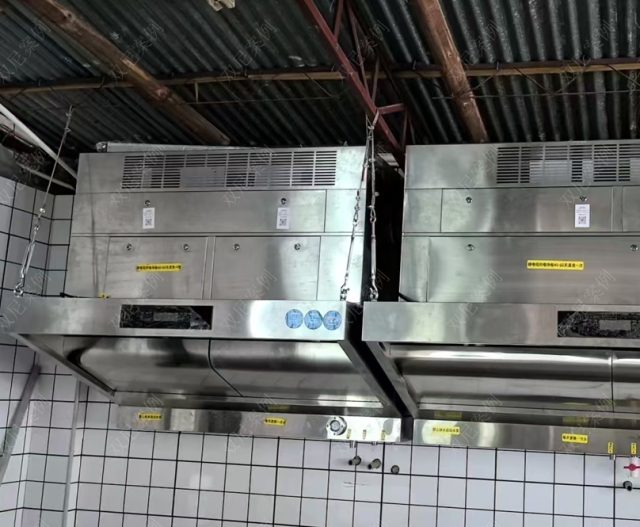
Mexico’s commercial kitchens are among the most demanding in the Americas. Al pastor trompos render fat against a vertical flame for hours, comal griddles work continuously through breakfast and dinner, birria pots and carnitas cauldrons produce dense steam and grease, and taquerías, cocinas económicas, hotel banquets and dark kitchens push exhaust through buildings that were often designed for something else. Add Mexico City’s 2,240-metre altitude—where air is roughly 20 % less dense—and a ventilation system that looks correct on a sea-level catalogue can fail on its first day of service. This article explains the Mexican regulatory stack that governs commercial kitchen exhaust, how altitude changes the engineering, and how capture, fire safety, sanitation, and odor control fit together.
1. What Mexican Kitchens Actually Emit
Mexican cooking is not a single exhaust profile. A taquería working a trompo and a comal produces continuous fine grease aerosol, carbon particles from the vertical gas flame, and strongly odorous aldehydes and phenolics from fat pyrolysis. A birria or barbacoa operation adds large volumes of steam, rendered fat, and smoke from long, slow cooking. A churrería or fried-fish stand produces a heavy but relatively uniform fryer load. A hotel banquet kitchen combines all of the above with high simultaneous occupancy.
The exhaust stream has two phases, and each behaves differently. The particulate phase ranges from large grease droplets that baffle filters can intercept, through 2.5–10 µm droplets that require finer separation, down to sub-micron carbon and condensed grease that pass through ordinary mesh. The gas phase contains nitrogen oxides from gas combustion, water vapor that condenses in ducts, and odor-active volatile organic compounds. A hood that only handles coarse grease will coat the duct with the fine fraction and release the odor fraction into the neighborhood.
Mexico’s climate and urban form make the problem harder. In coastal cities such as Veracruz and Acapulco, high humidity accelerates condensation and corrosion inside ductwork. In Mexico City, Guadalajara, and Monterrey, dense colonias put discharge points close to windows, balconies, and air intakes. In many buildings, there is no viable path to a rooftop discharge at all, which is why ductless and recirculating systems are increasingly common in ground-floor restaurants, food courts, and converted retail spaces.
2. The Mexican Regulatory Stack
Mexico does not have a single “kitchen ventilation code.” Compliance is assembled from four families of rules: food-safety standards, labor fire-safety standards, environmental standards, and local building and civil-protection codes. Each is enforced by a different authority, and each can stop a project independently.
2.1 NOM-251-SSA1-2009 — Food Hygiene
NOM-251-SSA1-2009, Prácticas de higiene para el proceso de alimentos, bebidas o suplementos alimenticios, is the federal food-hygiene standard enforced by COFEPRIS and state health authorities. It requires food establishments to maintain sanitary facilities, control pests, manage waste, and protect food from contamination. Ventilation enters the standard through its requirements for cleanable surfaces, avoidance of condensation drip onto food, and maintenance of hygienic air conditions in preparation areas.
In practice, an inspector will look at whether hood surfaces are cleanable and corrosion-resistant, whether filters are maintained, whether grease is dripping onto food-contact surfaces, and whether the kitchen has adequate air exchange. Stainless-steel construction, smooth welds, and removable filters make compliance easier. A greasy, dripping hood is both a fire risk and a sanitary finding.
2.2 NOM-002-STPS-2010 — Fire Prevention in Workplaces
NOM-002-STPS-2010 is the federal labor standard for fire prevention and protection, issued by the Secretaría del Trabajo y Previsión Social (STPS). It applies to any workplace with fire risk, regardless of size or sector, and it is enforced during STPS inspections. The standard requires employers to identify fire hazards, classify fire risk, control ignition sources and flammable materials, maintain firefighting equipment, establish evacuation routes, train brigades, and document drills.
Commercial kitchens fall squarely within its scope. Grease-laden ducts, open flames, hot surfaces, and gas appliances are obvious fire hazards. STPS inspectors expect documented risk assessment, functioning fire suppression, clear access to extinguishers and shut-offs, and evidence that cleaning and maintenance are happening. A kitchen that cannot produce these records is exposed to fines and, after a serious incident, to broader liability.
2.3 NOM-085-SEMARNAT-2011 and NOM-043-SEMARNAT-1993 — Air Emissions
At the federal environmental level, NOM-085-SEMARNAT-2011 sets emission limits for indirect-heating combustion equipment with a nominal thermal capacity of 530 MJ/h or more—roughly 15 boiler horsepower. It covers smoke, particulate matter, carbon monoxide, sulfur dioxide, and nitrogen oxides, with stricter limits in critical zones such as the Valley of Mexico, Guadalajara, Monterrey, Tijuana, and several industrial corridors. NOM-043-SEMARNAT-1993 sets a general limit on solid particulate emissions from stationary sources.
Most restaurant hoods are not “combustion equipment” in the regulatory sense, but larger kitchens with boilers, steam generators, or industrial ovens can fall within NOM-085. More importantly, the LGEEPA—Mexico’s General Law for Ecological Equilibrium and Environmental Protection—gives SEMARNAT and state authorities the power to require emission controls or tighter limits case by case. A restaurant whose exhaust creates visible smoke or odor nuisance near sensitive receptors can be drawn into that framework even without a specific kitchen NOM.
2.4 Local Building Codes and Civil Protection
Building codes and civil-protection rules vary by state and municipality. The Reglamento de Construcciones for Mexico City and equivalent reglamentos in Guadalajara, Monterrey, and other cities set requirements for duct construction, fire-rated penetrations, clearance to combustibles, and mechanical exhaust. Municipal Protección Civil offices and local fire departments inspect commercial kitchens and can require automatic grease-fire suppression, hood cleaning access, and emergency shut-offs.
This is where most compliance failures occur. A hood may be technically adequate but installed without the clearance the local code requires, or a duct may penetrate a fire-rated wall without an approved damper or wrap. Because enforcement is local, the authority having jurisdiction—not a national checklist—determines whether the installation passes.
3. Altitude: The Variable Most Suppliers Ignore
Mexico City sits at roughly 2,240 metres above sea level. At that altitude, atmospheric pressure is about 20 % lower and air density is correspondingly lower. A fan rated for a given volumetric flow at sea level moves the same volume at altitude only if its static pressure is sufficient; more often, the actual mass flow and capture performance drop. A hood sized from a sea-level catalogue can let smoke roll off the cookline even though the fan is running “at rating.”
The engineering consequence is that extract rates and fan selection must be corrected for altitude. Capture depends on mass flow, not just volume, so the designer must convert the required mass flow at site conditions back to a volumetric rating and select a fan that can deliver it at the actual static pressure. Make-up air must also be corrected, because every cubic metre extracted has to be replaced by tempered air, and oversizing “to be safe” wastes energy all day.
Altitude also affects gas combustion. Burners rated for sea level may produce different heat output and NOx characteristics at altitude, which changes the thermal plume and the exhaust load. Kitchen designers in Mexico City, Toluca, Puebla, and other highland cities should treat altitude correction as a first-order requirement, not a margin.
4. Capture, Ductwork, and Fire Safety in Practice
A compliant Mexican kitchen exhaust system starts with capture. The hood must overhang the cooking surface on all open sides, be low enough to intercept the thermal plume before it spreads, and be high enough for staff and appliance access. Wall canopies, island hoods, backshelf hoods, and proximity hoods have different capture characteristics, and the choice should follow the appliance schedule rather than a generic rule.
Ductwork must be smooth, sealed, cleanable, and routed with as few bends as possible. Grease ducts should slope toward a drain or access point, include inspection openings, and be constructed of materials that resist grease and corrosion. Ducts must not pass through unrelated spaces or share chase space with other building services. Fire-rated penetrations require approved dampers, wraps, or enclosures, and the local fire authority may require automatic fan shutdown and fuel shut-off on alarm.
Grease filters are the first line of defense, but they are not a treatment system. Baffle filters intercept large droplets and provide flame protection; they do not capture sub-micron grease or odor. That is why Mexican kitchens with heavy loads increasingly add a second stage—electrostatic precipitation or a comparable fine-particle separator—before the duct, followed by a gas-phase stage where odor is a problem.
5. Sanitation and Food-Safety Details That Inspectors Check
NOM-251 compliance is often decided by small details. Hood and duct surfaces should be stainless steel or another cleanable, non-absorbent material. Filters should be removable without tools and should drain away from food. Condensation should not drip onto preparation surfaces. Pest entry points around duct penetrations should be sealed. Cleaning records should be available and should match the actual condition of the hood.
Ventilation also affects temperature and humidity in the kitchen. A hood that is undersized for the cooking load will leave heat and moisture in the room, which can promote condensation, mold, and pest activity—all findings under NOM-251. In that sense, adequate exhaust is a food-safety control, not just a comfort measure.
6. Environmental and Odor Compliance
Mexico has no dedicated national odor law, but odor is regulated indirectly. LGEEPA defines pollution broadly, and SEMARNAT or state environmental agencies can act on complaints, require emission controls, or impose conditions in an environmental license. NOM-085 caps VOC emissions from certain combustion and industrial sources, and state and municipal rules can be stricter.
For restaurants, the practical risk is a neighbor complaint. In dense Mexico City colonias, Guadalajara neighborhoods, and Monterrey commercial corridors, exhaust discharged at low level or near residential windows can generate complaints quickly. Municipal environmental authorities may respond with inspections, warnings, fines, or operating restrictions. The defense is to treat odor before discharge: a grease and particulate stage followed by an activated-carbon or equivalent gas-phase stage, with the discharge point located away from windows, balconies, and air intakes.
Dark kitchens and delivery-only concepts add a new dimension. Mexico City, Guadalajara, and Monterrey have seen rapid growth in multi-brand kitchens operating from converted warehouses and retail units. These facilities concentrate many fryers, grills, and hoods in one building, often in mixed-use zones. Municipal zoning and civil-protection reviews are increasingly focused on cumulative exhaust, odor, noise, and fire risk, and operators should expect scrutiny of the combined load rather than each tenant in isolation.
7. Sizing Heuristics for Mexican Kitchens
The following starting points are widely used by Mexican HVAC designers; final sizing should be confirmed by a project-specific calculation that corrects for altitude and local code.
Taquería with trompo and comal: A 3 m cookline typically needs 6,000–8,000 m³/h, with deep hood overhang and a treatment train that handles fine grease and carbon. At Mexico City altitude, the fan must be selected for the corrected mass flow, not the sea-level catalogue rating.
Birria or carnitas kitchen: Long, slow cooking with large pots produces heavy steam and grease. Allow 7,000–10,000 m³/h for a 3–4 m line, with stainless duct, condensate drainage, and frequent filter cleaning.
Hotel or banquet kitchen: Multiple cooking blocks operating simultaneously require a combined load calculation. A 10 m line with fryers, ranges, ovens, and grills can exceed 20,000 m³/h. Demand-controlled ventilation is worth considering to reduce off-peak energy use.
Small café or bakery: Light-to-moderate loads generally need 2,000–3,500 m³/h per metre of hood, with emphasis on moisture and flour-dust control rather than heavy grease capture.
Food truck or market stall: A single fryer or grill usually needs 1,000–2,000 m³/h. Compact ventless equipment is often the only practical option where no duct is available.
8. Choosing the Right Architecture
Where a safe rooftop discharge is available and the cooking load is high—hotel kitchens, large taquerías, birria operations, central kitchens—a ducted system with electrostatic purification and a centrifugal fan is the conventional choice. The electrostatic stage removes fine grease and carbon; a carbon stage handles odor; the duct carries the cleaned stream to a discharge point above roof level and away from intakes.
Where ducting is impossible—ground-floor restaurants in dense colonias, food courts, converted retail spaces, historic buildings, food trucks, and market stalls—a ductless range hood is often the only viable path. The hood captures the plume, the electrostatic cell removes particulate, and an activated-carbon or dedicated odor stage treats the gas phase before the air returns to the kitchen or exits at low level. A ductless unit still needs to satisfy capture, airflow, maintenance access, and negative-pressure requirements, but it avoids the structural and zoning barriers of a full rooftop duct.
For mobile and temporary operations, ventless catering carts provide a self-contained capture-and-treatment platform that can be moved with the business. They suit festivals, street markets, event catering, and temporary kitchens where permanent installation is not possible.
Souniny supplies both ductless and ducted kitchen exhaust purification systems for the Mexican market, with CE-certified equipment and a 12-month whole-unit warranty. The ductless range hood family covers light, moderate, and severe cooking loads, while the ducted ESP purifier range serves high-volume taquerías, birria kitchens, and hotel banquets. For operators whose ceiling height or structural limits rule out an integrated hood, a split cabinet purifier can stand on the floor behind or beside the cookline, connecting to a shallow canopy by a short duct and providing the same electrostatic and carbon stages without vertical equipment above the hood.
Matching the unit to the load follows the same logic used elsewhere on the site: high-volume frying, charcoal, and comal work call for the heavy-duty capture and odor stages typified by the ND-series; light-to-moderate café, bakery, and sandwich lines are better served by the N-series; and where odor is the dominant complaint, an Odor Removal Tower carbon stage is added downstream of either unit.
9. Documentation and Maintenance That Survive an Inspection
Mexican compliance is increasingly documentation-driven. An STPS, COFEPRIS, Protección Civil, or municipal inspection may ask for a ventilation project signed by a qualified professional, proof that hood and duct sizes match the cooking load, maintenance logs for filters and treatment stages, grease-thickness records or cleaning invoices, fire-suppression test records, and—where applicable—an environmental license or emissions inventory.
Maintenance intervals depend on load. Light-duty cafés may clean filters weekly and inspect ducts annually. Taquerías, birria kitchens, and hotel banquets often need filter cleaning every few days and professional duct cleaning two to four times per year. Charcoal and wood-fired operations may need weekly inspection of carbon buildup and monthly deep cleaning. Electrostatic cells should be washed on the manufacturer’s schedule—typically every few weeks in heavy-use kitchens—and ceramic insulators and sealing strips should be inspected for wear.
Keeping these records in one folder turns a potential shutdown into a manageable conversation. It also protects the operator if a fire or complaint occurs, because it demonstrates that the system was designed, installed, and maintained to the applicable standard.