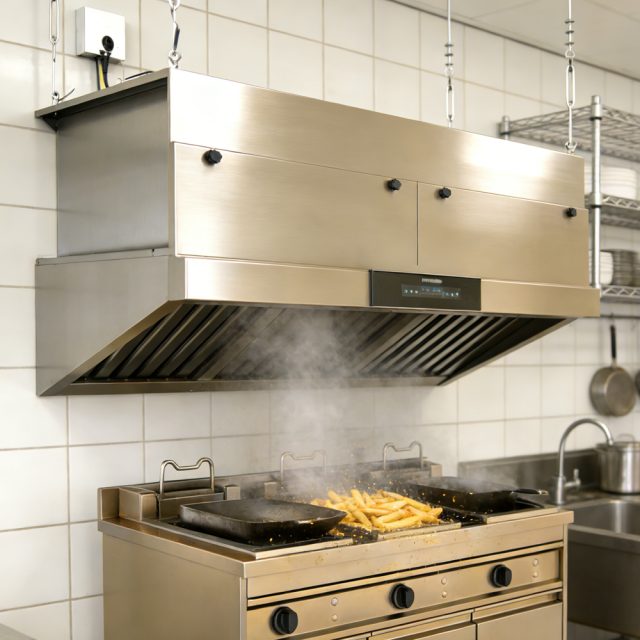
South Africa sits between two regulatory worlds: a national building-standards system that is unusually specific about how a commercial kitchen extraction system must be built and cleaned, and a municipal air-quality regime that turns cooking odour into a legal nuisance the moment a neighbour complains. For restaurant owners, franchise operators and kitchen consultants working in Johannesburg, Cape Town, Durban or the smaller metros, the compliance picture is more concrete than most expect — and it hinges on one SANS standard most people have never read: SANS 1850.
Three Layers of Law, One Extraction System
A commercial kitchen in South Africa answers to three overlapping regimes at once. The first is the National Building Regulations and Building Standards Act, applied through the SANS 10400 series: Part O covers lighting and ventilation, and Part T covers fire protection. Local authority building control officers review plans against these parts before an occupancy certificate is issued — a kitchen planned without a compliant extraction route can hold up the certificate for the entire building.
The second layer is the National Environmental Management: Air Quality Act, 2004 (Act No. 39 of 2004), usually abbreviated to NEM:AQA or the Air Quality Act. It is administered nationally by the Department of Forestry, Fisheries and the Environment, but real enforcement power is devolved to metropolitan municipalities through their own air-quality by-laws. The Act’s odour test is deliberately practical: any emission considered malodorous or a nuisance to a reasonable person qualifies, and property occupiers carry an explicit duty to take reasonable steps to prevent offensive odours escaping their premises.
The third layer is workplace law. The Occupational Health and Safety Act places the duty to provide a safe working environment on the employer — a duty that does not transfer to a cleaning contractor or landlord. Municipal environmental health practitioners (EHPs) inspect food premises for hygiene compliance, and extraction systems that harbour grease and bacteria are a recognised inspection finding. A failed EHP inspection can stop trade.
SANS 1850: The Standard With Hard Numbers
SANS 1850 — The design and manufacture of commercial kitchen extraction systems — is the document that separates a real kitchen extraction design from a fan bolted to a canopy. It is the reference the fire consultant quotes, the cleaning contractor certifies against, and increasingly the document insurers ask about. Its key requirements for ducted systems include:
- Dedicated ducts only. Each kitchen gets its own extraction system, taken to the closest outside wall or roof, never connected to toilet, parking or general building ventilation.
- No fire-resisting penetration. Ducts must stay within the kitchen compartment and lead directly to the exterior; they may not penetrate any fire-resisting occupancy or division separating element.
- Velocity window 5–9 m/s. Duct air velocity must sit between 5 and 9 metres per second — fast enough to keep grease airborne, slow enough not to overload the fan.
- Access for cleaning. Ducting of at least 400 mm × 450 mm allows personnel entry; access panels are installed at maximum 3 m centres, at every change of direction and at the top and bottom of risers. Smaller ducts need inspection hatches at maximum 2 m centres.
- No spiral ducting on any part of the extraction system — joints must be folded flanged sheet metal, grease-tight, with gaskets that tolerate elevated temperatures.
- 500 mm clearance from ducts to combustible construction, reducible only with authority-approved fire barriers.
- No fire dampers in the canopy. Grease-laden airflow is meant to leave continuously, not be interrupted inside the capture zone.
- Risers that behave. Vertical risers must not create a nuisance at discharge, or must extend at least 300 mm above the rooftop.
Fans get attention too: backward-curved centrifugal, mixed-flow or axial impellers are preferred, because their open construction resists unbalance and is easier to clean — a direct acknowledgement that in a grease system, maintainability is a safety property, not a comfort.
The Braai Clause: Solid Fuel Is Treated Seriously
SANS 1850 dedicates a section to solid-fuel ovens — in the South African context, that means wood-fired pizza ovens and, above all, braai-based cooking lines, which are a genuine restaurant category from Pretoria to the Garden Route. The requirements are strict: a dedicated extraction and ventilation system, a spark arrester where airborne embers are possible, a cleaning regime that scrapes the combustion chamber back to bare metal, and ducting manufactured from mild steel, fully welded, on its own duct run. A braai house that shares ducting with a neighbouring tenancy fails this section on day one.
Six-Monthly Cleaning — and the Certificate That Insurers Ask For
SANS 1850 requires the kitchen canopy extraction system — canopy interior, filters, ductwork and fan — to be deep-cleaned every six months, with a compliance certificate issued on completion. Specialist cleaning contractors across South Africa work to this cycle, and the certificate has become a de facto financial document: after a kitchen fire, most insurers require a copy of the cleaning certificate before settling a claim. No certificate, contested claim.
The six-month rule is a floor, not a recommendation. Heavy-duty kitchens running charcoal grills, wok lines and pressure fryers deposit combustible grease inside ducts in weeks, and pragmatic operators on those profiles clean more often. It is worth noting what happens when a system is under-provisioned: grease that should stay airborne in the 5–9 m/s duct stream condenses instead, leaks through joints, stains ceilings, and feeds the bacteria cycle that EHP inspectors look for. Filtration at the canopy is the first line of defence — baffle filters removed and immersion-degreased, never wiped in place — but filtration and cleaning together only work when the system was engineered correctly in the first place.
Practical rule for South African operators: file every cleaning certificate for the life of the tenancy. EHP inspections, fire-safety audits and insurance claims all end at the same filing cabinet.
Odour Law: The Reasonable-Person Test and the By-Law Machine
Nuisance odour is where South African enforcement actually bites most restaurants. The Air Quality Act lists odorous substances among air pollutants, and the metros have built enforcement machinery on top of it:
- Cape Town — the Air Quality Management By-law (2016, amended 2021) prohibits emissions that cause a nuisance and empowers air-pollution control zones.
- Johannesburg — the Air Pollution Control By-law (2021) follows a notice ladder: a pre-notice giving ten days to submit representations, then a final written notice, and if the occupier still fails to act, the Council may remedy the situation itself and recover the costs from the offender.
- eThekwini (Durban) — the Air Quality Management By-law (2020) expressly includes odorous substances in its definition of air pollutants.
The practical consequence: a braai or fryer whose exhaust discharges across a residential boundary in a dense suburb like Melville or Observatory is not a design taste question — it is a statutory nuisance with a cost-recovery tail. Extraction location, discharge height and odour treatment all move from “nice to have” to “legal exposure”.
Sizing the System South African Kitchens Actually Need
Standards are silent on airflow figures per metre of cookline, so engineering practice fills the gap with accepted heuristics: roughly 2,000 m³/h per metre of hood for conventional cooking, 2,500 m³/h per metre for open display cooklines, and about 4,000 m³/h per burner for heavy solid-fuel or charcoal work. A two-metre hood over a two-burner charcoal line lands near 8,000 m³/h — real volumes that make fan selection and duct sizing non-trivial, and that explain why under-velocitised spiral-duct improvisations are a fire risk rather than a shortcut.
Energy realities sharpen the sizing decision. With electricity costs climbing and load-shedding still shaping operating hours, fan power matters: oversized constant-speed extraction burns money every service, while a system sized to the actual cookline — matched capture, correct velocity window, cleanable impellers — holds compliance at the lowest credible running cost.
Where Ducting Is Impossible: The Ventless Route
A large share of South African food service does not occupy a purpose-built shell. Shopping-centre kiosks, CBD ground-floor tenancies where the landlord will not approve roof penetrations, food-truck pitches, hotel live-cooking stations and front-of-house braai counters all share one constraint: no realistic duct route, and a by-law environment that punishes a badly placed discharge. For those sites the engineering answer is capture-and-treat at source: a ductless range hood that pulls grease-laden vapour through a multi-stage electrostatic ESP cell and a carbon odour stage, then returns the air to the kitchen. Properly sized to the cookline, this route removes the discharge point — and with it the by-law nuisance exposure — entirely.
This is the design logic behind Souniny’s ductless range hood family: the same pollutant sequence the standards worry about — particulate grease first, gaseous odour second — treated in the same order, without a duct. Where a site can carry ductwork, especially at high volumes, the ducted path remains the default, and the ducted ESP purifier range covers that high-volume end within the SANS 1850 velocity and access requirements.
A Compliance File That Survives Inspection
South African operators who pass EHP visits, fire inspections and insurance reviews tend to hold the same folder: approved building plans showing the extraction route; the SANS 1850-aligned design sheet (velocity, duct dimensions, access-panel schedule); six-monthly cleaning certificates with photographic evidence; the fan and impeller maintenance record; discharge-position documentation showing compliance with the municipal by-law; and the odour-treatment specification if a carbon or electrostatic stage is installed. For tenant operators, adding the landlord’s written approval of the extraction route closes the last common dispute before it starts.
For mobile operators — food trucks, market pitches, event catering — compliance moves with the vehicle, which is why ventless catering cart systems designed around self-contained purification are increasingly the practical choice for South African street-food and events work.
The Engineering Conclusion
South Africa’s framework rewards operators who treat extraction as engineered infrastructure: a dedicated, access-panelled, correctly velocitised duct system — or, where ducting is genuinely impossible, a source-treatment hood with electrostatic and carbon stages. The six-monthly SANS 1850 clean, the reasonable-person odour test and the notice ladder in the metro by-laws are all mechanisms that convert neglected air into measurable cost. Design to the pollutant sequence — capture grease particulate, then treat odour — and the certificates, inspections and insurer conversations become paperwork rather than crises. For kitchens matching light-to-medium fume loads to a self-contained unit, the N-series and ND-series ductless units paired with an Odor Removal Tower map directly onto that pollutant sequence; heavy ducted volumes map onto the ESP purifier and centrifugal fan path. Either way, the sizing math comes first.
Fire Safety: Where Part T Meets the Grease Duct
SANS 10400 Part T (fire protection) is what turns extraction design into a fire-engineering conversation. A grease duct passing through a building carries the same logic as any service penetration: where it must cross a fire-resisting element, the penetration has to be sealed to the equivalent fire rating, and the local fire authority can impose additional conditions during plan approval. For high-rise and mixed-use buildings — an increasingly common site for restaurant tenancies in Cape Town’s CBD and Sandton office conversions — the fire engineer signs off the duct route before the kitchen designer finalises anything else. The reason is arithmetic: grease deposits are combustible insulation inside a duct, and a duct fire travels along the run faster than the kitchen burns.
The SANS 1850 restrictions that surprise newcomers all trace back to this physics. The prohibition on spiral ducting exists because spirally wound seams trap grease and resist cleaning. The velocity floor of 5 m/s exists because slower air lets particles drop out and pool at joints. The dedicated-duct rule exists because a shared duct gives a fire a corridor into another tenant’s space. Nothing in the standard is bureaucratic decoration; each clause is a fire that already happened somewhere.
Airflow, Power Cuts and the Maintenance Loop
Two operating realities shape maintenance practice in South African kitchens more than in most markets. The first is load-shedding: when extraction stops mid-service, cooking usually continues on gas, and grease-laden vapour that would normally leave the building instead pools at ceiling level and condenses on canopy surfaces and filter banks. A kitchen that survives frequent outages cleans its filters more often than the calendar suggests, and operators increasingly install capture efficiency headroom — larger canopies relative to cookline — precisely to absorb those intervals.
The second is dust and pollen load in Gauteng, which loads pre-filters alongside grease and accelerates the pressure-drop cycle. A baffle filter or ESP cell that measures clean on Monday and blocked by Friday is not a defect; it is the regional airborne load doing its job upstream of the collector. Building the cleaning loop around measured pressure or visual inspection — rather than fixed dates alone — keeps airflow at design volume between the mandatory six-monthly deep cleans, and keeps the 5–9 m/s duct velocity window intact, which is the number the whole system’s fire safety depends on.