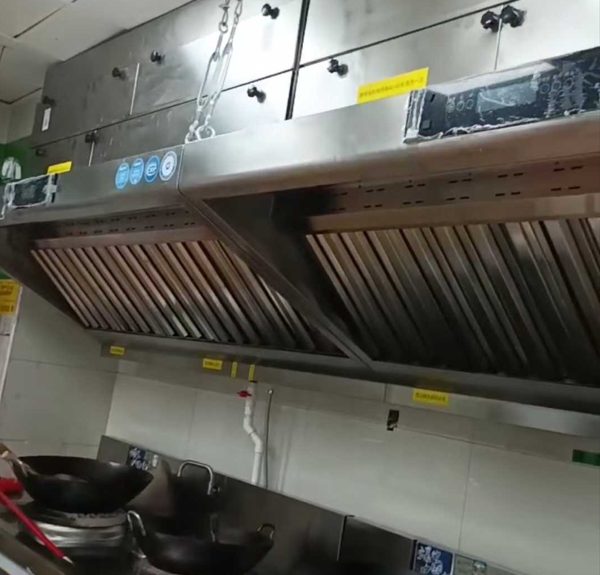
Switzerland commercial kitchen ventilation explained: the VKF fire protection regulations and annual exhaust inspections, labour-law duties under ArGV 3 and SUVA, cantonal food inspectorate licensing, neighbour odour and noise disputes under Civil Code Article 684 and the Noise Abatement Ordinance, and sizing for rösti-and-frying cooklines, alpine hotel kitchens and heritage old-town restaurants.
1. The Swiss Cooking Emissions Profile
Swiss professional kitchens run a distinctive duty mix. The everyday workhorse is the frying line: rösti, schnitzel, and potato dishes keep griddles and deep fryers under continuous medium-to-heavy load, while raclette and cheese dishes add a high-humidity, high-odour steam component that clings stubbornly to textiles and furnishings. Alpine hotel and mountain-resort kitchens layer full banquet and half-board production on top, with the characteristic Swiss twist of extreme seasonality – a ski resort kitchen idles through late autumn, then runs twelve to sixteen hours a day from December to Easter. At the other end of the market, old-town restaurants in Zurich, Bern, Lucerne, and Geneva operate on the ground floors of centuries-old buildings, many of them listed, where a new duct penetration through the facade or roofscape is a planning negotiation, not a construction detail.
The emission stream is the familiar trio – grease aerosol, sub-micron particulate, and odour-bearing volatile compounds – but the Swiss regulatory and social context makes the odour phase unusually binding. Switzerland is dense, affluent, and litigious about neighbourhood quality: a restaurant whose exhaust drifts into the apartments above is not facing a vague complaint but a codified civil claim. That context shapes everything that follows.
2. The Four Regulatory Pillars
2.1 VKF Fire Regulations – The National Backbone
Swiss fire safety is organised differently from most European countries: the authoritative technical rulebook comes not from a ministry but from the VKF – the Association of Cantonal Fire Insurers – whose regulations apply in all cantons, administered locally by cantonal building insurance and fire protection authorities. The VKF framework defines structural, technical, and organisational measures, with an increasingly risk-based approach tailored to each building and activity. For food service, the kitchen exhaust system is a named inspection object: extractor hoods, ventilation ducts, and fans must be checked annually – the duty is anchored in labour law via ArGV 3 and the VKF regime – and cleaned regularly, with filter condition reviewed at least every six months, more often under heavy grease load. The stated reason is explicit: grease accumulated in a ventilation duct is a flashover path that turns a cookline fire into a building fire. Fire extinguishers must be serviced by certified experts on a three-year cycle, detection and alarm systems carry their own inspection intervals, and escape-route marking and lighting follow their own VKF directives. The operator’s obligations end in documentation: inspection logs, cleaning records, and certificates that insurers will read closely after any incident, with benefit reductions on the table where maintenance was neglected.
2.2 Labour Law – ArGV 3, SUVA, and FCOS 6508
The second pillar is occupational safety. The Labour Act (ArG) and its Ordinance 3 (ArGV 3) make the employer responsible for healthy air at the workplace; SUVA, the Swiss accident insurance institution, enforces sector requirements for gastronomy including high-performance kitchen exhaust with grease filtration and adequate supply air; and FCOS Guideline 6508 obliges every employer to conduct a documented risk assessment that explicitly includes room ventilation. For a kitchen this means the exhaust system is not merely a comfort or planning question – undersized extraction that leaves staff working in heat and fume is a labour-law defect, and the risk assessment file is where the employer proves the duty was taken seriously.
2.3 Food Hygiene – The Cantonal Inspectorate Path
Every food business must register with the responsible cantonal food inspectorate, ideally at the planning stage; construction completion is followed by an official inspection before trading begins. The hygiene regime – anchored in the federal Foodstuffs Act and the Hygiene Ordinance – requires the functional separation of clean and unclean zones, washable surfaces, and ventilation that keeps condensation and contamination away from food. Cantonal variations matter: business permits differ by canton, and several cantons require a restaurateur’s licence (Wirtepatent) for on-site consumption. The inspectorate’s advice during planning is free and binding in practice – engaging early is the single cheapest compliance step in the whole process.
2.4 Civil Code Article 684 – The Neighbour Law
Switzerland has no dedicated national numeric odour limit for restaurants; the binding instrument is property law. Article 684 of the Civil Code obliges every property owner to refrain from excessive interference with neighbouring plots, and paragraph 2 names the culprits directly: smoke and soot emissions, offensive odours, noise, and vibrations that exceed the tolerance neighbours owe one another, judged against local practice and the nature of the properties. The test is objective – a reasonable neighbour in the same conditions – and intensity, duration, time of day, and predictability all count; odour from a fry line is more tolerable in a commercial zone than under bedroom windows. Remedies are real: the injured neighbour brings a negatory action under Article 641 paragraph 2 CC to end the disturbance, can claim damages, and in urgent cases can obtain interim measures from the civil court. On the administrative side, noise from commercial activity can be reported to the cantonal environmental authority, which holds injunction powers under the Federal Environmental Protection Act and the Noise Abatement Ordinance – a route often faster and cheaper than civil litigation. For exhaust systems there is a practical corollary: any duct run through a building or over a roof typically needs a building permit, and the permit file is where neighbourhood-law exposure is settled in advance.
3. Design Practice on the Ground
Swiss ventilation design follows recognised technical standards – the SIA series, with SIA 382/1 setting general fundamentals for ventilation and air-conditioning, and European kitchen-specific methods such as EN 16282 or DW/172 duty calculations for extraction sizing. The hygiene dimension references VDI 6022 for the cleanliness of ventilation systems. The design constants look familiar: a canopy sized to the cooking line with capture overhangs, deliberate make-up air rather than leakage through door gaps, and slight negative pressure in the kitchen so odours migrate toward the hood. The alpine climate adds its own discipline: winter design temperatures well below freezing make untreated make-up air untenable, so tempered supply – and increasingly heat recovery between exhaust and supply – is standard practice rather than an upgrade, with meaningful returns over a twelve-to-sixteen-hour winter operating day.
Odour control in the exhaust train follows the European pattern: grease separation at the hood, high-efficiency particulate treatment – electrostatic precipitation achieves ninety per cent and above on grease aerosol with washable collector cells – and activated carbon finishing where the discharge sits close to sensitive receptors. UV-C and ozone stages appear in some ducts for odour oxidation. The Swiss difference is not the technology but the tolerance threshold: because Article 684 exposure scales with receptor proximity, the purification stage is often sized by the neighbour situation rather than by the cooking load alone.
4. Sizing Heuristics for Swiss Venues
Field sizing reuses the standard duty-based heuristics, matched to the Swiss mix:
High-street restaurants and brasseries. Mixed lines of ranges, fryers, and griddles size around 2,000 cubic metres per hour per metre of hood for general cooking, stepping to 2,500 for open, high-heat sections, with roughly 4,000 cubic metres per hour per heavy appliance as the cross-check. Hood overhangs of 150 to 300 millimetres beyond the appliance line protect capture.
Alpine hotel and half-board kitchens. Peak season duty argues for systems that hold efficiency across a brutal duty swing: washable ESP stages rather than consumables that must be freighted up a mountain valley mid-season, demand-responsive fan control for the shoulder months, and maintenance concentrated into the October-November and April-May windows.
Old-town heritage restaurants. The binding constraint is usually the building, not the cooking: where a compliant duct to a roof termination cannot be permitted, recirculating purification removes the question entirely, subject to the hygiene and labour-law rules on air quality.
Markets, festivals, and seasonal stalls. Switzerland’s dense calendar of markets and festivals generates mobile duty: compact 1,000 to 2,000 cubic metre per hour units with integrated filtration, plus the municipal trading permit that governs the pitch.
5. Choosing the Right Architecture
The architecture decision in Switzerland splits on one question: can a compliant duct exist? Where it can – hotel podiums, commercial ground floors with a clear riser, new builds – a conventional ducted extract with high-efficiency purification is the robust answer, and the ducted ESP purifier range covers that end with washable cells sized against the measured system curve. Where it cannot – the listed old-town facade, the apartment-over-restaurant block where Article 684 makes any new discharge a negotiation – recirculation changes the equation: capture, purify through ESP cell and carbon stages, and return the air indoors. Souniny’s ductless range hood family addresses exactly that segment: the ND-series all-in-one for heavy fry and grill duty, the N-series for lighter cafe and bistro cooklines, and an Odor Removal Tower carbon stage where receptor proximity makes odour the binding constraint. For the market-and-festival circuit and seasonal outdoor operations, self-contained mobile catering carts with integrated purification match both the duty and the municipal permit path.
6. Documentation and Inspection Survival
Swiss compliance is a records discipline. The fire file holds the annual exhaust-system inspection report, the filter-check log on its six-month cycle, extinguisher service certificates, and the detection-system inspection trail. The labour-law file holds the FCOS 6508 risk assessment with its ventilation section. The hygiene file holds the food inspectorate registration and the inspection report. And the lease file matters more than operators expect: under the Code of Obligations the landlord must hand over premises fit for use, and a defective ventilation system can constitute a defect entitling the tenant to remedies – so the condition of the exhaust system belongs in the handover report, photographically documented. The common thread is that every Swiss authority and counterparty reads maintenance records first; a documented system is a compliant system, and an undocumented one is assumed neglected.
7. Energy, Seasonality, and the Total Cost View
Swiss electricity prices and winter heating costs make the energy dimension of exhaust unavoidable. The exhaust fan is a constant-speed load in most legacy installations, running full duty from prep to closing; the conditioned-air ledger on top – every cubic metre exhausted must be replaced by air heated to room temperature through an alpine winter – often exceeds the fan electricity itself. The modern response pairs demand-controlled ventilation, where hood sensors modulate fan speed to actual cooking load, with heat recovery between exhaust and supply air. Against a seasonal baseline, the arithmetic is striking: a resort kitchen that drops to forty per cent duty in shoulder months pays full price for a fixed-speed system and a fraction of it for a modulated one. Operators planning refits should meter the existing system first – power logging plus an airflow traverse over two trading weeks – so the retrofit case rests on measured rather than assumed savings; the payback on control upgrades in Swiss energy prices is commonly inside two to three years.
8. The Cantonal Patchwork and the Permit Sequence
Switzerland’s federal structure means the headline rules are national but the process is local. The practical sequence for a new or refitted kitchen: first, the cantonal food inspectorate notification during planning – their preliminary check shapes the hygienic layout before money is spent. Second, the building permit for any exhaust duct that penetrates the building envelope or rises over the roof, with the neighbourhood-law exposure settled inside that file rather than after opening. Third, the municipal or cantonal business permit, plus the restaurateur’s licence – the Wirtepatent – where the canton requires one for on-site consumption. Fourth, the fire protection conversation with the cantonal building insurance or fire authority, covering extinguisher provision and, for larger operations, automatic suppression. Fifth, registration of the ventilation maintenance regime into the annual VKF-cycle documentation from day one. Operators who run this sequence in order rarely face surprises; operators who sign a lease and buy equipment first routinely discover that the duct they assumed is the duct that cannot be permitted. In a market where a ground-floor old-town site can hinge entirely on the exhaust question, the permit sequence is not administration – it is the project.