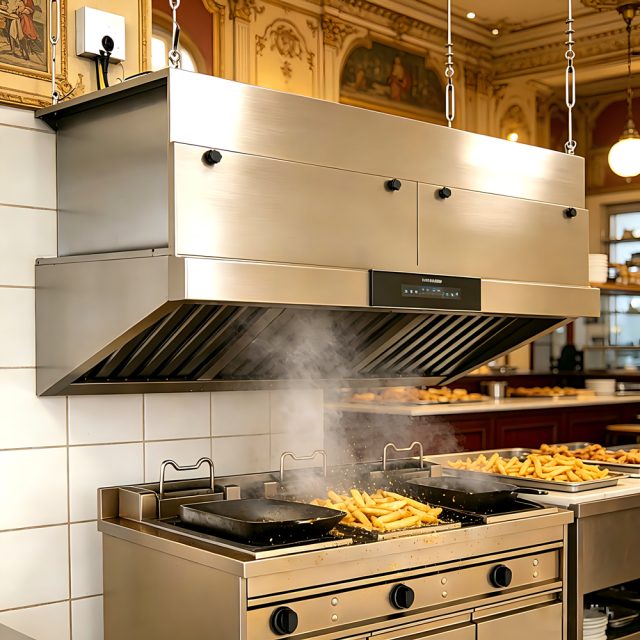
The quotation tells you what a kitchen ventilation system costs. The tender and acceptance clauses decide what you actually get. Buyers who move from comparing quotations to signing a contract without rewriting the specification into measurable, enforceable clauses almost always discover the gap at commissioning day, when the only leverage left is refusing to pay – and by then the unit is already on the roof. This checklist turns the negotiation points into clauses you can paste into an enquiry, a tender, or a purchase order, and it works the same whether the winning system is ductless or fully ducted.
Why Tender Clauses Decide the Outcome
A ventilation purchase has three moments where money and risk change hands: the specification is frozen, the equipment is delivered, and the system is accepted. Most disputes trace back to the first moment, because a specification written as adjectives – “efficient”, “quiet”, “low maintenance” – cannot be failed at the third. A supplier who commits to “high purification efficiency” has committed to nothing; a supplier who commits to “particle collection efficiency of at least 95 percent on the manufacturer laboratory rig, with the test report handed over as a contract document” has committed to something a third party can check.
Three failure patterns repeat across real projects. First, acceptance is never defined, so “commissioning” collapses into switching the fan on and listening to it. Second, the delivery boundary is never drawn, so nobody has priced the crane, the electrical connection, or the make-up air balancing, and each party assumes the other one did. Third, consumables are never named, so the cheaper quotation quietly wins by omitting the cost of replacement ESP cells, collector plates and activated carbon that the buyer will pay for every year anyway. Each of these is fixable with one or two clauses written before the contract, not after.
Freeze the Performance Specification First
Everything in the acceptance section depends on numbers fixed here. Write the airflow basis into the tender explicitly, because two suppliers can both be “correct” and differ by 60 percent in quoted fan size if one sized to hood length and the other to burner count. The widely used duty figures for conventional hooded lines are approximately 2,000 m3/h of exhaust per metre of canopy length, rising to roughly 2,500 m3/h per metre for open display cooking without a front panel, and around 4,000 m3/h per open burner for wok and char-grill duty. Ask every bidder to state which basis they used and to size to the worst case of the two.
Fix the capture requirement next: a face velocity across the hood filters of 0.4 to 0.5 m/s, with the hood overhanging the appliance front edge by 150 to 300 mm depending on appliance depth and ambient draughts. These two numbers, together with the appliance schedule, are what make “the kitchen smells fine” a testable claim rather than an opinion.
Where electrostatic precipitation is part of the treatment train, specify it by component, not by slogan: an ESP cell operating in its designed voltage range, collector plates that can be removed for washing without tools, ceramic insulators rated for the wash-down environment, and a published purification efficiency of at least 95 percent for grease-laden vapor. State that the two-stage order matters – particle removal upstream of any carbon odour stage – because a carbon bed placed first saturates with grease within weeks and stops working as carbon at all.
Finally, freeze the standards reference. Citing EN 16282 (hood geometry, filter classes, cleanability and duct requirements), NFPA 96 where US practice applies, DW/172 in UK-tendered projects, or the local equivalent prevents each bidder from self-certifying against its own house document. One line in the tender – “design, manufacture and documentation shall comply with EN 16282; deviations must be declared line by line” – eliminates the majority of datasheet games before they start.
Acceptance Criteria That Can Actually Be Measured
Acceptance clauses should each contain three things: the quantity, the instrument or method, and the pass threshold. A workable core set:
| Exhaust airflow | Pitot traverse or anemometer grid at the fan inlet or a straight duct section; measured airflow within plus or minus 10 percent of the specified design duty, with fan speed recorded as the baseline for future checks. |
| Capture and containment | Smoke-pencil or visual smoke test at every appliance under full load; no visible spillage at the hood face, verified at the specified face velocity of 0.4 to 0.5 m/s. |
| Purification performance | Manufacturer type-test report for the ESP cell (laboratory efficiency of at least 95 percent on grease particulate) delivered as a contract document; for sensitive sites, an agreed third-party spot measurement. |
| Noise | Sound pressure level measured at 1 m from the unit, background-corrected, against a stated limit – for example 65 dB(A) in the kitchen and the local authority boundary limit (commonly around 55 dB(A) daytime in residential districts) for any externally mounted fan. |
| Vibration | Impellers dynamically balanced to grade G6.3; no visible vibration at fan casing or ductwork at operating speed. |
| Access and cleanability | Grease duct access panels at no more than 3 m centres and at every direction change, per EN 16282-5 practice; each panel demonstrably openable without special tools. |
Two drafting notes. First, accept datasheets as references but never as proof: the clause should say the type-test report is a deliverable, handed over before final payment, not a PDF attached to the bid. Second, separate factory acceptance from site acceptance. For a ductless all-in-one unit, factory acceptance covers the electrical safety test, ESP cell high-voltage run and fan run-in; site acceptance adds capture, noise and odor checks in the real kitchen. For a ducted build, add duct leakage and airflow balancing to site acceptance, because the ductwork is where a ducted system most often underperforms its datasheet.
The Delivery Boundary: Who Does What
The single most common source of cost overrun on ventilation projects is an unpriced task sitting between two scopes. Write the boundary as a matrix, name a party for every line, and attach it to the tender so bidders price what they are responsible for:
| Task | Supplier | Buyer / Contractor |
|---|---|---|
| Rigging, lifting and crane time to final position | Declare weight and lifting points | Usually buyer – confirm in writing |
| Power supply circuit, isolator and cabling to the unit | Wiring inside the unit to the terminal | Buyer’s licensed electrician |
| Ductwork fabrication and installation (ducted builds) | Quote as option or include – must be stated | Or buyer’s HVAC contractor |
| Make-up air provision and balancing | State the required supply volume | Buyer’s contractor executes |
| Structural checks for roof or wall mounting | Provide loads and anchor drawing | Buyer verifies structure |
| Permits, fire authority notification, landlord consent | Supporting documents | Buyer files and pays |
| Commissioning, testing and training | Executes, buyer witnesses | Witness and sign |
| Water and drainage for wash-type or auto-clean stages | Connection points specified | Buyer plumbs to point |
The make-up air line deserves emphasis. Every extract system displaces air that must come from somewhere; if the tender is silent, the supplier sizes the fan to a kitchen that will run at excessive negative pressure, doors become hard to open, capture degrades, and both sides blame the other. State the required supply volume (commonly about 80 to 90 percent of extract in conditioned buildings, more where the kitchen is open to the dining space) and who balances it.
Payment Milestones Tied to Acceptance
Payment structure is your enforcement mechanism; a specification without payment leverage is a suggestion. A defensible default for mid-size projects is roughly 30 percent on order, 60 percent against delivery documents and completed factory tests, and 10 percent retained until site acceptance is signed against the criteria above. For larger ducted works, split the delivery milestone so ductwork completion and balancing are separately paid, and keep the retention until the airflow traverse report and the full documentation package are handed over.
Define what “acceptance signed” means: a named checklist, witnessed by the buyer or the buyer’s consultant, each line marked pass or fail, with a defined re-test cycle (for example, supplier remedies and re-tests within 14 days at supplier cost) and an explicit deemed-acceptance date so a buyer who refuses to witness cannot hold the supplier hostage indefinitely. Both protections belong in the same clause – one stops the supplier shipping an untested system, the other stops the project stalling.
Warranty, Consumables and Spare Parts
Warranty clauses fail quietly when they are silent about consumables. Typical practice across the industry is a 12-month whole-unit warranty, with explicitly excluded wear items: ESP cells, collector plates, sealing strips and ceramic insulators, plus activated carbon, which is a consumed medium rather than a component at all. None of this is unusual – what matters is that the tender states it, so a bid is not won by whoever “forgets” to price the carbon.
Then make the operating costs visible and comparable between bidders. Require each bidder to submit, with the offer: the recommended wash or clean interval for the ESP cell under the buyer’s duty (busy kitchens typically land at 2 to 4 weeks), the recommended carbon replacement interval (commonly 3 to 6 months for fresh beds), annual consumption quantities, and the price list for spare ESP cells, collector plate sets and carbon charges. Two bids with the same capital cost can differ by a factor of two over five years once these numbers are honest – and the difference usually sits in carbon quantity and cell serviceability, not in the fan.
Add a spares availability clause: spare ESP cells and collector plate sets purchasable separately for at least 5 years after purchase, with delivery time stated. This single line is what protects a buyer from the proprietary-component trap, where a discontinued cell type quietly turns a working hood into scrap.
Seven Clauses Suppliers Push Back On
Expect negotiation on these seven, and know the defensible position for each:
1. “Equivalent products are acceptable.” Reject bare equivalence; allow substitution only against a declared, documented comparison to the specified parameters. Otherwise the word “equivalent” erases the specification.
2. “Datasheet values replace testing.” Datasheets are references; acceptance is measured. Keep the type-test report as a payment-condition deliverable.
3. “Acceptance is energising the system.” Energising proves wiring, not performance. Tie the final milestone to the measured criteria table.
4. “Noise is site-dependent, no limit possible.” True, background varies – which is why the clause specifies measurement method and background correction, not silence.
5. “Make-up air is not our scope.” Correct, and irrelevant: the clause asks the supplier to state the required supply volume, which is design input, not scope.
6. “Consumables cannot be priced now.” They can be listed: interval, quantity per year, unit price. A refusal to list them is information in itself.
7. “Training and documentation are extras.” Handover without a documented operating and cleaning routine is how systems die in month four. Documentation – as-built layout, test reports, cleaning schedule, spares list, warranty terms – is part of the deliverable, and the retention payment is its enforcement.
Matching the Architecture to the Clauses You Wrote
Once the tender language is fixed, the architecture question usually answers itself. If the building has an acceptable duct route – a shaft, a roof above the kitchen, an existing grease duct in good condition – a ducted system with an in-duct ESP cell and a matched centrifugal fan remains the default for high volume and severe duty, and the clauses above apply directly: traverse the airflow, verify access panels, retain payment against the traverse report. The ducted ESP purifier range exists precisely for that end of the market, where ductwork is an asset rather than a liability.
Where there is no duct route – ground-floor retail units, basements, heritage facades, leased premises where the landlord will not approve a penetration – recirculating architecture is not a compromise but the enabling technology, and the tender should be written around capture velocity, multi-stage purification and the carbon odour stage instead of duct leakage. A ductless unit pairing an ESP cell with a carbon stage sized to the fume load makes the specification self-contained: everything the acceptance test measures lives inside one cabinet. Buyers comparing offers will find that a ductless range hood family is typically specified and accepted exactly this way, with factory acceptance covering the electrical and high-voltage tests and site acceptance covering capture, noise and odour at the hood face. Equipment in this class is CE-certified as standard, and manufacturers should be asked to state cell wash intervals and carbon consumption in the bid itself.
For very heavy fume duty in a ductless format, the practical ceiling is carbon saturation rate, which is why serious quotations declare a separate odour treatment unit rather than an oversized carbon tray inside the hood; a dedicated Odor Removal Tower paired with the extraction unit keeps the carbon serviceable and the odour stage honest. And where the kitchen sits at low clear height – a 2.4 m ceiling in a retrofitted premises, for example – a floor-standing purification cabinet split from a shallow canopy, joined by a short duct, solves the headroom problem without inventing a new acceptance regime; the same measured criteria apply, only the geometry changes.
One last boundary worth a clause: mobile and temporary cooking. Market stalls, pop-up counters and event kitchens need the same capture and odour logic in a wheeled format, and suppliers serving that segment publish it through their mobile food carts line rather than fixed hoods; if a project mixes a fixed kitchen with front-of-house live cooking, write the two acceptance regimes in the same tender so neither is improvised later. Buyers who want to see how a complete ductless line is structured – light-duty extraction through N-series units, heavy-duty duty through ND-series, with the odour stage as a separate tower – can review the ductless range hood overview and lift its architecture description straight into a tender annex.