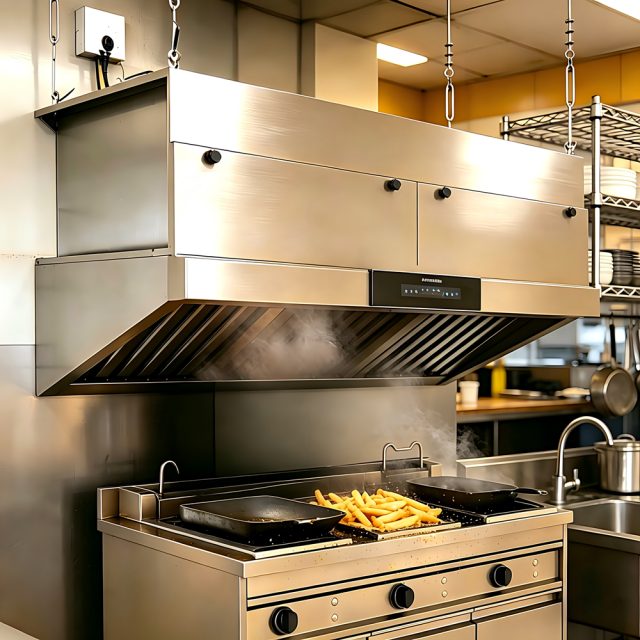
Two quotations for the same kitchen can sit within a few percent of each other on day one and end five years apart on cost. The difference hides in the lines that do not appear on any quotation: duct cleaning contracts, carbon charges, electricity spent pushing air through ductwork, conditioned air thrown out of the building, and the cleaning downtime a bad architecture multiplies. This article builds the five-year total cost comparison between a ducted extraction build and a ductless recirculating build the way a buyer should – line by line, with numbers that can be checked and replaced with local tariffs.
Why the Day-One Comparison Misleads
The quotation comparison most buyers run – equipment price against equipment price – measures only the smallest part of the purchase. For a ventilation system, the equipment itself is typically well under half of what the kitchen will spend over five years, and the ducted-versus-ductless decision moves almost none of the visible lines while moving most of the invisible ones. A ducted build shifts cost out of the quotation and into the building: fabrication and installation of grease-tight ductwork, roof or facade penetrations, a make-up air path, and a permanent cleaning contract to keep the duct safe. A ductless build collapses those lines into consumables that arrive on a predictable schedule.
Neither architecture is “cheaper” in the abstract. The ranking depends on four local variables a buyer already knows: energy tariffs, climate, building constraints, and how many hours the kitchen actually runs. The model below makes those dependencies explicit so the same arithmetic works in Dubai, Manchester or Manila.
The Seven-Line Cost Ledger
Every ventilation purchase, ducted or ductless, spends money in seven places over five years. Write all seven into any comparison – a bid that is silent on a line has not omitted it, it has deferred it to the buyer:
| 1. Capital equipment | Hood, purification stages, fan. The only line most quotations compete on. |
| 2. Installation and rigging | Lifting, electrical connection, commissioning. Higher where structural work is involved. |
| 3. Ductwork and building work | Ducted only: fabrication, penetrations, fire-rated sealing, make-up air provision. Often rivals the equipment line itself. |
| 4. Fan energy | Kilowatts x running hours x tariff, every year, on both architectures – but the ducted build pays duct pressure losses on top of the fan’s own duty. |
| 5. Conditioned-air loss | Ducted only: every cubic metre extracted must be replaced and re-conditioned. In hot or cold climates this can exceed the fan electricity. |
| 6. Consumables | ESP cell washing, carbon replacement, filter replacement. Ductless pays more here by design; the ducted build’s grease filters still need washing. |
| 7. Cleaning and compliance | Ducted: a recurring professional duct-cleaning contract, now effectively mandatory for insurance. Ductless: hood and cell cleaning done in-house on a schedule. |
Option A: The Ducted Build, Five Years
Work a representative case: a heavy-duty line with a 2.4 m hood at about 5,000 m3/h, running 12 hours a day, roughly 4,300 hours a year, with electricity at 0.25 EUR per kWh.
The fan duty for a ducted run of moderate length settles around 1.5 kW of absorbed power. At those hours and tariffs the fan draws about 1,500 EUR a year, or 7,500 EUR over five years – before duct losses and before the motor ages. The conditioned-air line is the one buyers forget: 5,000 m3/h of exhaust must be replaced by make-up air that a climate-controlled building then re-treats. In a cooling-dominated climate, replacing that air can easily cost as much again as the fan electricity, taking the energy pair to 3,000 EUR or more per year.
The cleaning contract is the second structural line. Grease ducts require professional internal cleaning on a cadence set by use – typically quarterly to half-yearly for a heavy line – and insurers increasingly demand the certificate. Across five years this is five to ten contracted visits, plus grease filter washing in-house every few weeks. Add inspection downtime: each duct clean touches access panels at 3 m centres, and a kitchen that trades off the schedule pays for it in lost service.
What the ducted build buys for all this is capacity and headroom: effectively unlimited airflow growth, a discharge point the neighbours never smell, and the only honest architecture for solid fuel. When an adequate duct route already exists from a previous tenant, line 3 collapses toward zero and the ducted case strengthens dramatically.
Option B: The Ductless Recirculating Build, Five Years
The same cookline as a recirculating system pays no duct fabrication, no penetration, and no make-up air re-treatment – the air never leaves the room. Its ledger moves into consumables, and the two that matter are carbon and cell washing.
Carbon scales with fume load. On heavy duty, a fresh activated-carbon charge of around 25 kg replaced on a three-month cycle costs on the order of 800 EUR a year; doubling the charge mass often lowers the per-kilogram price enough that a 50 kg charge on the same cycle lands near 530 EUR – deeper beds saturate more slowly and buy margin. Cell washing on a heavy-duty schedule of every two to four weeks, priced as in-house labour or an outsized service visit, adds roughly 1,500 EUR a year. Total consumables settle around 2,000 to 2,300 EUR a year – noticeably more than the ducted build’s consumable lines, but the ducted build’s savings there are consumed by the cleaning contract and the energy pair.
Energy is where the recirculating architecture wins structurally. The fan still runs 4,300 hours, but it pushes only its own resistance – no duct friction, no weather cap, no make-up imbalance to fight. And because the air stays inside, the kitchen’s heating or cooling bill carries no extraction penalty at all. In a Gulf summer or a northern winter, that difference alone can exceed every consumable in the ledger.
The honest costs of recirculation are operational, not financial: discipline. Carbon that is left past saturation stops working silently, and the odour complaint arrives before the calendar does. The architecture converts a contract line into a routine, and the routine has to be real.
The Worked Side-by-Side
| Line (annual, representative) | Ducted build | Ductless build |
|---|---|---|
| Fan electricity (1.5 kW x 4,300 h x 0.25 EUR) | About 1,500 EUR | Lower – own resistance only, typically 30 to 40 percent less |
| Conditioned-air re-treatment | Up to 1,500 EUR in hot/cold climates | Zero |
| Carbon charges | In-duct carbon bed, similar order | About 530 to 800 EUR |
| Cell / filter washing | About 1,000 to 1,500 EUR incl. grease filters | About 1,500 EUR on heavy duty |
| Professional duct cleaning | 5 to 10 visits over 5 years | Not applicable |
| Ductwork and building work | Capital-scale, once | Not applicable |
Two cautions on any table like this one. First, the numbers are shape, not gospel: local tariffs, labour rates and building conditions move every line, and the point of the model is that all seven lines are estimable before the purchase, not that any single figure is universal. Second, the capital lines must be compared on equal scope – a ducted quotation that excludes ductwork against a ductless quotation that includes everything is not a comparison, it is an accounting error. This is exactly the normalisation the quotation-audit checklist exists to enforce.
When the Ranking Flips
The ducted case strengthens when: a sound duct route already exists (line 3 collapses); the kitchen is large or grows, because recirculating capacity scales in modules that eventually lose to one big fan; energy is cheap and the climate is mild, shrinking the re-treatment penalty; the menu includes solid fuel, which is ducted territory outright; or the site is a landlord-approving owner-occupier who capitalises the asset.
The ductless case strengthens when: there is no duct route or the lease forbids penetration – then the comparison is moot, because ductless is the only buildable option; the climate is extreme and energy is expensive; hours are moderate and growth is speculative; the premises are leased short-term, where building work never amortises; or the kitchen sits in a mall or residential block where discharge permission itself is the scarce resource.
A useful discipline: run the model twice, once with today’s tariffs and once with energy 50 percent higher. If the ranking survives both runs, the decision is robust; if it flips, the purchase is a bet on the energy market, which is a different decision than the one most buyers think they are making.
Make Bidders Quote the Five Years
The model only works if suppliers disclose the variables, and they will – if the enquiry asks. Four numbers turn any pair of quotations into this comparison: the fan’s absorbed power in kilowatts at the duty point; the recommended activated-carbon charge in kilograms and its replacement interval for the declared duty; the recommended ESP cell wash interval; and whether duct cleaning, rigging and make-up air are inside or outside the quoted scope. A supplier who will not state these four numbers has, in effect, declined the comparison – and the tender clauses from the acceptance checklist make stating them a condition of bidding.
Where the Architecture Decision Lands
For the kitchens where the ledger above favours recirculation – leased premises, malls, basements, extreme climates, moderate hours – the ductless range hood family is the architecture those seven lines describe: an ESP cell and carbon stage inside the hood, consumables that arrive on a stated schedule, and no structural lines at all. Where an existing duct route tips the ledger the other way, the ducted ESP purifier range covers the high-volume end with in-duct purification sized to the declared duty.
Inside the recirculating rows, the five-year arithmetic explains the product split: a N-series unit on a light-duty menu runs carbon on six-month cycles and stretches cell washes toward six weeks, while a ND-series unit on wok or fryer duty accepts deeper consumable spending as the price of capacity – which is precisely the trade the worked example above prices. Where the odour stage needs to be visible, measurable and serviceable rather than buried in the canopy, a separate Odor Removal Tower paired with the extraction unit keeps the carbon charge honest and the complaint calendar quiet. Low-headroom rooms and narrow service recesses resolve the same way with a floor-standing cabinet split from a shallow canopy, and front-of-house or mobile cooking tiers its own single-appliance ledger through the mobile food carts line. Equipment in this class is CE-certified as standard, and every number the model needs – absorbed power, carbon charge, wash interval – belongs on the quotation, not in the appendix.
A Mini-Case: The 100 m2 Mall Unit in a Hot Climate
Put the model to work on the configuration that fills most inquiry inboxes: a 100 m2 fast-casual unit on the lower ground floor of a shopping mall in a cooling-dominated climate, with a moderate fryer-and-griddle cookline at about 4,000 m3/h and 4,000 running hours a year. The ducted option is usually not even offerable – the mall will not grant a riser penetration – but run it anyway to see what it would cost: duct fabrication and sealing against a food-court ceiling, a riser share negotiated with four neighbours, make-up air drawn from an already over-pressed common corridor, and a quarterly duct-cleaning contract working in three-hour service windows. The energy pair alone lands well above 2,500 EUR a year once the re-cooling penalty is counted at a Gulf or Southeast Asian tariff.
The recirculating option replaces that entire column with two rows: a carbon charge of roughly 500 to 800 EUR a year and cell washing in-house on a two-to-four-week cadence. The kitchen also keeps its conditioned air, which in a mall is somebody else’s cooling bill until you extract it – then it becomes yours. When mall landlords refuse duct routes, this arithmetic is the reason; they are not being difficult, they are reading the same ledger. The buyer’s job is to have the two columns priced before the lease is signed, because after signature, the architecture decides itself and the negotiation moves to who pays for it.
What the Ledger Cannot Price
Four effects resist the spreadsheet but belong in the decision. Noise sits where the fan sits: a ducted build can push its fan to a plant room or roof, while a recirculating unit keeps its fan in the room it serves – a real cost in open kitchens where the fan noise lands next to the dining conversation. Floor area has a rent: a ductless build spends a fraction of a square metre on the hood itself, while a ducted build’s shafts, risers and plant footprint quietly rent at retail rates; in prime street-front premises, the duct’s occupied area can out-earn the equipment that justified it. Menus drift upward: kitchens add a grill or a second fryer within two years far more often than they plan to, and the architecture that absorbs one more appliance without a rebuild is worth real option value. Exit costs exist: a leased unit usually must be reinstated at handover, and removing a welded grease duct system costs a multiple of what removing a recirculating hood costs – a line that belongs in any five-year model for a tenant with a three-to-five-year horizon.
None of these overturn the ledger; they break ties. When the priced columns come out within fifteen percent of each other, these four unpriced ones are the actual decision – and writing down which of them matters to the specific site is what turns an architecture debate into an architecture decision.