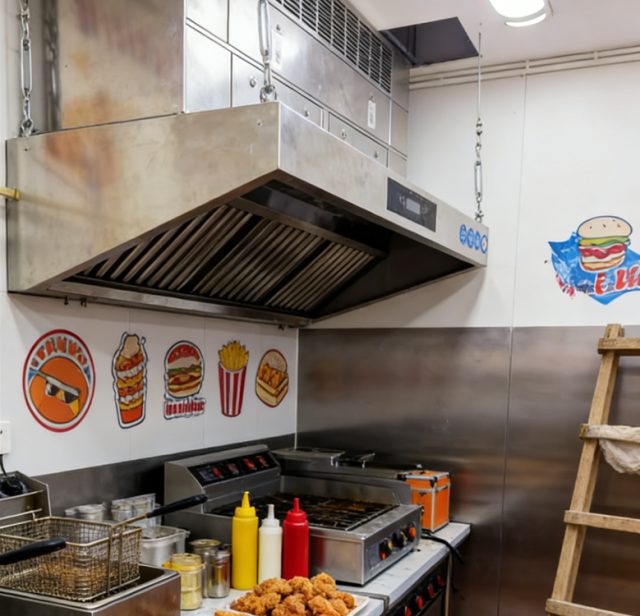
A Belgian friterie is the smallest professional kitchen in the country and, per square metre, one of the heaviest fume producers in European foodservice. Two or three twin-basket fryers running a double-fry process six to ten hours a day generate more aerosol than a restaurant kitchen twice the floor area, and they usually sit on a market square or a high street frontage with flats above and neighbours within twenty metres. Before any hood is quoted, the buyer needs three things on paper: the extraction load the double-fry process actually produces, the permit conditions the three regional regimes attach to the discharge, and the duct cleanliness evidence the fire insurer will ask for. This guide sets out each layer with numbers a buyer can copy into a specification and use to compare quotes line by line.
Why the Double-Fry Process Sets the Load
A friterie does not cook the way a restaurant does. The Belgian fried-potato method runs in two stages: a blanch fry at roughly 150–160 °C that cooks the potato through, then a finish fry at 175–190 °C that builds the crust. Most traditional fritkoten finish on demand, which means the second fryer cycles up and down all afternoon rather than running in steady batches. Every cycle lifts a burst of oil mist: the hotter the oil and the wetter the product, the more aerosol is generated per minute.
The fume load is therefore driven by three variables a buyer should write down before talking to any supplier: the number of fryer baskets and their oil surface area, the share of output finished on demand (a takeaway friterie peaks at Friday and Saturday evenings when every order is finished fresh), and whether a snack grill, curry-sauce warmer or meat fryer shares the same canopy. A two-fryer potato line alone is a heavy-duty duty class; add a meat fryer and a griddle for snacks and the canopy is dealing with continuous frying plus open-surface grill emissions from one hood.
Two pollutant phases come out of that canopy, and they must be treated in order. The particulate phase is oil aerosol: droplets from roughly one to ten microns down to sub-micron smoke and char particles that stay airborne. The gaseous phase is what any filter misses: volatile organic compounds, acrolein and the fried-oil odour molecules that travel through the discharge and reach the neighbours. Any equipment chain that treats these out of order — carbon before particulate removal — fouls the carbon with oil and loses its odour capacity within weeks. This ordering rule is worth writing into the specification itself, because it is the single most common design mistake in small fryer kitchens.
Sizing the Extraction Line: A Worked Example
Take a typical square-front friterie: two twin-basket potato fryers, one meat fryer and a small griddle under a single 2.4 m canopy. The hood-length sizing rule used across commercial kitchen projects is 2,000–2,500 m³/h of airflow per metre of hood for heavy frying duty. That gives a design range of 4,800–6,000 m³/h for this kitchen; a buyer should take the upper figure when the fryers sit directly under the discharge end of the hood, because the capture velocity over a fryer bank must hold at roughly 0.4–0.5 m/s at the canopy edge.
Three cross-checks keep the number honest. First, the overhang: the canopy should extend 150–300 mm beyond the appliance edges, or fryer plumes escape the capture zone on busy evenings. Second, duct velocity: at 4,800–6,000 m³/h through a 400 mm round duct, the transport velocity sits near 10 m/s, enough to keep aerosol from settling in the duct — a 300 mm duct at the same flow runs slower and starts depositing oil. Third, the carbon stage: odour adsorption needs contact time, not just carbon volume. At 5,000 m³/h (about 1.39 m³/s), a carbon bed sized for 0.2 s residence time needs roughly 0.28 m³; at 0.4 s about 0.56 m³; at 0.6 s about 0.83 m³. With bulk activated carbon at roughly 465 kg/m³, that is about 130, 260 or 390 kg of carbon behind the same fryer line. When a quotation states a carbon cartridge but not its weight or the claimed residence time, that is the first line to query — undersized carbon beds are the usual reason a friterie still smells a month after handover.
Buyer checkpoint: ask every supplier to state the design airflow, the capture velocity at the canopy edge, the duct diameter and velocity, and the carbon mass with the residence time it supports. Four numbers, and any quote can be compared against another without a catalogue.
The Permit Layer: Three Regional Regimes, One Friterie
Environmental regulation in Belgium is regional, and a friterie operator deals with whichever regime covers the site. Flanders runs the integrated omgevingsvergunning, which merged the environmental and planning permits in 2017 and is filed online through the Omgevingsloket. Wallonia applies its environmental permit under the decree of 11 March 1999, and Brussels-Capital applies its environmental permit ordinance of 5 June 1997. Each region sorts establishments into classes 1, 2 and 3 by nuisance potential: class 1 needs regional authorisation, class 2 municipal authorisation, class 3 a simple notification. A village friterie typically lands in class 3 or low class 2; a city-centre fritkot with neighbours above is where the classification and the conditions tighten.
Two timelines matter for a fit-out schedule. In Flanders, a local class-2 dossier is decided by the College of Mayor and Aldermen within about three and a half months after one public enquiry and one advisory round; a provincial class-1 dossier takes about four and a half months. A new flue through a facade or roof can also need planning approval — a recurring obstacle in Brussels townhouses and protected Flemish facades, where an internal or discreet discharge is often the only workable route.
The odour condition is the one that decides equipment. The regional frameworks set odour as a permit condition measured at the property boundary in European odour units per cubic metre (ouE/m³), with limits typically in the range of 200 to 500 ouE/m³ depending on the sector and how close the residential receptors are. Compliance is demonstrated with dynamic olfactometry to EN 13725. Three consequences follow for a friterie buyer. The boundary, not the stack, is what the regulator reads — so discharge position and plume rise belong in the permit dossier. Complaints are a real enforcement trigger: the Flemish Environment Agency (VMM) inspects on complaint, and persistent nuisance can tighten permit conditions or suspend operations. And the direction of travel is stricter: the Flemish government has signalled tighter odour emission limits for food-related sectors by 2028, so equipment chosen with margin today avoids a forced retrofit later.
One more clause from the Flemish regime shapes small-kitchen design directly: under VLAREM II, installations must be designed, built and operated so that air pollution is limited as far as possible, capturing fumes at the point of generation and meeting minimum discharge-height rules. In practice this means a friterie cannot argue that a short unfiltered discharge behind the parapet is acceptable because the volumes are small — capture at source and a raised, positioned discharge are the baseline the permit writer expects to see.
The Fire and Insurance Layer: Codex, Cleaning and EN 15780 Annex J
Belgium has no national statute that names a cleaning interval for kitchen extraction ductwork. The obligation arrives sideways, through two channels a friterie buyer should understand before signing anything. The first is workplace fire prevention: European Directive 89/654/EEC, transposed into the Codex on well-being at work (Book III, Title 3, fire prevention at work), which the Federal Public Service Employment supervises — a grease-laden duct is a workplace fire hazard the employer must manage. Local rules can go further; the Antwerp police codex, for example, requires ventilation ducts in commercial kitchens to be cleaned once a year by an approved company.
The second channel is the fire insurer, and for most fritkoten it is the stricter one. Fire insurance is mandatory, and policies commonly condition cover on extraction systems being cleaned at least once a year by a specialist contractor, with a cleaning certificate kept on file. An industry rule of thumb places the professional-kitchen threshold at twenty or more meals per day — which every friterie exceeds before the lunch rush ends. A friterie that cannot produce a certificate after a fryer fire risks more than the claim: it risks cover itself.
The measurable framework behind those certificates is EN 15780:2025, whose new Annex J addresses commercial kitchen extract systems directly. It fixes deposit limits a buyer can write into the acceptance clause: an average grease deposit of 200 microns or less is acceptable, above 200 microns cleaning is required, and a local deposit above 500 microns demands immediate action. Deposit thickness is measured with a wet film thickness gauge covering 50–800 micrometers, at defined points: the hood and the plenum behind the grease filters, the duct one and two metres from the hood, the sections between hood and fan, the fan and its adjacent ducts, bends and direction changes, and the discharge duct. Annex J also sets the access requirements that decide whether cleaning is even possible: access panels at maximum two-metre intervals, at every bend, damper and fan, marked and with fire protection restored after each visit. A duct run with no access panels is not a compliant duct run — it is an uninspectable one, and the cleaning certificate a friterie needs annually cannot be issued honestly for it.
Buyer checkpoint: before signing, ask where the access panels are on the as-installed drawings, confirm no span exceeds two metres, and require the EN 15780 Annex J reporting format — pre- and post-clean photographs, measurements in microns, and the calculated next-cleaning interval — as the deliverable for each annual visit.
What the Equipment Chain Must Prove
Putting the three layers together, a friterie extraction specification is a chain of verifiable claims, and each claim is something a supplier either states with numbers or does not. The particulate stage opens with stainless baffle filters in the canopy — the first line, cleanable weekly, with a stated capture efficiency — and then an electrostatic stage for the sub-micron aerosol that baffle filters pass. The gaseous stage follows: activated carbon sized in mass and residence time as above, with the replacement interval and the condition indicator (pressure drop across the bed or a stated carbon weight per change) written down. The whole chain is pitched in the order particulate first, carbon second; anything quoted the other way round should be rejected on principle.
For a permit dossier, the equipment claims map directly onto the conditions: the airflow and capture figures support the capture-at-source expectation, the carbon stage supports the boundary odour condition, and the discharge position and height answer the minimum-stack rules. For the insurer, the chain adds maintainability: filters the staff can clean, ESP cells and collector plates a contractor can pull for wash-down, and access panels along the duct run that make the annual certificate possible. A kitchen assembled around those proof points passes the three checks that decide a Belgian friterie — the permit, the insurer and the neighbour — and, just as important, can be re-proven every year with a documented measurement rather than an argument.
Where the building allows a full duct run to a raised discharge, the conventional architecture pairs a ducted electrostatic precipitator line with a matching centrifugal fan sized for the transport velocity above. Where it does not — the common case for fritkoten on protected squares and in narrow high-street frontages — the same two-phase treatment chain is built into a ductless range hood that recirculates the cleaned air or discharges through a short, discreet flue, and the odour performance is proven the same way: stated carbon mass, stated residence time, measurable deposit limits. For the fritkoten that move with the season — market pitches, kermis weeks, a second stand at the coast — the same duty class rides on wheels, and ventless mobile food carts carry a compact fryer line with the capture-and-carbon chain built into the hood itself.
How This Is Solved in Practice
For a double-fry friterie line, the design response to the constraints above is a heavy-duty ductless hood pairing an ESP cell with an activated-carbon odour stage — in the SOUNINY range this duty maps to the ND-series, whose carbon stage can be specified against the residence-time table above. Where the friterie splits its menu — a lighter snack-grill or sauce line beside the fryer bank — the lighter N-series unit can serve that secondary line while the ND unit carries the fryers, keeping each hood matched to its actual duty. For kitchens where the permit requires a tall discharge the building cannot provide, a floor-standing Odor Removal Tower decouples the carbon stage from the canopy: a short duct connects a shallow capture hood to a standing carbon column that holds the residence time the boundary condition needs, without vertical components above the hood.
The selection logic is the same whichever architecture the building allows: size the airflow by hood length and cross-check by fryer count, order the treatment phases particulate before carbon, size carbon by residence time in seconds rather than by cartridge count, and make every claim in the quotation a number the acceptance visit can measure. A Belgian friterie bought that way opens on schedule, keeps its insurer file complete, and stays open when the VMM arrives after the first complaint — because the answer to that visit is a measurement, not a defence.