Brazil runs one of the most thermally intense food-service cultures on earth. From open-flame churrasario charcoal pits in Porto Alegre to all-day feijoada kitchens in Rio, dende-oil fry stations in Bahia and high-output dark-kitchen clusters in São Paulo, the national menu produces an exhaust stream loaded with grease-laden vapor, sub-micron particulate, and odor-active volatile organic compounds. Operators who ignore that plume risk more than dirty ceilings: Brazilian law layers technical, sanitary, fire, and environmental obligations on top of one another, and a single neighbor complaint can trigger a municipal embargo or a state environmental fine. This article maps the four pillars of Brazilian commercial kitchen ventilation law—ABNT NBR 14518, the state fire corps (Corpo de Bombeiros Militar), ANVISA food-safety rules, and CONAMA air-quality obligations—and explains how sizing, capture, and treatment decisions must satisfy all of them at once.
1. The Brazilian Cooking Emissions Profile
Brazilian kitchens are not a single category. A bakery in Curitiba handling pão de queijo and sugar-dusted pastries emits flour dust, warm moisture, and light grease aerosol. A beach kiosk in Recife frying acarajé in palm oil produces dense grease-laden vapor and acrid smoke. A churrascaria in the South keeps hardwood charcoal burning at 600–900 °C for ten to fourteen hours a day, releasing fine carbon, polycyclic aromatic hydrocarbons, and persistent odor. A São Paulo dark kitchen with twenty independent fryer banks multiplies all of those loads inside a single warehouse.
That diversity matters because Brazilian regulation treats kitchen ventilation as both a food-safety issue and an environmental-control issue. The effluent is not just “smoke”; it is a two-phase mixture. The particulate phase includes grease droplets above 10 µm that inertial filters can intercept, droplets between 2.5 µm and 10 µm that need finer capture, and sub-micron carbon and grease particles below 1 µm that pass through ordinary mesh. The gas phase includes nitrogen oxides from gas combustion, water vapor that condenses inside ducts, and odorous aldehydes, phenolics, and mercaptans from fat pyrolysis and charcoal combustion. Any ventilation design that only addresses one phase will fail in the other.
Climate compounds the problem. In the humid North and Northeast, condensate inside ductwork accelerates grease deposition and corrosion. In the South, winter temperature swings make duct draft and condensation worse. And in dense coastal cities, the physical path to a rooftop discharge point is often blocked by neighboring buildings, air-conditioning intakes, and residential balconies. The result is that many Brazilian operators cannot simply run a traditional duct to the roof even when they want to.
2. The Four Regulatory Pillars
Brazilian kitchen ventilation compliance sits at the intersection of four separate regimes. Understanding which body enforces which rule prevents operators from solving one problem while creating another.
2.1 ABNT NBR 14518 — The Technical Ventilation Standard
ABNT NBR 14518:2020, Sistemas de ventilação para cozinhas profissionais, is the central Brazilian technical standard for professional kitchen ventilation systems. Its current edition updated the 2000 original and aligned it with modern load-classification practice. The standard applies to new kitchens, renovations, expansions, and temporary or mobile installations including food trucks, trailers, kiosks, and covered stalls. It explicitly covers both ducted exhaust and recirculating systems, so a ductless hood is not exempt from compliance.
NBR 14518 classifies cooking blocks by severity, which drives hood selection and airflow. Light duty covers bain-marie, ovens, microwaves, coffee makers, and pasta cookers. Moderate duty covers stoves, deep-fat fryers, electric and gas grills, combi ovens, griddles, and sandwich presses. Severe duty covers char-broilers, high-output grills, frying pans, and steakhouses. Solid fuel duty covers wood-fired and charcoal ovens. A single kitchen often mixes classes, and the ventilation rate is sized for the dominant or combined load.
The standard also addresses the full system: hood geometry and overhang, face-velocity targets, demand-controlled ventilation (CVD), duct material and slope, fan arrangement, fire-prevention devices, air compensation, balancing, and inspection routines. It references NFPA 96 for fire-safety principles and ASHRAE guidance for load calculations, but it is a standalone Brazilian document that inspectors expect to see reflected in project submissions.
2.2 Corpo de Bombeiros Militar — Fire Safety
Each Brazilian state maintains a Military Fire Corps (CBM) responsible for fire-prevention oversight. Kitchen exhaust systems fall under state technical instructions (ITs) that incorporate grease-duct fire protection, suppression system interfaces, and emergency shut-offs. Although the exact names of the instructions vary by state, the substance is consistent: grease-carrying ducts must be constructed and maintained to limit fire propagation, access panels must allow internal inspection and cleaning, and cooking appliance fuel shut-offs must be tied to fire-detection systems.
Fire risk in Brazilian kitchens is heightened by three local factors. First, solid-fuel grilling deposits carbonized, highly flammable residue. Second, palm and animal fats used in regional frying have high calorific value and low flash points once they coat duct surfaces. Third, high humidity accelerates corrosion that thins duct walls and can create holes where flame can escape. CBM inspections therefore pay close attention to documented cleaning frequency and to visible grease accumulation at access panels and fan housings.
2.3 ANVISA RDC 216/2004 — Food Safety and Air Quality
ANVISA’s RDC 216/2004 sets good-practice rules for all food-service establishments in Brazil, from restaurants and bars to hospital kitchens, school canteens, hotels, and food trucks. The resolution is hygiene-oriented rather than engineering-oriented, but it directly affects ventilation because it requires installations that facilitate cleaning, ordered workflow, pest control, and the protection of prepared food from contamination. Stagnant air, grease fallout onto exposed food, and poorly maintained filters are all inspection triggers.
RDC 216 also underpins the health-surveillance licensing process. A municipal Vigilância Sanitária inspection can withhold an operating permit if the kitchen cannot demonstrate adequate exhaust and air exchange. Because the rule is federal but enforced municipally, operators must check local interpretation: some cities require documented hood and duct maintenance logs, while others focus on visible cleanliness and absence of odors in dining and food-prep areas.
2.4 CONAMA and State Environmental Agencies — Atmospheric Emissions
At the federal level, CONAMA Resolution 491/2018 sets national outdoor air-quality standards for particulate matter, sulfur dioxide, nitrogen dioxide, ozone, carbon monoxide, and lead. It does not give kitchen-specific emission limits, but it obliges states and municipalities to manage local air quality. In practice, that means a restaurant discharging greasy or odorous exhaust into a dense neighborhood can be cited under state environmental law if the discharge contributes to local pollution or nuisance.
In São Paulo, CETESB enforces state environmental rules and can impose fines for atmospheric emissions that exceed license conditions or create pollution risks. Municipal zoning and postura codes add another layer: São Paulo Municipal Law 17,853/2022 specifically regulates dark kitchens, requiring environmental characterization, noise compliance, and separation distances, and restricting large dark-kitchen warehouses to industrial zones. Other large cities, including Rio de Janeiro, Belo Horizonte, and Brasília, apply similar municipal controls over exhaust discharge height, location, and odor impact.
3. NBR 14518 Design Requirements in Practice
Turning the standard into a working design means answering five questions: how much air, how is it captured, how is it moved, how is it treated, and how is it documented.
3.1 Airflow and Load Matching
NBR 14518 expects airflow to be calculated from the cooking-block severity, the geometry of the hood, and the thermal load of the equipment. A common Brazilian rule of thumb used by HVAC designers is approximately 2,000 m³/h per metre of hood length for general cooking, rising to 2,500 m³/h/m for open-display or high-heat lines. For burner-based sizing, roughly 4,000 m³/h per burner is a starting point, with heavy-fume processes such as wok or charcoal work requiring more.
Those numbers are useful for budget conversations, but they are not a substitute for a project-specific calculation. A 1.8 m char-broiler under a 2.4 m hood in a Rio steakhouse will need very different treatment from the same hood length over induction ranges in a corporate cafeteria. The standard also requires that supply-air volume be lower than exhaust volume so the kitchen stays under negative pressure, preventing grease and odor migration into dining areas.
3.2 Capture and Containment
Capture efficiency depends on hood overhang, face velocity, and the thermal plume rising from the cookline. NBR 14518 aligns with international practice: the hood should overhang the cooking surface on all open sides, and the canopy should be low enough to intercept the plume before it spreads into the room but high enough to allow staff movement and appliance access. Face-velocity targets vary with hood type—wall-mounted canopies, island hoods, backshelf hoods, and proximity hoods all have different capture characteristics.
In Brazilian practice, many existing kitchens were built without enough overhang or with flat filters that create airflow blockage. Retrofits must often extend the canopy depth or add side panels to improve containment without tearing out the entire line. When that is impossible because of low ceilings or existing structure, a floor-standing cabinet unit can separate the purification stage from the canopy while still meeting the intent of the standard.
3.3 Ductwork, Fire Protection, and Maintenance
For ducted systems, NBR 14518 requires smooth, cleanable ducts with access openings for inspection and cleaning, proper slope to drain condensate and grease, and fire-rated penetrations through walls and floors. Grease ducts must not share chase space with other building services, and exhaust fans must be located and specified to handle grease-laden air without overheating or clogging.
Fire-prevention devices include grease filters, flame-suppression systems, automatic fuel shut-offs, and—where required by the local CBM—fixed fire-suppression nozzles inside the hood plenum and duct. The standard also requires a documented maintenance program: filters must be washed or replaced on a schedule appropriate to the cooking load, internal ducts must be inspected, and accumulated grease must be removed before it reaches hazardous thickness.
3.4 Demand-Controlled Ventilation (CVD)
NBR 14518 recognizes demand-controlled ventilation as a valid strategy for reducing energy use while maintaining capture. A temperature sensor or optical sensor in the hood monitors cooking activity and varies the exhaust fan speed. During idle periods the fan runs at 20–30 % of design flow; during peak cooking it ramps to full flow. This approach is increasingly important in Brazil because INMETRO’s RTQ-C building-energy-efficiency regulation and PROCEL energy-labeling program reward designs that reduce fan power density. RTQ-C sets a prescriptive limit of 5 W/m² for kitchen fan power, making CVD and efficient motors practical necessities in large kitchens.
4. Emissions, Odor, and Environmental Compliance
Beyond fire and food safety, Brazilian operators must manage the environmental impact of discharged exhaust. CONAMA 491/2018 created the national air-quality framework, but enforcement is decentralized. In practice, the most common triggers are neighbor odor complaints, visible smoke at the discharge point, and discharge too close to windows, balconies, or air intakes.
Municipal zoning often dictates whether a commercial kitchen can operate in a given building. In São Paulo, Law 17,853/2022 brought dark kitchens under explicit zoning and environmental rules, and similar municipal pressures exist across Brazil’s major cities. The practical response is to treat exhaust before it leaves the building. That means at least two stages of pollution control: a mechanical or electrostatic stage for grease and particulate, and a gas-phase stage for odor compounds such as activated carbon or another adsorptive media.
Electrostatic precipitation is particularly relevant for Brazilian kitchens because it handles the sub-micron grease and carbon particles that mesh and baffle filters miss. A well-maintained ESP cell captures fine particles by charging them and collecting them on grounded plates, after which an activated-carbon stage adsorbs odor molecules. For operators in dense urban neighborhoods or shopping malls with no rooftop discharge route, a fully ductless configuration with internal recirculation can satisfy both NBR 14518 and local odor-control requirements, provided the treatment stages are sized for the actual cooking load.
5. Sizing Heuristics for Common Brazilian Venues
The following heuristics are widely used by Brazilian HVAC designers as starting points; final designs should be confirmed by project-specific calculations and local CBM or environmental-agency requirements.
Quick-service fry station: A 3 m fryer-and-griddle line in a São Paulo dark kitchen typically needs 6,000–7,500 m³/h of exhaust, with at least 30 cm hood overhang on the front and sides. If the menu is fryer-heavy, lean toward the upper end and include grease filtration plus odor control.
Churrascaria charcoal pit: Solid-fuel grilling is the most demanding load. A 2 m charcoal line can require 8,000–12,000 m³/h depending on pit depth and fuel type. Hoods must be deep enough to capture radiant heat and smoke, and the treatment train must handle both coarse carbon and fine tar aerosol. Ducted ESP with a centrifugal fan is the conventional answer for high-volume charcoal, but only where a safe discharge point exists.
Beach kiosk or food truck: Small footprints and no fixed ductwork call for compact ventless equipment. Airflow needs are lower—often 1,000–2,000 m³/h for a single fryer or grill—but odor control is critical because the unit sits close to customers and neighbors.
Bakery or café: Light-duty equipment generally needs 2,000–3,500 m³/h per metre of hood, with an emphasis on flour-dust control and moisture management rather than heavy grease capture.
6. Choosing the Right Architecture
The Brazilian regulatory stack does not dictate a single technology path, but it does create a decision tree. Where a full duct run to a safe rooftop discharge is possible and the cooking load is very high—solid-fuel churrascarias, large hotel banquet kitchens, central production kitchens—a ducted system with ESP purification and a centrifugal fan remains the default. The ESP stage handles fine grease and carbon; the carbon stage handles odor; and the duct carries the cleaned stream to a discharge point above roof level and away from intakes.
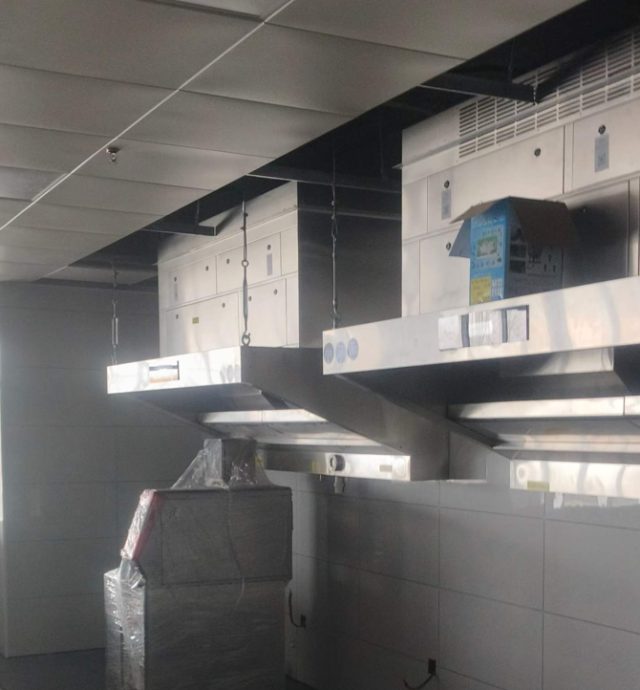
Where ducting is impractical—shopping-mall food courts, ground-floor restaurants in mixed-use buildings, listed historic centers, beach kiosks, food trucks, and dark kitchens in converted warehouses—a ductless range hood is often the only feasible route. In that architecture, the hood captures the plume, the electrostatic cell removes particulate, and an activated-carbon or dedicated odor stage treats the gas phase before the air is returned to the kitchen or exhausted at low level through a short duct. A ductless unit must still satisfy NBR 14518 on capture geometry, airflow, maintenance access, and negative-pressure balance, but it avoids the structural and zoning barriers of a full rooftop duct.
For mobile and temporary cooking, ventless catering carts provide a self-contained capture-and-treatment platform that can be moved with the operation. They are especially useful for festivals, beach service, event catering, and dark-kitchen overflow stations where permanent installation is impossible.
Souniny builds both ductless and ducted kitchen exhaust purification systems for the Brazilian market, with CE-certified equipment and a 12-month whole-unit warranty. The company’s ductless range hood family covers light, moderate, and severe cooking loads, while the ducted ESP purifier range serves high-volume charcoal and banquet applications. For operators whose ceiling height or structural limits rule out an integrated hood, a split cabinet purifier can stand on the floor behind or beside the cookline, connecting to a shallow canopy by a short duct and providing the same electrostatic and carbon stages without vertical equipment above the hood.
Matching the unit to the load follows the same logic used elsewhere on the site: high-volume frying and charcoal in churrascarias and central kitchens call for the heavy-duty capture and odor stages typified by the ND-series; light-to-moderate frying, baking, and sandwich lines are better served by the N-series; and when odor is the dominant complaint, an Odor Removal Tower carbon stage is added downstream of either unit.
7. Documentation and Maintenance That Survives an Inspection
Brazilian compliance is increasingly documentation-driven. A Vigilância Sanitária or CBM inspection will typically ask for: a ventilation project signed by a qualified professional; proof that the hood and duct sizes match the cooking-block load; maintenance logs for filters, ESP cells, and carbon stages; grease-thickness records or cleaning invoices; and, in some municipalities, an environmental characterization or emission-control plan. Keeping these records in one folder turns a potential embargo into a manageable conversation.
Maintenance intervals depend on load. Light-duty kitchens may clean filters weekly and inspect ducts annually. Moderate and severe kitchens often need filter cleaning every few days and professional duct cleaning two to four times per year. Solid-fuel operations may need weekly inspection of carbon buildup and monthly deep cleaning. ESP cells should be washed on the schedule recommended by the manufacturer—typically every few weeks for heavy-use kitchens—and ceramic insulators and sealing strips should be inspected for wear because they are consumable items.