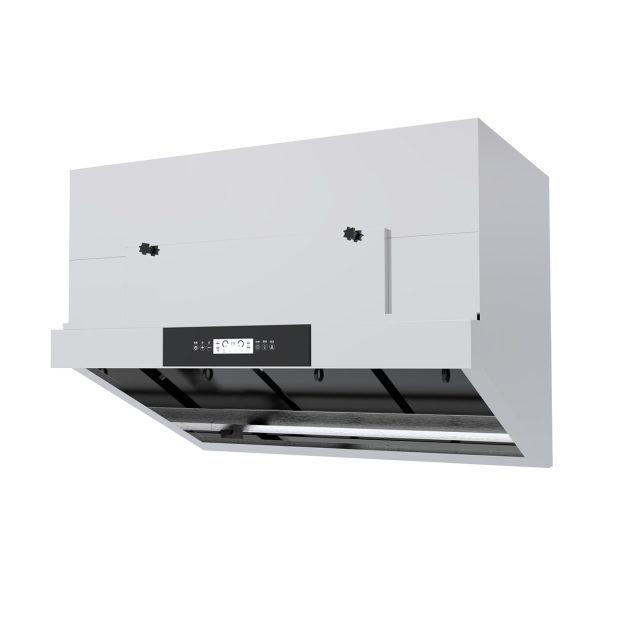
Bubble tea and dessert cafés may look light on grease, but their back-of-house air quality challenges are real. Boiling tapioca pearls, searing syrup toppings, deep-frying churros or mochi, and constant milk-steaming all release a stubborn mix of steam, oil mist, and sweet-food odors. Because many of these outlets lease space in shopping malls, high streets, or food courts, building a traditional ducted exhaust shaft is often impossible or prohibitively expensive. A ductless range hood solution lets operators capture pollutants at the source and recirculate cleaned air indoors, keeping the front counter and seating area fresh without punching holes in landlord walls.
Why Bubble Tea and Dessert Cafés Need Targeted Ventilation
Compared with full-service restaurants, a bubble tea shop runs a compact but intense cooking cycle. Tapioca pearl cookers boil for hours, releasing humid steam loaded with organic volatiles. Waffle, egg-puff, and soufflé pancake stations generate light grease-laden vapor. Deep-fried toppings such as chicken bites, calamari, or sweet potato fries add real cooking oil aerosol. Even low-temperature processes like milk-steaming and chocolate-melting can elevate indoor relative humidity and leave a cloying sweetness in the air.
In a small footprint, these emissions concentrate quickly. Customers notice the smell first; staff feel it as sticky surfaces, fogged glass, and lingering odors on clothing. Landlords and mall operators notice it as complaints from neighboring tenants and accelerated HVAC filter loading. Standard ceiling extract fans only move the problem around, while basic mesh filters require constant cleaning and do little for odor. A purpose-built commercial range hood with integrated purification is the only approach that removes both particulate and smell at the cooking station.
The Ductless Advantage for Retail and Mall Locations
Bubble tea brands often expand through franchised kiosks inside malls, transport hubs, and university precincts. These sites share three constraints: limited ceiling height, no existing grease-rated ductwork, and strict landlord rules about external penetrations. Installing a conventional grease duct to the roof can take weeks, require fire-rated boxing, and trigger expensive make-up air calculations. By contrast, a ductless range hood sits over the cooking line, filters the exhaust through multi-stage purification, and returns treated air back into the room.
This architecture removes the dependency on rooftop ductwork, so a new outlet can open faster and relocate if the lease changes. It also reduces the load on the building’s main air-conditioning system, because the hood removes heat, moisture, and odor before they spread. For franchisees who must replicate a clean, consistent brand experience across dozens of locations, ductless ventilation offers a standardized, scalable package that is easier to approve and quicker to install.
Note: Ductless recirculation is suitable when the cooking process is light-to-medium oil fume. Heavy charcoal or high-volume frying still requires a ducted system with ESP purification and a Centrifugal Fan.
The Chemistry of Bubble Tea and Dessert Odors
Bubble tea and dessert emissions are not just steam; they carry complex volatile organic compounds that create the sticky-sweet smell customers may initially enjoy but soon find overwhelming. Sugars and amino acids react during heating to form Maillard compounds and caramelization by-products. Dairy proteins and fats release lipid-oxidation volatiles, while frying introduces aldehydes and acrolein. Tapioca starch boiling emits humid aerosol that carries these molecules into every corner of the shop.
Left untreated, these compounds adsorb onto walls, ceilings, fabrics, and POS displays, creating a permanent “fried-dessert” scent that conflicts with the brand’s clean, Instagram-ready image. Conventional ventilation that simply dumps air outside can also waste conditioned air and may not meet landlord rules in multi-tenant buildings. A recirculating purification system must therefore handle three jobs in one: capture grease droplets, condense steam, and adsorb odor molecules before returning the air.
How the Souniny N-series Handles Light Oil Fume
The N-series is Souniny’s light oil-fume, ductless all-in-one range hood. It is engineered for kitchens where emissions are moderate in volume but high in nuisance value: exactly the profile of a bubble tea or dessert café. The hood captures steam and oil mist through a stainless-steel baffle pre-filter that knocks down larger droplets, then passes the remaining fine aerosol through a high-voltage electrostatic field. Charged sub-micron particulate adheres to collector plates, while the integrated odor-removal stage treats VOCs before the cleaned air returns to the dining zone.
Because the N-series is self-contained, it does not need a separate external fan or rooftop outlet. The unit’s internal blower is matched to the hood aperture and filtration stages, so airflow stays balanced as filters load over time. Operators benefit from a compact footprint, lower installation cost, and the ability to place cooking equipment against walls or in island counters that would be unreachable with a conventional duct run.
Odor Removal Tower: The Sweet-Scented Problem Solver
Odors are the silent brand-killer in dessert and beverage businesses. A bubble tea shop that smells like yesterday’s fried snacks or stale syrup will lose impulse customers, no matter how good the drinks look. Souniny’s Odor Removal Tower is designed as a dedicated deodorizing module that pairs with the N-series hood. It uses activated carbon and targeted media to absorb the volatile organic compounds behind sugary, milky, and fried smells, so the recirculated air is neutral rather than perfumed.
The tower module is sized to the outlet’s cooking load and can be serviced from the front or side of the hood line. Replacing the media is a tool-free operation that staff can perform during routine closing checks, keeping downtime minimal. For franchise networks, this predictable maintenance rhythm makes it easier to budget operating costs and maintain a uniform customer experience.
Cabinet Purifier for Compact Back Counters
Many dessert cafés have only a narrow back counter with a single induction wok, crepe station, or deep fryer. A full overhead hood may not fit under a low soffit or may block sightlines between staff and customers. Souniny’s Cabinet Purifier provides a compact, ductless alternative that can sit on the counter or be wall-mounted beside the cooking appliance. It pulls emissions through the same electrostatic-odor sequence as the larger hoods but in a smaller envelope, making it ideal for add-on cooking stations, seasonal menus, or franchise prototypes.
Tip: Pair a Cabinet Purifier with the N-series when a café has both a hot-drink bar and a small frying station. The split configuration keeps each appliance’s emissions close to its capture point, improving efficiency and simplifying cleaning.
CV Catering Carts for Pop-Up and Event Service
Bubble tea brands frequently activate at festivals, night markets, and mall atriums. For these temporary or front-of-house locations, Souniny’s mobile carts provide a plug-and-play ventilation solution. The CV-B Countertop Cart supports compact crepe, waffle, or topping-fry setups, while the CV-C Tempered Glass Cart offers a sleek display profile that lets customers watch the show without smelling the cooking. Both cart families use the same ductless purification philosophy as the N-series, so operators can maintain brand consistency across permanent shops and mobile units.
Designing the Capture Zone: Hood Positioning and Airflow
Effective capture is the difference between a quiet, odor-free café and one that still feels greasy despite having a hood. For bubble tea and dessert stations, the hood should overhang the appliance by at least 150 mm on each side to account for cross-drafts from doorways, POS fans, and customer movement. Mounting height typically ranges from 0.75 m to 1.0 m above the cooking surface for light-fume equipment; lower mounting improves capture but must not obstruct workflow or fire-suppression access.
Internal baffles and the electrostatic section should be sized to the total latent load, including steam from boiling kettles. In humid environments, the pre-filter must drain condensate safely, and the collector plates must be spaced to avoid shorting from water carryover. Souniny N-series hoods are built with stainless-steel construction and moisture-resistant high-voltage components to handle these conditions without corrosion or electrical faults.
Comparing Ducted, Ductless, and Hybrid Approaches
Operators sometimes assume that only a ducted hood is “real” ventilation. In reality, the right choice depends on cooking intensity, building constraints, and lifecycle cost. A ducted ESP system with a Centrifugal Fan is unbeatable for heavy grease and charcoal, but for a bubble tea shop the capital cost, landlord approvals, and make-up air penalty rarely pay back. A basic ductless mesh hood is cheaper upfront but traps little odor and requires nightly filter changes to avoid becoming a grease reservoir.
The N-series with Odor Removal Tower sits in the sweet spot: true particulate removal via electrostatic precipitation, real deodorization via activated carbon, and no building penetration. For sites that later add a charcoal grill or expand frying capacity, a hybrid retrofit can keep the N-series for beverage stations and add a ducted ESP line for the new heavy-load appliance. This staged approach protects the original investment while scaling with the business.
Installation, Codes, and Daily Operation
Even though ductless hoods avoid rooftop ductwork, they still must meet local commercial kitchen codes. In the United States, UL 710B covers recirculating systems, while NFPA 96 sets grease-exhaust safety rules. European operators should align with EN 16282 for kitchen ventilation, and Australian outlets with AS 1668.2. Souniny equipment is CE certified, giving multi-market franchisees a documented compliance foundation.
Best practice for bubble tea and dessert cafés includes positioning the hood 0.75–1.0 m above the cooking surface, keeping the capture area clear of display signage, and scheduling weekly wipe-downs of the pre-filter to prevent sugar buildup. Electrostatic collector plates should be soaked and rinsed on a monthly basis, or more frequently during peak summer trading. When the Odor Removal Tower’s carbon media reaches its rated life, replacement cartridges restore original deodorizing performance.
Franchise Rollout: Standardizing Ventilation Across a Chain
For franchise brands, every day a new location waits for ventilation approval is a day of lost revenue. Ductless systems reduce that wait because the footprint and utility requirements are predictable. Souniny can supply the same N-series hood dimensions, electrical specs, and maintenance kits to every outlet, simplifying procurement and training. Because the units do not require rooftop access, the same design works in ground-floor kiosks, basement food courts, airport mezzanines, and university pop-ups.
Operations manuals can include a single daily, weekly, and monthly cleaning protocol regardless of city or landlord. Field audits become faster because inspectors only need to verify capture, airflow, and filter condition, not the integrity of a long grease duct. For a brand’s sustainability story, ductless recirculation also reduces the energy wasted on heating or cooling make-up air, supporting green-building claims and ESG reporting.
Energy, Cost, and Customer Experience
Ductless ventilation lowers both capital and operating costs. There is no long grease duct to fabricate, insulate, or clean; no roof penetration to maintain; and no make-up air unit to offset the air pulled out of the building. The N-series returns conditioned air to the room, which means the café’s HVAC system does not have to reheat or recool replacement air. Over a multi-year franchise lease, these savings often exceed the initial equipment investment.
Perhaps more importantly, clean air protects the brand. Customers linger longer, share more photos, and return more often when the space smells fresh. Staff productivity and retention also improve when the work environment is free from sticky films and sugary odors. For bubble tea and dessert chains competing on atmosphere as much as flavor, ductless purification is a strategic operating decision, not just a mechanical one.
Sizing and Selecting the Right Unit
Bubble tea outlets range from a 6 m² mall kiosk to a 40 m² flagship with a full dessert kitchen. Souniny sizes each hood by the total cooking surface area, the peak number of appliances in use, and the type of emissions. A single-boiler pearl station with a small waffle iron may only need the N-series compact model, while a flagship that also fries toppings and bakes soufflés may combine an N-series over the hot line with a Cabinet Purifier at the fry station.
When selecting equipment, operators should verify the hood’s capture velocity, electrostatic cell capacity, and odor-media volume. CE certification confirms electrical and emissions compliance for Europe and many other markets, while the stainless-steel construction handles the sugar-laden humidity common in dessert shops. Souniny’s application team can review floor plans and appliance schedules to recommend the exact configuration, avoiding both under-specified units that leave odors behind and over-specified systems that waste capital and energy.
Conclusion
Bubble tea and dessert cafés face a unique ventilation challenge: light but persistent oil fume, high humidity, and strong odors in small, customer-facing spaces. Souniny’s N-series ductless range hood, paired with the Odor Removal Tower, captures and cleans these emissions without external ductwork. For tighter counters, the Cabinet Purifier offers the same technology in a compact form, while the CV-B and CV-C mobile carts extend the brand to pop-up and event locations. With CE-certified equipment and a scalable design, Souniny gives dessert and beverage operators a clean-air platform that grows from a single kiosk to a global franchise network.