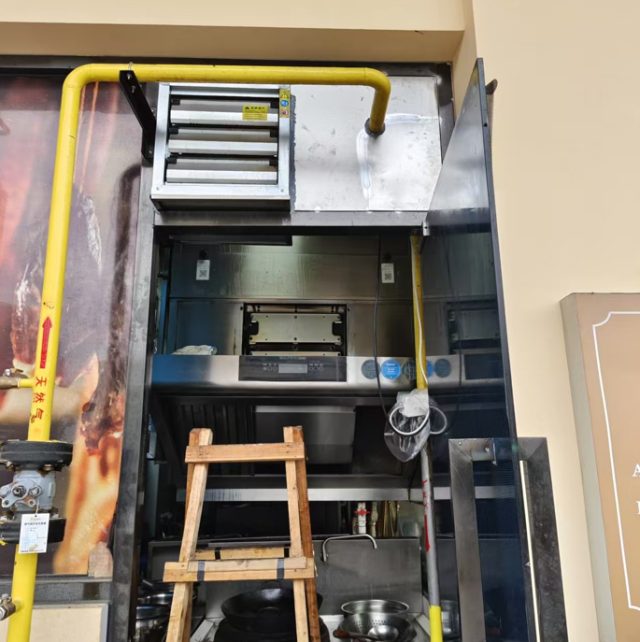
Three quotations arrive for the same kitchen. One is 8,400, one is 11,200, one is 15,900. Every one of them says “3,000 m3/h, 95% efficiency, stainless steel, 2-year warranty”. The totals differ by 90 percent, and none of the documents explains why. This is the normal state of commercial kitchen ventilation procurement: the difference between a good purchase and an expensive mistake is almost never in the headline number, it is in six or seven lines that most quotations either omit or leave deliberately vague. Here is how to normalise, audit and compare those lines before you sign.
Step One: Put All Three Quotes on the Same Basis
Before comparing anything, rewrite each quotation into a common basis. Six normalisation axes do most of the work:
- Airflow basis — is the quoted volume the fan’s free-air rating, or the volume actually delivered at the resistance of your hood, filters, duct, treatment stage and discharge? A 3,000 m3/h fan at zero static pressure may deliver 2,100 m3/h once 600 Pa of system resistance is applied.
- Hood length basis — quotes stated per metre of hood are not comparable to quotes stated per appliance or per burner. Convert everything to m3/h per metre of cooking line and m3/h per burner before you compare prices.
- Scope inclusions — duct, silencer, roof curb, fire-rated penetration, make-up air, electrical panel, VFD, crane, commissioning, training, documentation. Two quotes at the same price can differ by a full day of rigging and a 4,000 EUR make-up air unit.
- Duct length assumption — “includes duct” means nothing without a length and a routing. Fifteen metres horizontal plus two risers is a different project from three metres straight through a wall.
- Delivery term — EXW, FOB, CIF or DDP. Freight, insurance, duty and unloading are frequently the missing 10 to 18 percent of an imported system, and the unloading itself may need a forklift or crane that nobody quoted.
- Warranty start point — from shipment, from delivery, or from commissioning? On an imported system the difference can be four to six months of coverage on the parts most likely to fail first.
Do this on a single spreadsheet, one column per supplier, one row per line item. When the normalisation is finished the gap between the 8,400 quote and the 15,900 quote often shrinks to something explainable — and occasionally it widens, because the cheap quote is missing the odour stage entirely.
The Line Items Where Quotations Hide the Difference
1. Airflow stated without a duty point
A volumetric figure on its own is not a performance claim. Ask for the fan curve with your calculated system resistance plotted on it, and for the resulting operating point: airflow, static pressure, shaft power, efficiency. If the supplier cannot produce a curve, they are quoting a catalogue number rather than a system. The practical check afterwards is a pitot-tube traverse or a calibrated hood-mouth anemometer survey at commissioning — measured airflow within about 10 percent of design is the usual acceptance threshold.
2. Static pressure budget
Total resistance is the sum of every component in series: grease filters at their loaded condition, the treatment stage, silencers, duct friction over the actual run, bends, the discharge hood or cap, and any fire damper. Grease filters alone can add 80 to 150 Pa when loaded; a dense electrostatic stage can add 100 to 250 Pa; carbon beds add 150 to 400 Pa when new and materially more as they load. A quote that specifies a fan “suitable for the hood” without a pressure budget has quietly transferred that risk to you: the system will be installed, it will under-perform, and the argument will be about who pays for the second fan.
3. The efficiency percentage, and what it is a percentage of
“95% efficiency” means nothing until three questions are answered: efficiency on what (grease mass, total particulate, sub-micron smoke, odour), at which particle size distribution, and at what airflow and loading? Grease arrestment in a baffle filter and smoke removal in an electrostatic cell are different claims measured by different methods. Look for the test basis — a standard reference, a particle size band, a stated airflow — and for an efficiency-versus-pressure-drop curve rather than a single peak figure. A quote offering one number, with no test condition, is a marketing statement, not a specification.
4. Electrostatic cell construction
Where a quote includes an electrostatic stage, the cell specification is the technical heart of the offer and is usually compressed into two words. What matters: plate spacing (wider spacing is easier to clean but needs higher voltage for the same field strength), total collector plate area, the number of cells, the resulting dwell time at your airflow, and the high-voltage supply type with its arc and short-circuit protection. Also ask for cell weight and whether the cell can be removed by one person through the available access — a 40 kg cell in a low ceiling void is a maintenance problem that surfaces in year two, not at handover.
5. The odour stage: mass, not claims
Activated carbon is where the cheapest quotes quietly disappear. The relevant numbers are the mass of carbon in kilograms, the bed depth, the resulting contact time at design airflow, and the stated replacement interval. A quotation that lists “carbon filter included” with no mass, no depth and no replacement cost is not a comparable line. This single item frequently accounts for a 25 to 40 percent difference in five-year cost between two systems that looked identical on page one.
6. Materials, gauges and joint detail
Stainless steel is a family, not a specification. Ask for the grade (304 and 201 differ in corrosion resistance and in price) and the sheet thickness in millimetres — 0.8 mm and 1.2 mm are both “stainless” and are not the same product. For ducts, ask how joints are made: folded and sealed, or welded and grease-tight. Ask whether access panels are included at the spacing your cleaning contractor needs, because a duct that cannot be accessed cannot be cleaned, and an uncleaned duct is an insurance problem in most European markets.
7. Fan, motor and drive
Direct drive or belt driven, motor insulation class, IP rating, operating temperature rating for grease-laden air, and whether a variable-frequency drive is included or extra. Ask for the sound pressure level in dB(A) at a stated distance and octave data if the discharge is near a boundary — noise conditions appear in permits in most dense urban jurisdictions, and retrofitting an acoustic enclosure after a complaint is far more expensive than specifying a quieter fan and a silencer at the start.
8. Electrical and controls scope
Who supplies the isolator, contactor, VFD, control panel and the interlock with the kitchen fire suppression system? Where does the supplier’s responsibility stop — at the terminal box, at the panel, or at the building’s distribution board? This is the single most common source of variation orders on kitchen projects: the mechanical quotation assumes the electrical contractor handles it, the electrical contractor assumes the opposite, and the gap is discovered on the day of commissioning.
The Scope Boundary: Write It Down Before You Compare Prices
Build a one-page responsibility matrix and require every bidder to complete it. The rows that decide projects: structural survey and roof penetration, flashing and weatherproofing, rigging and crane hire, duct fabrication and insulation, fire-rated penetration seals, grease-tight joints and pressure testing, make-up air provision and its tempering, electrical supply to the isolator, control wiring, fire suppression interface, commissioning with measured airflow, operator training, as-built drawings, O&M manual, declaration of conformity and spare parts list.
Two rules keep this honest. First, anything not marked “included” in writing is excluded, regardless of what was said in the meeting. Second, every exclusion must carry a priced allowance, so the comparison is against a complete installation rather than a partial one. An exclusion without a number is not transparency, it is a deferred argument.
The Five-Year Arithmetic That Beats the Purchase Price
A worked example makes the point faster than any argument. Take a 3,000 m3/h kitchen running 4,000 hours a year, and compare a low-cost offer against a better-specified one at 30 percent higher capital cost.
- Fan electricity — 1.5 kW absorbed at the duty point, 4,000 hours, 0.25 EUR/kWh: about 1,500 EUR a year. A poorly matched fan running 25 percent above its design point adds roughly 380 EUR a year, every year.
- Carbon replacement — a 25 kg bed with a four-month life costs 800 EUR a year in media at 8 EUR/kg; a correctly sized 50 kg bed on a nine-month cycle costs about 530 EUR. The larger bed usually costs more at purchase and less by year two.
- Cell and filter cleaning — one hour a week of staff time at 30 EUR is 1,560 EUR a year. A cell design that takes two hours instead doubles that line, and in high-volume kitchens it is the largest single operating cost after electricity.
- Duct and hood deep cleaning — 600 to 900 EUR a year for a modest installation, higher where access panels are missing and the contractor has to cut inspection openings.
- Downtime — one unplanned day of closure in a 60-cover restaurant typically exceeds the entire annual difference between the two offers.
Add those lines over five years and the cheaper capital number is regularly the more expensive system — before counting the cost of a failed inspection, a refused insurance claim, or a nuisance complaint that forces a retrofit.
Seven Red Flags in a Quotation
- Airflow quoted with no static pressure and no fan curve.
- An efficiency percentage with no test basis, particle size or airflow condition.
- “Equivalent to” a named competitor’s model instead of a specification of their own.
- Warranty that excludes consumables, labour and freight both ways — the three things that actually cost money.
- No O&M manual, no as-built drawings, no declaration of conformity in the document list.
- Payment terms demanding the full amount before shipment, with no retention and no commissioning milestone.
- A quotation with no validity period, followed by pressure to sign within days. Genuine suppliers hold prices for 30 days as a matter of course.
Negotiation Levers That Do Not Cut Quality
When the budget is genuinely tight, trade on the commercial terms rather than on the technical ones. Ask for a spare parts kit and a second set of grease filters instead of a discount; ask for an extended warranty with a stated response time; ask for commissioning documentation with measured airflow and a training session, both of which cost the supplier hours rather than material; ask for a consumables bundle priced for two years so the running cost is visible before you commit; ask for staged payment against delivery, installation and commissioning; and if several sites are involved, consolidate freight and negotiate on the volume rather than shaving the specification of the first unit.
What you should not trade is the pressure budget, the odour stage mass, the material gauge, or the duct access. Those four lines are the ones that reappear as cost, complaint or claim later, and they are the hardest to add after the ceiling is closed.
Where the Decision Lands
Once the quotes are normalised, most projects resolve into one of three configurations, and the choice is usually made by the building rather than by preference.
For light-duty lines — café, bakery, sandwich and breakfast service — with modest grease load and a short cooking day, a recirculating unit sized with a generous airflow margin handles the duty without a duct run. The ductless hood range covers that tier, and the decisive line in the quotation is the carbon mass and the cell cleaning routine, not the fan. For heavy-duty lines with wok, chargrill and fryer batteries running long shifts, the same architecture scaled up is the right tier, and here the pressure budget and the number of cells are what you should be auditing. Where the receptor is unusually close — a neighbouring window, a shared courtyard, a terrace on the property line — an additional dedicated gaseous stage turns an odour complaint into a documented performance figure.
Where a compliant high-level discharge is available, the ducted route with an in-line electrostatic stage plus a centrifugal fan at the calculated duty point remains the most efficient answer per cubic metre moved, and that is the configuration to compare like for like on fan curve and pressure budget. The ducted electrostatic purifier range is specified in exactly those terms: airflow at a stated resistance, not a free-air figure. And for food trucks, market pitches and temporary kitchens — where the “quotation” may cover no fixed installation at all — the ventless mobile catering platforms are worth pricing on the same basis, because the scope-boundary questions disappear and the consumable arithmetic becomes the whole comparison.
Shenzhen Shuangni Environmental Technology Co., Ltd. supplies both the recirculating and the ducted path, which is useful precisely at this stage of a project: the same supplier can be asked for both configurations on the same basis, and the comparison stops being an argument between two different sales stories.
The discipline that decides the outcome is unglamorous. Normalise every quote to the same airflow basis and the same scope boundary, demand a duty point and a pressure budget, price the consumables over five years, and put the exclusions in writing with allowances attached. Three quotations compared that way will tell you the truth about your kitchen in an afternoon. Three quotations compared on the total at the bottom of page one will tell you which salesperson was most optimistic.