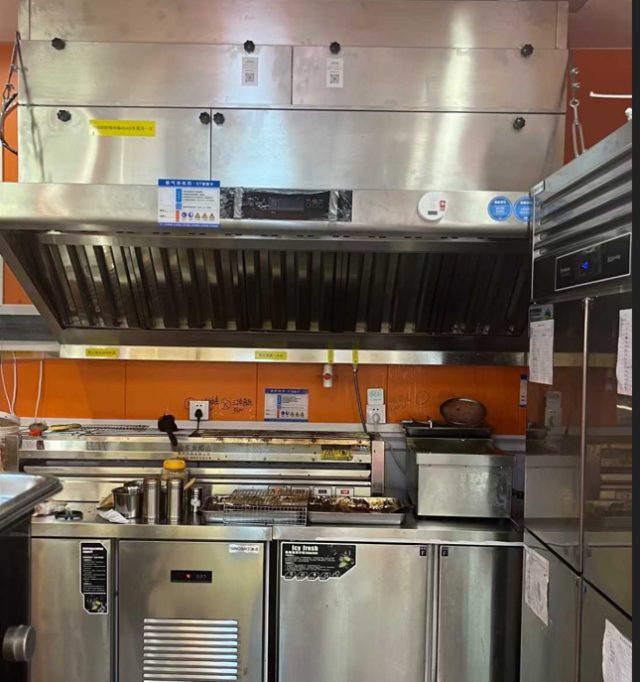
A konoba is not a restaurant in a box. The walls are 60 to 80 cm of limestone, the ceiling has no void above it, the roof is stone slab or terracotta laid on timber, and at the back there is a charcoal grill that has been in the same corner for forty years. Then, in May, the town fills up and the kitchen runs twelve hours a day until October, and the building stands empty and damp for the other six months. Four constraints — no technical ceiling, a protected façade, salt-laden air and a seasonal trading pattern — decide the extract system long before any airflow calculation does.
1. The three reports nobody warns you about
Croatia licenses a catering establishment through the county or city office for economy, and the file that has to be submitted is unusually specific about the extract system. Alongside the court registration and the lease, the applicant supplies a bundle of technical reports, and three of them are, in practice, reports about the kitchen ventilation.
| Report | What it has to demonstrate | Who produces it |
|---|---|---|
| Report on ventilation effectiveness | That the installed system actually captures and removes fumes, heat and moisture from the working areas, and that the air balance is coherent | An authorised ventilation or mechanical engineer |
| Report on noise testing, with a solution issued by the Ministry of Health | That noise protection requirements inside the workspace are met, and that the plant does not create a nuisance outside | An authorised acoustics laboratory |
| Report on air pollution from harmful emissions | Required specifically for premises that prepare and serve meals — the discharge and its odour and particulate load | An authorised environmental engineer |
Four further documents sit around these: the electrical installation test report, the gas tightness and gas appliance reports where gas is used, the operational licence under the Construction Act, and — where the building is registered cultural property — a licence to perform the activity issued by the conservational division of the Ministry of Culture, or by the city institute for monument protection in Zagreb. Add the fire department’s approval and the file is complete.
The practical consequence is that the buyer is not paying for a hood, but for three professional reports that a hood has to make true. A supplier who cannot give the designer the numbers those reports need — capture velocity, discharge height, duct velocity, sound power, odour stage duty — converts a two-week approval into a two-month correspondence.
2. Charcoal sits outside the harmonised calculation
This is the technical fact that most konoba projects discover late. Croatia is a CEN member and applies the EN 16282 series for commercial kitchen ventilation, which provides the calculation method for airflow, hood design, duct sizing and aerosol separation. Part 1 of that series states its scope clearly: it does not apply to solid fuel appliances such as charcoal grills.
So a konoba whose centrepiece is a gradele — fish and meat over charcoal — has no harmonised calculation route for the hood over that grill. The designer has to build a first-principles case: radiant heat from the bed, the plume velocity above the coals, the capture velocity needed at the hood face, the spark and ash load, and the fact that the grill cannot be switched off between covers. That case is what the ventilation effectiveness report argues, and the reviewer will ask what it is based on.
Three design answers hold up in practice. Give the charcoal grill its own hood, separate from the general canopy over the range and fryer, because the plume from coals behaves differently from the plume from a pan and mixing them compromises both. Design the grill hood at a higher face velocity than the canopy — 0.5 m/s rather than 0.4 — because the plume leaves the coals with upward momentum rather than drifting. And fit a spark arrestor and an ash trap ahead of any filtration stage, because a filter bank that receives embers is a filter bank that catches fire.
3. Stone walls: where the duct can actually go
A load-bearing limestone wall 70 cm thick is not a partition. Cutting a 400 mm opening through it needs a structural opinion and, in a protected old town, a conservator’s approval as well, and the conservator’s answer is often that the visible façade cannot change at all. In practice there are three routes, and they rank in this order.
- Reuse the existing chimney position. Almost every old konoba has a masonry chimney, and its roof penetration already exists and is already accepted. The flue itself is almost never usable — the section is too small, it may be shared, and it is not fire-rated for grease — but the position is gold: a new purpose-made duct can often be taken up the same stack line with the roof exit rebuilt around it.
- Roof penetration through the stone slab. Viable where the roof is being repaired anyway, because the flashing and the waterproofing have to be rebuilt around the new duct, and that is a roofing job as much as a ducting job. On a kupa roof of stone slabs this is skilled work; done badly it leaks within one winter.
- The internal courtyard. Often the only option in a dense old town, and the worst one technically, because a courtyard is the textbook poor-dispersion case: the plume has nowhere to go but into the windows above it. If the courtyard is the only route, the odour stage has to carry the burden that stack height would otherwise carry.
Two rules survive all three routes. Never connect into a shared chimney flue serving other premises or dwellings: the section is wrong, the fire rating is absent and the cross-contamination is immediate. And size the duct for grease transport rather than for pressure alone — 8 to 10 m/s is the usual working range, because below that the grease stops travelling and starts depositing on the duct floor, which is where duct fires begin.
4. Salt air, and the specification that fails in year three
This is the item most often value-engineered out, and the one that produces the angriest phone call two summers later. On the Dalmatian coast, corrosivity to ISO 12944 reaches C5-M — very high, marine — within roughly a kilometre of the shore, and C4 in sheltered positions. A galvanised fan casing in that environment shows rust streaks in the second season and perforates by the fourth. The operator then replaces the fan, blames the hood, and tells the next supplier that “stainless steel doesn’t last here”.
| Component | Wrong answer near the sea | Right answer |
|---|---|---|
| Hood and duct | 304 stainless or powder-coated mild steel | 316L stainless; 304 pits at welds in chloride |
| Fan casing | Galvanised sheet | 316L or equivalent coated marine grade |
| Motor | IP44, open frame | IP55 minimum, IP65 where washdown happens |
| Fasteners and brackets | A2 / 304 fixings | A4 / 316 fixings throughout |
| Roof termination | Zinc-coated cowl | 316L termination with a proper flashing detail |
Salt changes maintenance as well as specification. Chlorides plus grease produce stress-corrosion cracking at 304 welds, so a washdown schedule that leaves salt sitting in crevices is worse than no schedule at all. And the six idle months matter more than the season: an unheated stone building in winter holds condensate against every cold metal surface, so a fan that sits still from November to April corrodes on the inside of its casing. The mitigation is cheap and almost never specified — isolate and cover the plant at the end of season, and run it for ten minutes a month.
5. The season changes the economics, not just the schedule
A konoba on the coast typically trades 170 to 190 days a year at ten to twelve hours a day. That is roughly 2,100 operating hours, against 4,000 to 5,000 for a city restaurant open all year. Two decisions follow directly.
First, payback arithmetic must be done in operating hours, not calendar years. A larger plant and a smaller plant cost the same to buy roughly in proportion to their airflow, but their energy and maintenance are consumed only while running, and there are half as many running hours as the annual-average spreadsheet assumes. Comparing two options on “annual cost” hides this; comparing them on cost per operating hour exposes it.
Second, materials have to be chosen for the idle case, not the busy case. The worst corrosion happens in February, not in August. This is why a specification written for a year-round city restaurant underperforms on the coast even when every number on it is correct.
6. Noise in a stone lane
Old towns are acoustically hostile. Limestone walls reflect almost everything, a courtyard concentrates it, and the nearest bedroom may be four metres away across a lane with single-glazed windows. The same roof fan that is unremarkable on an industrial unit measures several decibels higher in that geometry, and the Croatian licensing file requires a noise report with a solution from the Ministry of Health for the workspace.
The measures that work are unchanged by geography: select the fan at a low tip speed rather than the top of its curve, put the silencer on the atmosphere side, mount on anti-vibration bases with flexible connections, and keep the discharge away from the lane elevation if the roof allows. What changes is the tolerance — in a stone lane there is no acoustic forgiveness, and a communal warden responding to a complaint is a slower and more expensive process than a better fan at order stage.
7. The fire file
Croatian fire protection law puts the obligation on the owner to keep ventilation, chimneys and other installations in working order according to technical norms and manufacturer instructions, with documentation of that maintenance. It also requires that fixed fire-extinguishing and detection installations be inspected at least annually by an authorised legal person, with a written record of the inspection — and, for equipment imported from abroad, a certificate of proper operation and suitability issued by an authorised legal person for each appliance or consignment.
That last provision matters if suppression equipment is supplied with the hood: the certificate is a local document, not a CE declaration, and it belongs in the quotation as a line item with a lead time. For a charcoal grill the rest of the file is straightforward but non-negotiable: grease filters that are actually cleaned, a duct cleaning interval set by trading hours rather than by the calendar, spark arrestors, and clearance from the coals to any combustible structure — which in a timber-roofed stone building is not a theoretical concern.
8. Sizing a typical konoba line
Take a realistic layout: a 1.2 m charcoal grill, a two-burner range and one fryer for potatoes, under a general canopy, in a room with a 3.2 m ceiling.
The grill hood. A 1.4 m by 0.7 m hood presents 0.98 m². At the 0.5 m/s appropriate for a charcoal plume, that is 0.49 m³/s, or about 1,760 m³/h.
The general canopy. A 2.4 m canopy with a 0.6 m opening presents 1.44 m². At 0.4 m/s, that is 0.576 m³/s, or about 2,070 m³/h.
The total. Roughly 3,800 to 4,000 m³/h, allowing for the fryer. At a grease-transport velocity of 9 m/s, 4,000 m³/h needs 0.124 m² of duct section — 400 mm diameter, or 500 by 250 mm rectangular, which is the size that actually fits behind a stone lintel.
If the route is refused and the system must recirculate, the odour stage becomes the binding constraint, and it should be specified by contact time and media mass rather than by box count: 4,000 m³/h is 1.11 m³/s, so a 0.4-second contact time implies about 0.44 m³ of carbon bed, which is roughly 200 to 220 kg of media. That mass has to be replaceable every few months by someone who can physically reach the unit, in a building with no service void — which is a design constraint, not a maintenance preference.
9. Where the equipment choice lands
Where the conservator will not allow a new roof penetration and the courtyard is the only remaining route, a self-contained hood that pairs a multi-stage electrostatic cell with a carbon odour stage keeps the whole compliance question inside the appliance — the ND-series for a line with a charcoal grill and a fryer running continuously, the N-series where the menu is lighter and the extract volume smaller. Where a stack is possible but the neighbouring windows are four metres across a lane, an Odor Removal Tower at the discharge buys the dispersion that the building will not give you in height. For the summer circuit — beach bars, festival stands, the seasonal terraces that appear along the coast in June — the mobile catering units carry their own extract and odour stage, which removes the stone building from the problem entirely.
Comparing the two fixed architectures on Croatian numbers is instructive. A ductless purification hood avoids the structural opening, the conservator’s file and the roof flashing, at the cost of carrying the full odour duty in media that has to be changed twice a season. A ducted electrostatic line with a centrifugal fan keeps the media small and the running cost low, but it needs a 400 mm hole in a 70 cm limestone wall and a stack that clears the ridge — which in a protected old town is a planning question before it is an engineering one.
10. Ten lines for the Croatian quotation
| No. | Item | What a checkable answer contains |
|---|---|---|
| 1 | Grill hood, separate from the canopy | Face velocity 0.5 m/s, hood dimensions, distance from the coal bed |
| 2 | General canopy | Face velocity 0.4 m/s, opening area, overhang beyond the cooking line |
| 3 | Duct route | Which of the three routes, the wall or roof penetration size, the structural and conservator approvals named as line items |
| 4 | Duct velocity | Design velocity in m/s, stated against the grease transport requirement |
| 5 | Materials | 316L for hood, duct and casing; A4 fixings; motor IP rating; corrosion category claimed |
| 6 | Odour stage | Media mass in kilograms and contact time in seconds, derived from the design airflow |
| 7 | Noise | Sound power by octave band, predicted level at the nearest window, silencer position |
| 8 | Fire | Spark arrestor, ash trap, filter class, cleaning interval, and who issues the local certificate for any suppression equipment |
| 9 | Idle-season provision | Isolation and covering method, monthly run instruction, washdown schedule for chloride removal |
| 10 | Reports support | Which figures the supplier will provide for the ventilation, noise and emissions reports, and in what format |
Item 10 is the one that separates a supplier who has exported to Croatia from one who has not. The three reports are the gate, and the numbers in them come from the equipment supplier, not from the consultant who writes them.
11. The short version
A konoba is a stone box with a charcoal grill, a protected façade and a six-month season. The charcoal grill falls outside the EN 16282 calculation, so the hood over it needs its own design case at 0.5 m/s rather than a table lookup. The duct has three possible routes and the only good one is usually the existing chimney position. Everything metallic should be 316L with A4 fixings because the coast is C5-M, and the plant has to survive February idle, not just August busy. Get 3,800 to 4,000 m³/h and a 400 mm duct right, support the three reports with real numbers, and the licence follows.