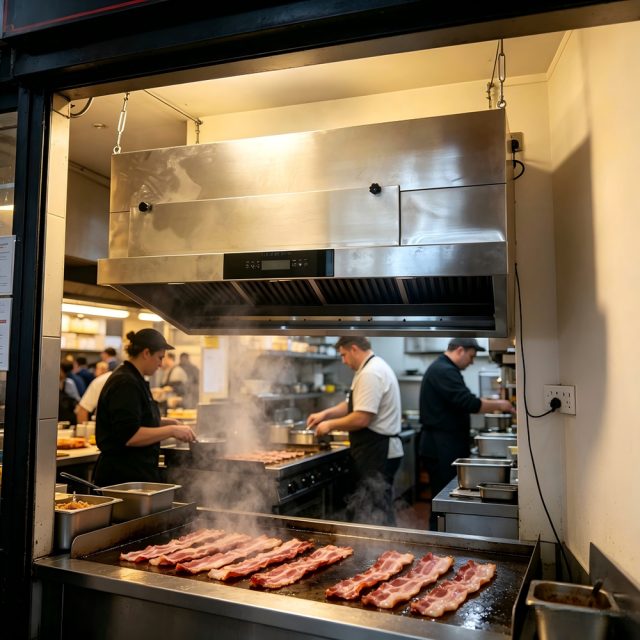
A guest paying two hundred dollars for a tasting menu notices things a casual diner never will. The temperature of the butter. The acoustics of the room. And — critically — the smell of the air. In fine dining, the dining room is not separated from the kitchen by a wall and a swinging door the way it is in casual restaurants; the open kitchen, the chef’s counter, and the pass are now central design elements of the premium experience. That architectural choice creates an air-quality problem that most commercial kitchen ventilation standards were never written to solve. NFPA 96 assumes a ducted canopy carrying grease-laden vapor out of the building. It does not address what happens when the kitchen is inside the dining room, when the guest is seated eight feet from the sear station, and when the entire concept depends on the room smelling of nothing but the plate in front of them.
Why fine dining is an unusual ventilation problem
A high-end restaurant kitchen does not produce the same exhaust profile as a QSR line or a hotel banquet operation. The cooking is lower-volume but considerably more varied, and the pollutants are chemically different:
- Low-and-slow techniques dominate. Sous-vide, confit, temperature-controlled holding, and gentle reductions produce water vapor and trace organic aerosols rather than the heavy grease plume of a flattop griddle. The volume is lower but the odor-active fraction is high and persistent.
- Searing is intermittent but intense. A tasting menu might finish eight covers in ninety seconds during service — a short, sharp burst of Maillard-crust aerosol and rendered fat particulate, then nothing for several minutes. Peak-load sizing matters more than average load.
- Butter, cream, and reduced stocks are constant. Butter aerosol is notoriously difficult to capture. It is finer than typical kitchen grease and carries an odor that reads as “stale” long after it has deposited on soft surfaces.
- Service is long and continuous. A three-hour dinner service means the purification system runs for hours without a cooldown cycle, and any odor breakthrough accumulates in the room rather than dissipating.
The consequence is that fine dining operators care about a metric the rest of the industry largely ignores: odor breakthrough. Not “is the air safe” — that is a solved problem — but “does the guest at table twelve smell the shallots being sweated at the garde manger.” That is a much stricter standard, and it is the reason the ductless capture-and-treat architecture has become the default answer in premium venues.
The ductless N-series + Odor Removal Tower workflow
For a fine dining room, the Souniny N-series (light-duty line of ductless all-in-one range hoods) is the natural starting point. Most of what a tasting-menu kitchen produces is light oil fume and vapor: sauce reductions, gentle sauté, poaching, and holding. The N-series captures that at the cooking surface, ionizes the particulate in an electrostatic field, and collects it on aluminum plates — then returns the treated air to the room. Because the architecture is ductless, there is no rooftop penetration, no vertical shaft, and no requirement that the building have been designed with a commercial kitchen in mind at all.
What the electrostatic stage does not remove is the odor-active fraction — the volatile organic compounds that carry the actual scent of alliums, reduced stock, and seared fat. Removing particulate is necessary but not sufficient for a two-hundred-dollar dinner. That is the role of the Odor Removal Tower (除味箱): a downstream module that pairs with the N-series to adsorb residual odorants and return genuinely neutral air to the dining room. The combination is what makes an open kitchen viable in a premium setting.
The ductless model only works if the room has a controlled intake path. A perfectly sealed dining room with no makeup air is not a solution — it is a different problem. Confirm that fresh-air supply is filtered and balanced on the same floor before commissioning any recirculating system.
Handling the sear station
Every serious fine dining kitchen has at least one high-heat element: a plancha, a charcoal grill, a heavy sauté section for the protein course. That element does not belong under a light-duty hood. This is where the ND-series (heavy-duty line) earns its place — sized for the heat and grease output of intense searing, and paired with its own Odor Removal Tower so the burst from an eight-cover pickup does not drift to the pass. In practice, a well-designed premium kitchen runs both: N-series over the gentle stations, ND-series over the fire.
Heritage buildings, hotel conversions, and the duct problem
The most common reason a fine dining operator ends up on ductless equipment has nothing to do with the food. It is the building. Premium restaurants disproportionately occupy the kinds of spaces that cannot be ducted:
- Heritage and listed buildings where facade and roof penetrations are protected, or where the roof structure cannot carry a commercial exhaust shaft.
- Ground-floor units in mixed-use developments with no allocated riser and a landlord unwilling to grant one.
- Boutique hotel conversions where the kitchen goes into a space that was never a kitchen — a former library, a banking hall, a ground-floor salon.
- Upper-floor restaurant spaces where a vertical duct run would consume sellable floor area or cross another tenant’s demise.
In each of these, a ducted canopy with a Centrifugal Fan and an inline ESP Purifier is either structurally impossible or commercially prohibitive. The ductless path is what makes the site viable at all, and for a fine dining operator whose entire value proposition depends on a specific room, that is decisive.
Where the ducted chain still wins
There are fine dining operations where the ducted architecture remains correct, and operators should not talk themselves out of it:
- Existing rated shaft in place. If the previous tenant was a restaurant and the exhaust infrastructure is already there and compliant, an ESP Purifier + centrifugal exhaust chain preserves that investment and keeps the kitchen footprint tighter.
- Heavy charcoal or wood-fired concepts at scale. A fine dining restaurant built around a large open hearth produces a continuous, high-temperature particulate load that exceeds what a ductless module should handle continuously. That belongs on a ducted system.
- Very high cover counts. Above roughly a hundred and twenty covers per service, the aggregate pollutant load generally favors a ducted solution with an inline electrostatic precipitator stage.
A good rule of thumb: if the concept is gentle cooking in a difficult building, go ductless. If the concept is fire and volume in a building that already has a shaft, go ducted. Most fine dining falls into the first category.
Front-of-house finishing and the tempered glass cart
Premium service increasingly moves cooking into the dining room: tableside flambé, guéridon carving, cheese trolleys, and dessert finishing performed at the table. That is a mobile cooking operation, and it needs its own capture solution. The CV-C tempered glass cart is designed for exactly this: a ventless, self-contained platform with a tempered glass enclosure that captures and treats light cooking emissions at the point of service, without any connection to a building system. For a dining room where the theater of tableside service is the point, the cart lets the chef perform in the room without paying for it in air quality.
Low ceilings and compact kitchens
Heritage conversions and boutique hotels frequently deliver kitchens with ceiling heights that a conventional canopy simply will not fit under. The Cabinet Purifier addresses this: a compact, self-contained ductless unit that delivers capture-and-treat performance in a vertical envelope that fits beneath a low soffit or inside a tight galley. For a premium restaurant operating out of a converted space with 2.6-meter ceilings, this is often the difference between a workable kitchen and a compromise.
Commissioning a fine dining room
The standards that apply — NFPA 96 for fire safety, ASHRAE 154 for ventilation performance, EN 16282 for European equipment, AS 1668.2 for Australian installations — will tell an operator whether the installation is compliant. They will not tell them whether the guest at table twelve can smell the shallots. That requires a different test:
- Baseline the room. Measure PM2.5 and, if possible, total volatile organic compounds in the dining room before service, with the purification system off.
- Run a worst-case service. Full covers, all stations firing simultaneously, doors as they would be during service.
- Measure again at the guest position — not at the hood. The relevant sample point is table height in the dining room, not the kitchen.
- Run an odor panel. Three or four staff members who have been out of the room for ten minutes should enter blind and report whether the room smells of cooking. Humans detect odor breakthrough long before instruments do.
- Set the cleaning cadence from the results. Electrostatic collector plates and adsorbent media are consumables; their replacement interval should be derived from measured breakthrough, not from a generic calendar.
Ductless equipment does not eliminate maintenance; it relocates it from a rooftop cleanout to the back-of-house. In fine dining, budget that time into the prep window — not into the overnight close, when nobody wants to be stripping collector plates at one in the morning.
The guest experience argument
It is worth stating the commercial case plainly, because fine dining operators respond to it. A tasting menu is a product sold partly on atmosphere, and atmosphere is olfactory. Guests who leave a two-hundred-dollar dinner smelling of fried shallots do not write that in the review — they write that the room felt “heavy,” or “close,” or they simply do not return. Air quality is one of the few capital investments in a premium restaurant that acts directly on the review score, the return rate, and the length of the average check. Sizing the purification to protect the room rather than merely to pass inspection is not an engineering nicety; in this segment it is the whole point.