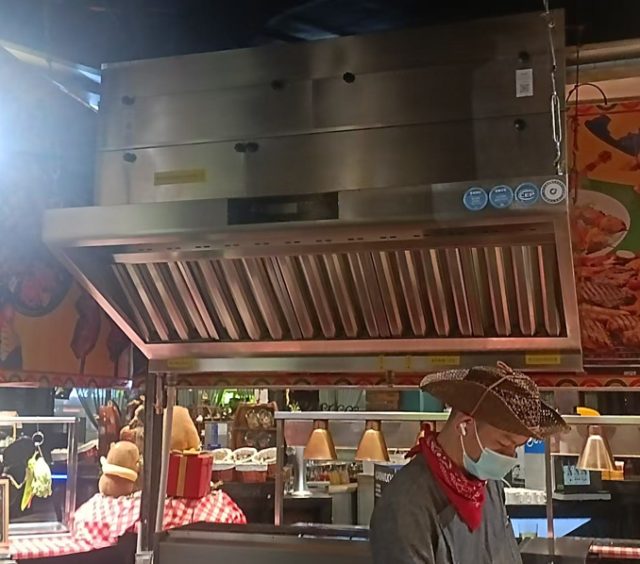
A fish and chip shop is the worst case in the United Kingdom’s official odour scoring table, and it is scored that way deliberately: frying is grouped with fried chicken, burgers and the wettest kind of pub kitchen at the highest cooking-type score the guidance allows. The practical consequence is that the extract system, not the fryer range, decides whether a shop can open at all — and unlike a restaurant, a chipper cannot trade quietly on a weak flue for a year and fix it later, because the neighbours are usually directly above the ceiling.
1. What the UK guidance is, and what it is not
The working document is Guidance on the Control of Odour and Noise from Commercial Kitchen Exhaust Systems, published by Defra in 2005 and prepared for Defra and the devolved administrations by Netcen, then part of AEA Technology. It is not statute. That matters less than it sounds, because three things give it teeth: local planning authorities routinely quote it in conditions attached to food and drink permissions, environmental health officers use it as the benchmark for Best Practicable Means when a statutory nuisance complaint is investigated under Part III of the Environmental Protection Act 1990, and a ventilation statement that does not follow its method is the fastest way to have a planning application deferred.
For a shop owner or a fit-out contractor, the guidance is therefore best read as a scoring system that produces a specification. It does not say “fit an ESP”. It says: score the site on four criteria, read the total, and buy the level of odour control that score demands — with the level defined, unusually precisely, by a carbon bed residence time in tenths of a second.
2. The score that decides everything
Four criteria are scored and added. Dispersion rewards a high, fast discharge and punishes a low one. Proximity rewards distance from the nearest sensitive receptor, which in a British high street usually means the flat above. Size counts covers or takeaway scale. Cooking type is fixed by the menu.
| Criterion | Condition and score | What a chipper usually gets |
|---|---|---|
| Dispersion | Very poor 20 (low level, courtyard, restricted stack) · Poor 15 (below eaves, or below 10 m/s) · Moderate 10 (1 m above eaves at 10–15 m/s) · Good 5 (1 m above ridge at 15 m/s and above) | 15 in a terrace, 5 on a detached unit |
| Proximity | Close 10 (receptor under 20 m) · Medium 5 (20–100 m) · Far 1 (over 100 m) | 10 where flats sit above or beside |
| Size | Large 5 (over 100 covers or large takeaway) · Medium 3 (30–100 covers) · Small 1 (under 30 covers) | 1 to 3 |
| Cooking type | Very high 10 (pub with heavy fried food, fried chicken, burgers, fish and chips) · High 7 (kebab, Vietnamese, Thai, Indian) · Medium 4 (Cantonese, Japanese, Chinese) · Low 1 (most pubs, Italian, French, pizza, steakhouse) | 10, always |
Totals map to three levels of odour control. Under 20 is low to medium. From 20 to 35 is high. Over 35 is very high. Three worked cases show how little room a fryer leaves you.
- Terraced high street, flats above, flue to rear eaves, four pans, 40 covers: 15 + 10 + 3 + 10 = 38. Very high control.
- Suburban parade, detached two-storey unit, ridge discharge at 15 m/s, receptor 25 m away, six pans, 90 covers: 5 + 5 + 3 + 10 = 23. High control.
- Retail park unit, nearest home 140 m, ridge discharge: 5 + 1 + 5 + 10 = 21. Still high control.
The third case is the one worth staring at. Even with good dispersion and a distant receptor, the cooking-type score of 10 keeps a fryer kitchen in the “high” band, because the two criteria that would have to fall are the two the operator cannot change. In practice, a chipper controls its score through dispersion and stack quality, not through menu or location.
3. Turning the score into kilograms of carbon
The three control levels are defined by carbon residence time, which is the single most useful number in the whole document because it can be calculated from airflow and checked against a quotation.
| Level | What the guidance accepts | Carbon residence time | Where it applies |
|---|---|---|---|
| Low to medium | Fine filtration or an ESP cell, then carbon; or fine filtration plus a counteractant system | 0.1 second | Score under 20 — almost never a fryer kitchen |
| High | Fine filtration or an ESP cell, then carbon; or fine filtration plus UV ozone | 0.2 to 0.4 second | Score 20 to 35 |
| Very high | ESP cell then carbon; or carbon plus counteractant; or UV ozone; or wet scrubbing | 0.4 to 0.8 second | Score over 35 |
Residence time is bed volume divided by volumetric flow, so it converts directly into a mass of media. Take a four-pan shop running 3,000 m³/h, which is 0.833 m³ per second. A 0.4-second requirement means 0.333 m³ of carbon bed. Activated carbon in bulk sits at roughly 450 to 500 kg per cubic metre, so the bed is about 150 to 165 kg. Push to 0.8 seconds for the very high band and it doubles to roughly 300 to 330 kg.
| Airflow | 0.1 s bed | 0.4 s bed | 0.8 s bed |
|---|---|---|---|
| 3,000 m³/h | 0.08 m³ · about 40 kg | 0.33 m³ · about 155 kg | 0.67 m³ · about 315 kg |
| 4,500 m³/h | 0.13 m³ · about 60 kg | 0.50 m³ · about 235 kg | 1.00 m³ · about 470 kg |
| 6,000 m³/h | 0.17 m³ · about 80 kg | 0.67 m³ · about 315 kg | 1.33 m³ · about 630 kg |
This is the arithmetic to run before signing anything. A quotation that offers “ESP plus activated carbon” with no residence time and no carbon mass cannot be checked against the score, and a planning condition will be written against the score. The number also has physical consequences: a 300 kg bed plus its housing is a roof load, it needs a plant area that a terrace back extension often does not have, and it needs a media change that someone can actually perform every four to six months.
4. Airflow and canopy: the fryer sets the number, not the room
Face velocity across the hood opening for frying plant normally sits between 0.4 and 0.5 m/s, at the high end where pans are close to the front edge of the range. A 2.4 m canopy with a 0.6 m opening presents 1.44 m², so 0.4 m/s gives about 2,070 m³/h and 0.5 m/s about 2,590 m³/h. Per-pan rules of thumb land in the same place: roughly 700 to 1,000 m³/h per fryer pan for heavy frying, so a four-pan range wants 3,000 to 4,000 m³/h and a busy six-pan shop with a range alongside it wants 5,000 to 6,000.
Three details change the number more than the fan choice. Overhang should run 150 to 300 mm beyond the appliance front, with side skirts where the range sits between walls, because capture at the front edge is what stops the smell reaching the shop floor. A canopy that is wider than the cooking line is not generous, it is expensive: every extra square metre of opening adds airflow, and every extra cubic metre of airflow adds duct, fan, ESP cells and carbon mass for the life of the shop. And make-up air has to be planned at 80 to 90 percent of extract, delivered outside the capture zone — if the only make-up is the front door, the system fails in winter, and the assumption behind the whole score fails with it.
5. The stack rule, and why cowls cost points
Discharge is the criterion an operator can actually improve, and the guidance is specific. Extracted air should discharge not less than 1 m above the roof ridge of any building within 20 m of the one housing the kitchen. If that is impossible for planning reasons, the fallback is 1 m above the eaves or dormer of the same building, with additional odour control. If neither is achievable, the guidance expects exceptionally high odour control, which in practice means the very top of the carbon range plus a written justification.
Efflux velocity is scored alongside height: 15 m/s or more at ridge level scores 5, 10 to 15 m/s above eaves scores 10, below 10 m/s or below eaves scores 15, and a courtyard or restricted stack scores 20. This is why decorative capping is a false economy. Local authority guidance discourages hat-type cowls precisely because they deflect the vertical discharge the score is rewarding; bird proofing and rain protection by other means are expected, capping is not.
6. Noise: BS 4142 and the condition that follows you
Odour gets the attention, noise gets the enforcement notice. Planning conditions for extraction plant in the UK are commonly written as a limit on the rating level at the nearest sensitive receptor assessed to BS 4142, often expressed as no more than 5 dB above background at night for a shop that trades late. The correction structure in BS 4142 — penalties for tonality and impulsiveness — is what turns an apparently compliant fan into a non-compliant one, because a whine or a beat is worth several decibels before any measurement is taken.
Four decisions made at design stage do most of the work: select the fan at a low tip speed rather than at the top of its curve, put the silencer on the atmosphere side of the fan rather than between fan and duct, mount plant on anti-vibration bases with flexible connections, and keep roof plant away from bedroom windows even when the sound power level is acceptable on paper. A 3 dB reduction is a halving of sound power, and it is nearly free before the unit is ordered.
7. Grease, fire and the cleaning certificate
The same guidance sets duct cleaning intervals by trading hours, and they are shorter than most operators expect: 12 to 16 hours a day means every three months, 6 to 12 hours a day means every six months, and 2 to 6 hours a day means annually. A chipper open from eleven in the morning until ten at night sits in the top band, which means four cleans a year on a duct that is often the hardest in the building to reach.
Two consequences for specification. First, access: a door within about 3 m of every change of direction, sized so that a person and tools can work, with an access schedule handed over at completion — a duct that cannot be cleaned is treated as a defect by both the insurer and the environmental health officer, whatever its airflow. Second, verification: in the UK the recognised standard for grease duct cleaning is TR19 Grease, and the deliverable is a post-clean report with photographs and deposit measurements at defined points, not an invoice saying the duct was cleaned. Ask for the report format before the first clean, not after.
Fire protection sits alongside this: a grease duct passing through a compartment wall needs fire-resisting construction and, where the wall is rated, a fire damper of the correct rating, plus fire suppression and baffle filters in the canopy itself. None of it is glamorous, and all of it is inspected after a fire rather than before one.
8. What actually goes into the planning application
Seven documents cover almost every case, and preparing them in this order avoids the usual two rounds of deferral.
- An odour risk assessment showing the four criteria, the scores and the total, with the site plan marked up for receptor distances.
- A plant specification naming the filtration stage, the carbon residence time and the carbon mass in kilograms.
- A discharge drawing showing the stack height against every ridge within 20 m, with the calculated efflux velocity.
- A noise assessment to BS 4142 with sound power levels for fan and plant, and the nearest receptor identified.
- A maintenance schedule matching the trading-hour cleaning intervals, naming who does it and how it is recorded.
- A duct route drawing with access door positions, fire stopping details and the plant weight for structural review.
- A use class statement. In England, hot food takeaways have sat outside the main use classes since September 2020 while restaurants and cafés fall within Class E, so converting a sit-down shop to takeaway-only can require permission on its own, independently of the extract system.
9. When there is nowhere to put a flue
Terraced parades, basements, arcades, converted listed buildings and shopping centres with shared risers all share the same problem: the 1 m above ridge rule cannot be met, and the fallback above the eaves is refused by the landlord or the conservation officer. This is the case for a recirculating system, and it is worth being precise about what such a system does and does not buy.
The score does not improve because the flue disappeared. A local authority applying the method will normally require the same carbon residence time for the band the site scores into, plus a maintenance regime it can inspect, because the odour still leaves the building — through the front of the shop rather than the roof. What changes is the binding constraint: with no stack, carbon duty and grease capture carry the whole load, so the specification has to be checked in kilograms and seconds rather than in hood length.
Three things are worth agreeing in writing before the unit is ordered: the carbon change interval in months, with the mass stated; who measures and records the residence time at commissioning; and what happens if a complaint arrives anyway, which in a recirculating installation usually means a media upgrade rather than a stack.
10. Where this is already an engineered assembly
Some of the arithmetic above is easier when capture, filtration and odour stage arrive as one tested unit rather than as a hood from one supplier and a carbon box from another. A ductless hood that pairs a multi-stage electrostatic cell with a carbon odour stage can be specified by residence time and media mass exactly as the guidance requires — the ND-series for fryer-heavy menus where the oil load is continuous, the N-series where the menu is lighter and the extract volume smaller, and an Odor Removal Tower at the discharge where a flue is permitted but the nearest window is close enough to matter. For operators trading from market stalls and converted trailers rather than a fixed shop, the mobile catering units move the same capture and media decisions into a chassis that has to carry them.
11. How the UK method differs from the continent
It is worth knowing this before specifying for more than one country, because the same hood sells into four different substantiation packages. The UK approach is score-based: the deliverable is a risk assessment that produces a band, and the band produces a residence time. Germany works from VDI 2052 and the mass-flow logic of TA Luft, where the question is how many milligrams per hour leave the stack. The Netherlands works through odour units under the environmental decree, and France through the debit and rejection rules of the ERP framework. A supplier who can only produce one document will be credible in one market.
Where a kitchen is small, the architecture choice sometimes does the compliance work by itself: a ductless purification unit removes the duct and stack question that generates most of the planning correspondence, at the cost of carrying the full odour duty in media rather than in height. Where the load is heavy and a flue is permitted, a ducted electrostatic precipitator with a carbon stage is the arrangement the guidance’s higher bands were written around.
12. Eight lines for the request for quotation
Whatever the site, the same eight lines make quotations comparable, and they are the eight an environmental health officer will ask about if a complaint ever lands.
| No. | Line item | What a checkable answer looks like |
|---|---|---|
| 1 | Extract airflow at the hood | A figure in m³/h, with the face velocity and opening area it was derived from |
| 2 | Capture arrangement | Overhang in mm at the front edge, side skirts yes or no, make-up air volume and location |
| 3 | Filtration stage | Baffle filter plus ESP cell, with cell count, plate spacing and the cleaning interval in weeks |
| 4 | Odour stage | Carbon mass in kilograms and residence time in seconds, stated as calculated from the design airflow |
| 5 | Discharge | Stack height relative to ridges within 20 m, and efflux velocity in m/s |
| 6 | Noise | Sound power level by octave band, predicted rating level at the named receptor, silencer position |
| 7 | Cleaning and access | Access door schedule, duct cleaning interval in months for the stated trading hours, report format offered |
| 8 | Media and spares | Carbon change interval, filter and cell spares listed with part numbers, and the weight of the plant for structural review |
A quotation that answers four of these eight is usually a quotation for a canopy and a fan. The odour band, not the hood, is what the planning condition will be written against, and it is decided by two numbers that take ten minutes to check: residence time and carbon mass.
13. The short version
Frying scores 10 for cooking type before the site is even considered, so a chipper is in the high odour band almost by definition and in the very high band whenever the flats are close. That band buys a carbon residence time of 0.2 to 0.4 seconds, or 0.4 to 0.8 where the score passes 35, which converts into roughly 150 to 320 kg of media on a 3,000 m³/h system. Airflow follows the pans at 700 to 1,000 m³/h each, the stack has to clear every ridge within 20 m by a metre at 15 m/s, and the duct will be cleaned three or four times a year whether or not anybody planned for access. Get those five numbers into the quotation, and the rest of the fit-out has something to stand on.