A high-volume fry line is the point where ventless marketing meets engineering reality. At twenty chickens an hour, the question stops being “does the hood clean the smoke” and becomes a set of quantities: airflow sized for the batch peak rather than the average, carbon media weighed in hundreds of kilograms, oil aerosol collected by the litre per day, and heat rejected into the room by the kilowatt. Get the quantities right and the line runs for years; get them wrong and the kitchen discovers it at Friday lunch. This article works the numbers for a fry line in the thousand-birds-a-day class, which is the scale the big fried-chicken chains and their imitators actually run.
Defining the Duty Before Sizing Anything
Start with the production figure, because everything downstream is derived from it. A line frying 1,000 pieces across a ten-hour trading day runs at an average of a hundred pieces per hour, but frying is not an average process: it runs in batches. A double-vat fryer drops a basket of twelve to sixteen birds every six to eight minutes at peak, and each drop and each lift releases an aerosol pulse well above the steady-state rate. Designing to the average is the single most common sizing error at this scale, because the hood that looks adequate at 10:00 on a Tuesday fails capture at 12:40 on a Saturday when four baskets lift in the same minute.
The practical rule is to size airflow for the peak batch moment with a factor of about one and a half over the steady-state requirement, and then to check capture velocity at the hood face against the 0.4 to 0.6 metre-per-second band used for heavy fryer duty. Below that band, the plume from a lifted basket escapes sideways into the kitchen before the hood can pull it in; above it, the kitchen starts pulling conditioned air it cannot afford to lose.
Airflow: The Worked Numbers
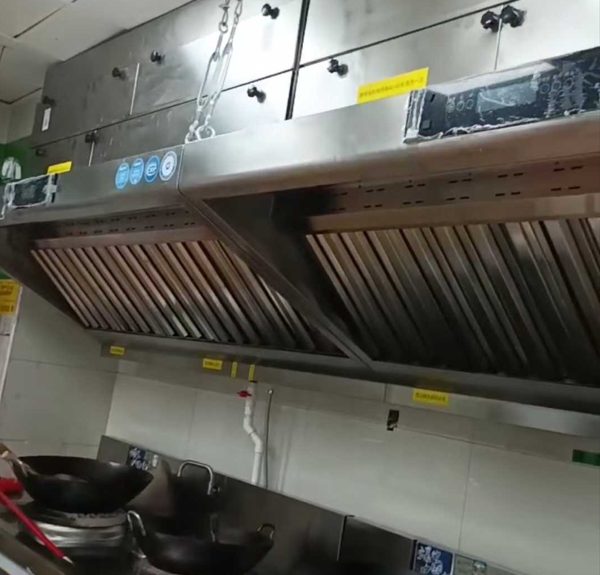
Take the common chain configuration: three double-vat fryers, one pressure fryer and a holding station arranged along a single cookline, covered by a 3.6 metre canopy. At heavy fryer duty the sizing rule of about 2,500 cubic metres per hour per metre of canopy gives 9,000 cubic metres per hour, which is 2.5 cubic metres per second. Across an open face of 3.6 by 1.05 metres, the face velocity works out at roughly 0.66 metres per second, sitting at the top of the heavy-duty band, which is where a volume fry line belongs: the batch pulses, not the nameplate rating, set the capture question.
Where the site has a duct, the same 2.5 cubic metres per second runs comfortably in a 630 millimetre duct at about 8.0 metres per second, inside the transport window that keeps grease moving instead of settling on the duct wall. Undersizing the duct to save money puts the line into the range where grease deposits build, and a fouled duct silently adds resistance the fan was never selected for.
The resistance stack for a ducted route with an electrostatic stage runs roughly as follows: 40 pascals at the entry, 160 across the baffle filters, 220 through the duct and bends, 280 across the electrostatic cells in the loaded condition, 60 through the carbon bed, and 40 at the terminal, for about 800 pascals before margins. Adding ten per cent for system effects gives 880, and the fan is selected at 900 to 1,000 pascals with a motor that keeps reserve for the fouled condition. Shaft power is 2.5 cubic metres per second times 900 pascals divided by a fan efficiency of about 0.62, which is roughly 3.6 kilowatts and a 4 kilowatt motor. A fan selected at the clean-filter condition with no reserve is the quietest way to guarantee an airflow complaint within a year. That resistance stack is also the datasheet a buyer should demand from any ducted ESP filter quoted for this duty: clean and loaded pressure drop, stage by stage, or the fan selection above is built on guesses.
Filtration at Volume: What Changes From a Small Hood
At a 2.5 cubic-metre-per-second duty, each filtration stage has to earn its place, because every stage consumes pressure, power and maintenance time. The baffle first stage does the heavy lifting: at fryer duty the oil aerosol is coarse enough that well-designed baffles capture the majority of the mass before the electrostatic stage sees it. That matters at volume because the electrostatic cell is a consumable of time, not just of hardware: the wash interval scales directly with the kilograms of oil pulled from the air, and a line like this generates enough aerosol that the cells need washing daily to three times a week, not monthly. The arithmetic is visible in the oil consumption itself: a line turning over 60 to 80 litres of frying oil per day will pull one and a half to three litres of it into the airflow, and every litre either lands in a filter stage that was scheduled for it or on a surface nobody scheduled.
The electrostatic stage at this duty should be a multi-pass arrangement, sized on the loaded pressure drop rather than the clean one, with access for cell removal that does not require scaffolding or dismantling the duct. Single-pass cells sold on clean-filter efficiency figures are the specification trap at this scale: the efficiency claim was measured at light loading, and the real duty saturates the first pass within weeks.
Oil Load and the Cleaning Economy
The consumption arithmetic makes the maintenance schedule concrete. A thousand pieces of fried chicken take up something in the range of 50 to 70 litres of frying oil per day, and two to four per cent of that oil leaves the vats as airborne aerosol, so between roughly one and three litres per day ends up in the extraction train. Each litre either lands in a filtration stage that was scheduled and sized for it, or deposits on the duct wall, the carbon bed or the neighbouring ceiling. Reading the number backwards is the useful exercise: the litres per day the line produces define the baffle wash interval, the cell wash interval and the carbon turnover together, and any schedule that ignores them was written for a different kitchen.
The labour figure belongs next to it. Washing baffles at this duty costs twenty to thirty minutes a day; an electrostatic cell wash cycle costs thirty to forty-five minutes plus drying time, which is why a spare cell set, washed and dried while the first set runs, keeps the line at full production with zero downtime. Carbon replacement at a few hundred kilograms per turn is a scheduled works item, not a Tuesday task, and it needs a trolley route and a disposal arrangement decided in advance. None of this is expensive; it is simply a running cost that arrives as labour and consumables rather than as an invoice, and the kitchens that treat it as an engineering line item are the ones whose hoods still read their nameplate airflow in year five. The buyer’s question to any supplier is therefore specific: give me the consumable table for my airflow and my oil load, not the generic one from the brochure, and quote the spare cell set as a line item rather than an afterthought.
The Carbon Question That Decides the Architecture
Odour control at 2.5 cubic metres per second is a logistics decision disguised as a chemistry decision. Half a second of contact time needs about 1.25 cubic metres of activated carbon, which at typical bed density is in the region of 600 kilograms. Six hundred kilograms of carbon has a replacement weight, a disposal cost, a manual-handling requirement and a floor-loading implication, and it turns over on a schedule measured in months at this load. There is no configuration of thin carbon pads that reaches this figure; a supplier quoting odour control at this airflow without stating media mass is not quoting odour control.
This is precisely where the architecture decision is made. A ducted route puts the carbon bed in a plant room where a forklift or a trolley can reach it, alongside the electrostatic housing, and the kitchen keeps its headroom. A fully recirculating canopy at this duty has to hold the same media above the cookline, which drives the hood’s weight, its service access and its structural fixing into ranges that many buildings cannot carry; where that route is chosen, the ductless range hood range is the place to start, specified on loaded pressure drop and real media mass rather than nameplate airflow. Where the fry duty sits in a kiosk or cart format rather than a fixed line, the mobile catering cart formats cover the smaller end of the same duty on a plug-in basis. The crossover between the two architectures is not a matter of taste: it is the point where carbon mass, cell washing access and heat rejection make the ducted route cheaper to own even when the duct itself costs money to build. At the thousand-birds-a-day scale, the ducted route usually wins on running cost, and the recirculating canopy wins only where the duct is genuinely impossible.
Heat: The Line Item Nobody Quoted
Four electric fryers at 13 kilowatts each are 52 kilowatts of connected load, of which about 85 per cent goes into the oil and the food. The remaining six to eight kilowatts go into the kitchen air, and a recirculating hood returns that heat to the room instead of sending it up a duct, so it becomes cooling load: roughly two tonnes of additional refrigeration to hold the same kitchen temperature. On a gas-fired line the burner enclosure adds combustion products and more rejected heat, which the ventilation path has to carry. Any proposal for a volume fry line that does not state heat rejection in kilowatts and the cooling answer in tonnes is not a proposal; it is a brochure. The number also belongs in the operator’s running-cost model, because the cooling bill arrives every month whether or not anyone connected it to the fryers.
Commissioning and Acceptance at Volume
The acceptance test for a line of this class has four checks. Airflow measured at the hood and at the fan against the design figure, within the usual tolerance of ten per cent on flow and five per cent on pressure. Capture demonstrated at the peak batch moment, not at idle: baskets dropped and lifted on a full fryer with the kitchen doors in their trading condition. A visible smoke observation at the discharge or at the room boundary for a recirculating line. And the odour stage checked at the boundary that matters, which in a dense street is the neighbouring tenancy rather than the roof terminal. The cleaning schedule is part of acceptance too: at this duty, baffle daily, electrostatic cells daily to three times weekly, carbon on a monitored interval, and the man-minutes for each stated on paper so the kitchen can staff it.
The most expensive failure in this class is not a wrong fan or an undersized cell; it is a cleaning schedule written for a small hood and applied to a volume line. Every subsequent performance complaint traces back to that document.
Six Failures That Repeat at This Scale
Airflow sized to the average instead of the batch peak. A single-pass electrostatic stage sold on clean-filter efficiency. Carbon specified without a media mass, so the odour stage is nominal. No drainage or grease routing planned for the litres per day the line actually produces. A fan with no reserve for the fouled condition, chosen on the clean-filter pressure drop. And heat rejection never stated, discovered when the air-conditioning cannot hold the kitchen in summer. Each of these is visible in a datasheet review before the order, which is the cheapest moment to catch it.
How This Changes What You Buy
At volume, the buying decision is between three architectures, and the numbers above decide it. Where a duct exists or can be built, the ducted route with a purpose-built electrostatic unit ahead of a centrifugal fan carries the duty with the carbon bed in a serviceable plant room. Where the duct is genuinely impossible, a recirculating canopy must be specified on loaded pressure drop, real media mass and structural capacity, not on brochure airflow. The ND-series ductless line covers the recirculating end of that range for heavy fry duty, an Odor Removal Tower carries the gas-phase stage where the boundary that matters is close, and the ESP Purifiers ducted line handles the high-volume end where the carbon logistics favour a plant room. Whichever way the decision lands, the buyer who walks in with peak airflow, contact time, media mass, heat rejection and cleaning man-minutes already on paper will find the quotation conversation shorter, and the kitchen that opens on those numbers is still meeting its own specification five years later.