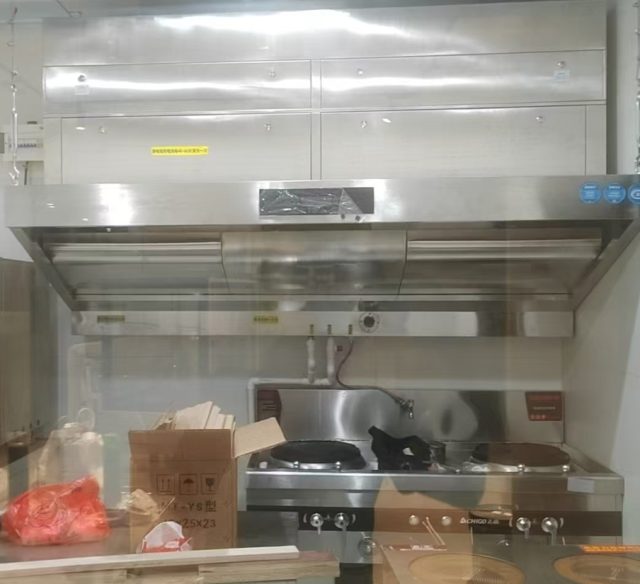
A owner of a small Hungarian vendeglo in Budapest is usually not short of vendors willing to sell a hood. What tends to be missing is a way to judge the quotes: which airflow number is defensible, which document proves odour is being handled, and what the fire authority will ask for at inspection. This article walks through the fume load of a typical Hungarian menu, the national rules that shape the specification, a worked sizing example around 7,000 m3/h, and a ten-point checklist you can carry into the negotiation.
What a Hungarian menu actually puts in the air
The classic vendeglo cookline concentrates three very different emission profiles within about three metres of bench. The langos fryer is the heaviest: dough sheets at 170-190 degrees C generate a dense aerosol of grease-laden vapour mixed with a large steam plume, and the steam carries sub-micron particulate that passes straight through ordinary metal mesh filters. Next to it, breaded dishes such as rantott hus and fried cheese are pan-fried or shallow-fried at similar temperatures; their breadcrumb crust sheds fine particles that cake onto hood surfaces and duct walls faster than most operators expect. Along the rest of the line, the gulyas and other stew pots contribute almost no grease but a strong, moisture-saturated plume of aromatic volatiles – paprika, onion, braising vapours – that is an odour problem rather than a filtration problem.
This split matters because it drives a two-stage treatment logic. The particulate phase – grease aerosol and breadcrumb dust – must be captured and separated first, because any carbon or adsorption stage placed upstream of an adequate grease separator saturates within weeks and becomes a replacement item the operator did not budget for. The gaseous phase – the odour compounds from broths and frying oil breakdown products – can only be addressed after the particulate load is removed, using an activated carbon stage sized on residence time, not on a catalogue promise. A quote that treats both phases as one filter change is the single most common specification error in this segment.
The rules that shape the Hungarian specification
Four instruments decide what a Hungarian kitchen installation must demonstrate, and none of them is optional in the way vendors sometimes imply.
Decree 306/2010 (XII. 23.) Korm. rendelet on air protection. The national air-protection decree states that loading the air with annoying odour is prohibited, and that an activity involving odour emission may only be pursued if the operator applies best available techniques. Where odour prevention is not technically guaranteed, the authority may restrict, suspend or prohibit the activity. In practice this is the clause behind a neighbour complaint about frying smells in a tenement courtyard: the operator carries the burden of showing a BAT-level treatment chain, not merely a fan on the roof.
Act LIII of 1995 on the General Rules of Environmental Protection. This framework act underpins the decree and establishes the complaint and enforcement path that a restaurant sits inside.
Decree 54/2014 (XII. 5.) BM rendelet – the OTSZ, Hungary’s National Fire Protection Regulation. The OTSZ governs fire risk classification, fire compartments, and the obligation to keep documentation and periodic inspections current. Under Act XXXI of 1996 on Fire Protection, a business employing more than five people, or operating premises with a capacity above 50 persons, must maintain a written fire safety regulation (tuze vedelmi szabalyzat) and keep it in line with the actual installation. A grease-laden extract duct is exactly the kind of element inspectors check against that document – so the duct material, access panels and cleaning interval must appear in the paperwork, not just on the invoice.
Joint Decree 3/2002 (II. 8.) on minimum workplace requirements. This is the instrument buyers overlook, and it has real numeric teeth for a hot kitchen. The decree caps the effective temperature at the workplace depending on workload: 31 degrees C for light physical work, 29 degrees C for moderately heavy work, and 27 degrees C for heavy work. Above an effective temperature of 24 degrees C the employer must provide protective drinks at least every half hour, and in workplaces where a suitable climate cannot be maintained by ventilation, rest breaks of 5 to 10 minutes per hour must be scheduled. A fry-and-stew kitchen is moderately heavy to heavy work; if extraction is undersized the room drifts past these limits and the operator acquires a labour-inspection exposure on top of the ventilation problem. Sizing the extraction to hold the kitchen below the applicable limit is therefore a compliance number, not a comfort number.
At the technical layer, the EN 16282 series (adopted in Hungary as MSZ EN 16282) is the reference design standard: Part 2 covers hood design and safety requirements, Part 5 duct dimensioning and hygienic cleanability, Part 6 aerosol separators, and Part 8 the testing of cooking-fume treatment installations. Specifying “designed to EN 16282” without naming the parts is a red flag; a serious vendor states which parts its hood, duct and separator claims rest on.
A sizing worked example you can take to tender
Consider a representative vendeglo kitchen: a fry section with a langos fryer plus two basket fryers under a 1.8 m canopy section, and a stew-and-plate range under a further 1.2 m section. Using the widely applied heuristic of roughly 2,000 m3/h per metre of hood for heavy fry loads (2,500 m3/h per metre for open fry stations with high evaporation, and about 4,000 m3/h per open burner), the arithmetic looks like this:
Fry section: 1.8 m at 2,000-2,500 m3/h/m gives 3,600-4,500 m3/h. Because the langos fryer is an open, steaming load, design at the top of the band: 4,500 m3/h. Stew and range section: 1.2 m at about 2,000 m3/h/m gives 2,400 m3/h. Combined design airflow: approximately 6,900 m3/h, which rounds to a 7,000 m3/h extraction duty.
Cross-check with capture velocity: a 1.8 x 1.1 m canopy has about 1.98 m2 of opening; at 7,000 m3/h (1.94 m3/s) the face velocity is roughly 1.0-1.2 m/s at the aperture once filter area is accounted for – consistent with recommended capture practice when the canopy overhangs the appliance edge by 150-300 mm. If a vendor quotes 3,000 m3/h for this cookline, the capture check alone shows the number cannot hold the plume over an open langos fryer.
Now the odour stage. At 7,000 m3/h, an activated carbon bed with a 0.2 second residence time needs about 0.39 m3 of carbon media; at 465 kg per m3 that is roughly 180 kg of carbon. A quote that states “carbon filter included” without a mass figure may be offering a cassette weighing a few kilograms, which saturates in days on a fry-heavy load. Ask for the carbon mass in kilograms and the claimed residence time, and you will separate real odour engineering from catalogue padding in one question. Fan duty follows from the same numbers: with roughly 500-560 Pa of system pressure (duct, baffle filters, ESP cell and carbon bed), a 700-800 Pa class centrifugal fan is the defensible selection, and the shaft power at 1.94 m3/s and 700 Pa is about 2.3 kW – so a 3 kW motor rating is the honest specification.
Ducted, ductless, or cabinet: the tenement decision
Budapest ground-floor kitchens, especially in the District VI-VIII tenement belt, share a structural constraint: the kitchen often sits with living bedrooms above or across a shared courtyard, and the facade may be protected, so a new vertical duct penetration is either impossible or politically expensive. Three routes exist, and the choice should follow the building, not the vendor’s catalogue.
Where a genuine duct run to a courtyard ridge or roof discharge can be built – with discharge height and separation from neighbour windows worked out on a drawing – a full extract line with an inline treatment train is the conventional answer; the ducted ESP purifier range covers that high-volume end, with the ESP cell handling the particulate phase and the carbon stage taking the odour compounds before discharge. Where no duct is feasible, a recirculating architecture is the practical route: a ductless all-in-one hood that pairs a washable grease separation stage with an ESP Cell and an activated carbon stage, discharging cleaned air back into the kitchen rather than into the neighbour’s window. The honest caveat: recirculation is not an exemption from the odour-prohibition rule in Decree 306/2010 – it is a way of engineering the emission down to a level where a courtyard complaint does not start. The carbon mass, not the marketing, decides whether that holds.
Two Hungarian-specific variations complete the picture. First, many vendeglok run a summer terrace or a weekend street grill out front; a fixed cookline is the wrong tool there, and the mobile food cart line exists precisely for ventless, street-side cooking with its own integrated treatment. Second, in shallow back-of-house rooms with 2.4-2.6 m ceilings, an in-line stack of stages does not fit vertically; a floor-standing cabinet unit joined to a shallow canopy by a short duct decouples purification from the hood height, and the ductless range hood family includes such compact cabinet formats for exactly this retrofit case.
Ten items the quote must contain
Bring this list to the negotiation. Each item is checkable on delivery, which is what makes it a contract clause rather than a preference.
1. Design airflow in m3/h per hood section, with the sizing basis stated (metres of hood, appliance count, or thermal load). 2. Face-velocity check at the canopy aperture, computed, not asserted. 3. Grease separation stage specified by type and test standard (baffle filters or ESP Cell per EN 16282-6). 4. Activated carbon mass in kilograms and claimed residence time in seconds – refuse “carbon filter included” without a figure. 5. Fan curve showing operating point at the calculated system pressure, with motor rating and absorbed power. 6. Access provisions: filter removal without tools, ESP cell slide-out, carbon replacement path, duct access panels at least every 2 m on any ducted run. 7. Fire documentation: materials and access noted in the fire safety regulation required under the OTSZ, plus a fixed extinguishing system per EN 16282-7 / EN 17446 where the build is ducted. 8. Commissioning report with measured airflow at the hood, not just the fan nameplate. 9. Cleaning schedule written into the offer: washable filters weekly in fry-heavy kitchens, ESP cell wash every 2-4 weeks by load, carbon replacement per pressure-drop or calendar. 10. Warranty split: whole-unit cover versus consumables – collector plates, sealing strips, insulators and carbon are wear items and must be priced as such.
Reading the deltas between two quotes
When two offers sit on the desk, the useful comparison is not the headline figure but four deltas. First, the airflow delta: if one vendor quotes 7,000 m3/h and the other 3,500 m3/h for the same cookline, the lower number is not a cheaper equivalent – it is a different physical claim, and the face-velocity check above settles which one holds. Second, the carbon delta: a 5 kg cassette against a 180 kg bed is a difference of roughly thirty-six in adsorption capacity, and the cheaper offer will convert into an odour complaint and a carbon replacement contract within one high season. Third, the warranty delta: a 12-month whole-unit warranty that lists collector plates, sealing strips and insulators as excluded consumables is normal and honest; a warranty that pretends no consumables exist is not. Fourth, the documentation delta: the vendor who supplies the commissioning airflow figure and the OTSZ-ready fire documentation with the offer is the one who has actually engineered the installation, because those documents cannot be produced after the fact for a system that was never measured.
A useful one-line summary for the negotiation: “Airflow per section with sizing basis, carbon mass in kg, commissioning airflow measured at the hood, and the OTSZ fire document updated at handover.” A vendor who answers all four in writing is almost always the one whose other six numbers hold up too.
How the constraints map to equipment
Translating the checklist into hardware: the fry-heavy Hungarian cookline wants a ductless all-in-one hood with a deep grease separation stage ahead of an ESP Cell, which is what the ND-series provides, with the Odor Removal Tower as the add-on carbon stage when the kitchen faces a courtyard or sits directly under dwellings. For a goulash-and-pastry kitchen where the load is steam and aroma rather than grease, a lighter unit such as the N-series paired with the Odor Removal Tower covers the same two-phase logic at lower airflow. On CE conformity: units built and certified to CE can be placed on the Hungarian market under the same EU framework, and the Shenzhen Shuangni Environmental Technology Co., Ltd. production behind the Souniny line has been CE certified since 2015-era product generations, which simplifies the documentation set at kolaudacio-style handover inspections.
The economics close the argument. Carbon at 180 kg per bed is an annual consumable at fry-heavy loads, ESP cell washing is a labour item of about an hour every fortnight, and the alternative – one authority-level odour complaint in a Budapest tenement courtyard – costs more than either, because under Decree 306/2010 the remedy can reach suspension of the activity. A specification that survives the ten-item checklist is, in effect, the cheapest insurance the operator will buy for this kitchen.