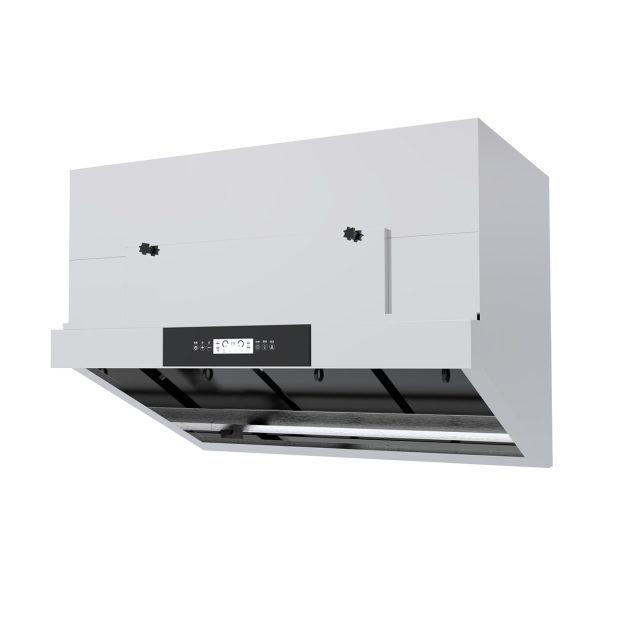
Japan regulates commercial kitchen exhaust through a stack of instruments that rarely appear together in Western guidance: the Fire Service Act (消防法) with its ordinance on fire-using equipment, municipal fire prevention ordinances and Tokyo Fire Department technical standards; the Building Sanitation Act (建築物衛生法), which imposes measured indoor air quality obligations on larger buildings; the Offensive Odor Control Act (悪臭防止法), which regulates odour at the site boundary using either 22 named substances or a sensory odor index; and local sewerage ordinances governing the grease trap. For an operator or a distributor working in Japan, these layers – not a single code – define what a compliant kitchen exhaust system looks like, how often it must be cleaned, and how its performance will be judged when a neighbour complains.
The Fire Service Act: Duct Construction, Grease Removal and Flame Arrest
The Fire Service Act itself sets the frame; the substantive kitchen-duct requirements sit in the ministerial ordinance on the location, structure and management of fire-using equipment (対象火気設備等の位置、構造及び管理…に関する省令) and in each municipality’s fire prevention ordinance, which in practice follows the model ordinance plus local technical standards. For kitchen equipment that generates grease-laden vapour, the requirements are specific and technical:
- The exhaust duct and canopy must be built from corrosion-resistant steel plate, or a non-combustible material with equal or better corrosion resistance and strength.
- Duct connections must be flanged or welded so the run is airtight – no slip joints, no taped seams.
- The duct and canopy must maintain at least 10 cm clearance from combustible building parts and combustible items, unless the adjacent surface is effectively covered with non-metallic non-combustible material.
- The exhaust duct must lead directly outdoors and must not be connected to ductwork serving any other purpose.
- Bends and downcomers must be minimised and the interior finished smooth, so that grease cannot lodge.
- A grease removal device – filters, extractors or equivalent – is mandatory on canopies that may produce grease vapour, unless the canopy discharges directly outdoors with no duct at all. The device itself must be non-combustible and corrosion-resistant.
- A flame transmission prevention device must be fitted to the duct.
- The canopy, grease removal device and duct must be of a structure that is easy to clean, and must be maintained clean enough that fire prevention is not compromised.
Two design consequences follow. First, the legislated order along the air path is grease removal device first, flame arrest second – the same particulate-before-gas sequence that European and North American practice reaches from first principles, but written into Japanese fire law. Second, the “no duct at all” carve-out is explicitly recognised: a canopy that discharges straight outdoors without a duct does not need a grease removal device. Everything downstream of that carve-out is where the engineering lives.
The 2026 Compliance Notice: Up-Draft Ducts, Daily Cleaning and the 0.4 mm Rule
Japan has a specific hazard that most markets do not regulate at all: the up-draft exhaust duct (上引き排気ダクト) used above tabletop charcoal and gas grills, the pattern that defines yakiniku, monjayaki and shichirin restaurants. Because these appliances sit on the table and the hood duct runs down from a low canopy or up through the seating area, grease accumulates close to an open flame. The Fire and Disaster Management Agency’s consultative reports note that these duct fires occur every year, with clean-up budgets squeezed and maintenance neglected.
The FDMA’s notice 消防予第279号 (3 July 2026) on proper management of up-draft ducts, together with the reference to Tokyo Fire Department technical standards, gives the market its first nationwide-shaped numeric framework. Where a grease removal device and a flame transmission device are installed:
- the grease removal device must sit between the duct’s lower air intake and the flame transmission device, and the bottom of the device must be 80 cm to 1 m above the fire source of the cooking appliance;
- the section from the air intake to the grease removal device must be visually inspected and cleaned every business day;
- the section from the grease removal device to the flame transmission device, and roughly 1 m beyond it toward the fan, must be inspected about every six months, and cleaned whenever grease build-up of about 0.4 mm is found;
- all remaining duct sections must be cleaned whenever grease deposits are observed.
Where no such devices are fitted, the fallback is stricter on the hot end: the section within roughly 1 m of the fire source must be inspected and cleaned every business day, and everything else inspected about monthly, again with cleaning triggered at the 0.4 mm threshold. Grease thickness is confirmed visually or with a dedicated gauge. The notice also urges that existing ducts be retrofitted at the next renovation with grease removal device, flame transmission device and inspection openings, and reminds operators to control the practice of loading large batches of food at once so that flame does not reach into the duct.
This is a materially different compliance culture from the “clean every one to six months according to duty” pattern used in North America and the UK. In Japan, the daily visual check is the baseline, and the record of those checks is what a fire inspector asks for. It also explains why Japanese kitchens of every size are unusually receptive to filtration architecture that removes grease upstream of the duct, rather than relying on duct cleaning throughput alone – an electrostatic precipitator range for ducted extract systems inserted ahead of a flame arrest device keeps the far duct substantially cleaner, which is exactly what the 0.4 mm rule rewards.
Odour at the Boundary: The Offensive Odor Control Act
Odour is regulated separately, under the Offensive Odor Control Act of 1971. The law does not apply nationally; prefectural governors (and mayors within city areas) must designate regulation areas where odour control is needed, and everything inside those areas is regulated regardless of business type or scale. Two alternative regulation systems exist, and each local government chooses:
- Concentration of specified offensive odour substances – 22 substances designated by cabinet order, each with a range inside which the local standard is set. Examples: ammonia 1-5 ppm, hydrogen sulfide 0.02-0.2 ppm, methyl mercaptan 0.002-0.01 ppm, trimethylamine 0.005-0.07 ppm, acetaldehyde 0.05-0.5 ppm, butyric acid 0.001-0.006 ppm.
- Odor index – a sensory index, defined as ten times the logarithm of the odour concentration, with local standards set anywhere in the range 10 to 21. Measurement uses the triangular odour bag method, in which a panel of typically six or more assessors is presented with three bags – one containing the sample, two containing odour-free air – and the odour is progressively diluted until the sample can no longer be identified.
Three emission points can carry standards: the site boundary, the gas outlet such as a stack or exhaust pipe (with height-corrected limits that are not applied below a corrected stack height of 5 m), and discharged water. For a restaurant in a dense commercial district, the boundary standard is the one that decides cases, because the boundary of a narrow urban site may be only metres from the exhaust discharge or from a neighbouring apartment window.
Enforcement runs through the municipality: where a site exceeds the standard and residents’ living environment is harmed, the mayor may issue an improvement recommendation and, failing that, an improvement order. Measurement of odour index is carried out by certified olfactory measurement operators under commission from the municipality. In practical terms, a kitchen whose exhaust carries a strong, unpleasant odour identity – frying, grilled meat, spices, fermentation – is exposed regardless of whether its particulate emissions are clean, because the odour index is sensory: it responds to the character of the smell, not only its mass.
That is the case for treating odour as a second, separate stage after particulate capture. Grease and smoke particulate must be removed first; volatile odour compounds then need a gas-phase stage, normally activated carbon sized for the actual duty rather than a nominal filter slab. Light and medium duty kitchens that cannot discharge at all – the many Japanese sites where a duct route does not exist – use a recirculating ductless range hood family precisely because it lets the odour stage sit inside the appliance instead of at a boundary line the operator cannot move.
The Building Sanitation Act: Measured Indoor Air, Every Two Months
Japan’s second layer of enforceable numbers is the Building Sanitation Act, which applies to specified buildings of 3,000 m² or more of floor area in listed uses – stores, hotels, theatres, assembly halls, offices and similar. A restaurant kitchen inside a department store, station building, shopping centre or large hotel sits inside such a building, and the building owner must appoint a qualified building environmental sanitation management technician and maintain indoor air within the following management standards:
- carbon dioxide 1,000 ppm or less;
- carbon monoxide 10 ppm or less (20 ppm where ambient air already exceeds 10 ppm);
- suspended dust 0.15 mg/m³ or less;
- temperature 17-28 °C and relative humidity 40-70% where air-conditioning is installed;
- airflow 0.5 m/s or less;
- formaldehyde 0.1 mg/m³ or less, measured once in the first summer period after new construction or major alteration.
Measurements are required once every two months, taken twice on the same operating day – morning and afternoon – and averaged. This matters for kitchen ventilation design in a way that operators often discover late: a kitchen extract that is oversized relative to make-up air will depressurise the floor, pull untreated air through the food hall, and show up as a deviation in the building’s own measurement record. A recirculating kitchen that returns poorly filtered air into a shared space shows up the same way. The measurement file is the building’s evidence, and an improvement order attaches to it.
Grease Traps, Wastewater and the Document Set
Parallel to the air side, kitchen wastewater passes through a grease trap (グリストラップ), required by sewerage ordinances and by the Building Sanitation Act’s pest and sanitation provisions, sized to the kitchen’s flow and cleaned on a documented schedule. In practice the Japanese compliance file for a kitchen is a bundle that a fire officer, a health centre inspector or a building manager may each ask for separately:
- fire equipment inspection records and the up-draft duct inspection and cleaning log (daily, monthly or six-monthly as applicable, with the 0.4 mm assessment noted);
- canopy, grease filter and grease removal device cleaning records;
- where applicable, odour measurement results and any local odour standard applied at the site boundary;
- building air environment measurement records for the two-monthly cycle;
- grease trap maintenance and waste-manifest records;
- the ventilation design basis – airflow, capture velocity, duct material and support detail – kept for the next inspection or renovation.
Sizing, and the Buildings That Make Ducts Impossible
Japanese designers size kitchen extract with the same fundamentals used elsewhere: roughly 2,000 m³/h per metre of hood for light duty and 2,500 m³/h per metre for open or high-load cooking, about 4,000 m³/h per burner where burner count drives the plume, a capture face velocity around 0.4-0.5 m/s, and a hood overhang of 150-300 mm beyond the appliance edge. What differs is how often the building refuses the discharge route the calculation assumes.
Japanese urban foodservice is dense and vertically stacked: multi-tenant buildings (雑居ビル) where a duct climbs through occupied floors before reaching the roof, basement restaurants (地下店舗) in station and department-store complexes, narrow-frontage shophouses with a residential floor above, and historic districts where altering the roofscape is not an option. When a compliant outdoor route cannot be created – and note that the Fire Service Act insists the kitchen duct be dedicated and lead directly outdoors, ruling out shared shafts – the choices narrow to three: a floor-standing purification cabinet that is separated from a shallow canopy so the vertical dimension above the cookline stays clear, a fully recirculating ductless hood where the duty is light or medium, or, for the mobile end of the market (event kitchens, festival stalls, market vans), a self-contained ventless catering cart range that carries its own capture and filtration.
How This Is Solved in Practice
Read together, the Japanese stack produces a clear selection logic. Charcoal and open-flame tabletop cooking – shichirin, yakiniku, robata – must stay ducted, with grease removal, flame transmission prevention and the daily cleaning discipline that the 2026 notice imposes. Light and medium duty lines, especially in buildings where a dedicated outdoor duct is impossible, are well served by all-in-one recirculating hoods: the N-series for light duty, the ND-series for heavier fume loads, each combining an electrostatic particulate stage with activated carbon inside the canopy, and the Odor Removal Tower where the menu carries a strong odour identity that the odour index at the boundary would otherwise punish. Where the site must nevertheless remain ducted, a dedicated duct with in-duct particulate separation ahead of a flame arrest device protects both the 0.4 mm cleaning threshold and the neighbour relationship.
The honest boundary matters more in Japan than in most markets, because the fire law is unambiguous about where flame can travel. A recirculating kitchen is not a substitute for a ducted design around an open charcoal fire, and no filtration stage changes that. Within those limits, though, the combination of daily inspection culture and boundary-line odour standards makes filtration quality – not duct cleaning frequency alone – the variable that decides whether an operator passes an inspection quietly or spends the following month arguing about odour with a ward office.