A quotation is a promise with an expiry date, and most buyers read the number without reading the clock. Three mechanisms decide whether the figure you signed still means anything when the equipment ships: the validity period, the escalation mechanism for anything that outlives it, and the currency and surcharge assumptions buried under the price. Fix all three before comparing numbers, because a cheap quote with a 15-day validity is usually more expensive than a firm quote held for 90 days.
Why Validity Periods Exist
Suppliers do not limit validity to be difficult. Kitchen ventilation equipment is priced from inputs that move: stainless sheet, copper for motor windings, electronic components, and ocean freight. A supplier who quotes a firm price for twelve months without any adjustment mechanism is either holding a large margin buffer, which you are paying for, or hoping the market behaves, which you are financing.
| Offered validity | What it usually signals | Risk carried by the buyer |
|---|---|---|
| 7-15 days | Order-book pressure; the supplier wants commitment before you compare alternatives | The price will change precisely when your drawing review finishes; effectively a booking fee, not a price |
| 30 days | Standard commercial practice for catalogue equipment | Workable only if approval cycles are genuinely closed inside a month |
| 60-90 days | Confidence in input costs and in the bill of materials behind the quote | Moderate; verify the quote covers freight and duty assumptions for the whole window |
| 6-12 months firm | Either a hedged position, a fat buffer, or a defined adjustment formula attached | Low, provided the formula behind any escalation is named and capped |
The relationship to watch is the one between validity and your own approval cycle. A custom hood package typically needs 5-10 working days for drawings to be issued and 5-10 more for comments to close, sometimes across two rounds. Add tender approvals, budget sign-off and landlord consent and the buyer’s own clock often runs 8-16 weeks. A 30-day validity that expires mid-approval is not a mistake by the supplier; it is a renegotiation scheduled in advance.
What “Valid” Actually Binds
Buyers assume validity covers the price. It usually does, but the quote is a bundle of assumptions, and each one can expire separately. Before accepting any quotation, identify which of these are fixed, which are assumed, and which are silent.
| Assumption in the quote | What “fixed” means | What silence means |
|---|---|---|
| Equipment price | Firm for the validity period | Supplier reprices at order; the validity clause is the only defence |
| Exchange rate | Quoted currency stated; rate frozen or irrelevant because you pay in that currency | Quote in USD, paid in EUR, converted on invoice day, supplier keeps the movement |
| Freight | Named Incoterm and route basis | “Freight estimated at time of booking”; ocean rates move more than equipment prices |
| Duty and taxes | Assumed tariff classification and rate stated | Trade policy changes during the validity window are your cost |
| Lead time | Stated in the same sentence as the price | Price held, queue position lost; a valid price with a 26-week lead time is a different offer |
| Spare parts and options | Priced as separate lines with their own validity | Bundled into the equipment price and unavailable later, or repriced freely |
The last row deserves attention because it is where framework buyers lose money. If the quoted spare parts and consumable prices lapse with the equipment quote, the supplier controls your five-year running cost after the first purchase. Ask for the spares and wear-parts price list to be valid for a longer period, typically 12-24 months, because the volumes are small and the volatility is low.
The Itemization That Makes a Quote Negotiable
A quote you can negotiate is an itemized quote. The comparison article on this site covers how to weigh line items against each other; the point here is narrower, which is that itemization is also what makes a validity period enforceable. If the price is one lump sum, the supplier can defend any later increase by pointing at any input. If the quote shows equipment, controls, packing, spare parts, freight and optional items separately, then the escalation conversation is about the two or three lines that actually moved.
Ask for these elements to be explicit on the face of the quotation, not in an attachment: the validity date, the Incoterm and named port or delivery point, the currency, the payment terms, the assumed tariff classification where imports are involved, and the list of surcharges that may apply after acceptance. A supplier who resists putting the validity date on the document has told you something before the negotiation starts.
Escalation: Five Models, One Discipline
Projects outlive validity periods for ordinary reasons. Approval cycles run long, sites open late, phased fit-outs order kitchen two a year after kitchen one. The answer is not a longer validity, which the supplier prices as risk. The answer is a defined adjustment mechanism, agreed while both sides are calm, that converts unknown movements into a formula.
| Model | How it works | When it fits |
|---|---|---|
| Firm fixed price | One price, no adjustment, supplier carries all input risk | Short horizon, standard equipment, stable volumes; expect the buffer to be priced in |
| Fixed price plus index formula | Firm until a date, then a published index moves a stated share of the price | Multi-phase rollouts and long approval cycles; the industry standard for a reason |
| Material surcharges | Base price fixed; named material movements above a threshold adjust named lines | Copper-heavy or stainless-heavy packages where one input dominates |
| Open book with fixed fee | Materials at documented cost plus a fixed conversion fee, audited annually | Frameworks and repeat purchases where trust compounds |
| Currency-adjusted | Price indexed to a stated exchange rate band | Cross-border deals with weak-currency buyers and dollar inputs |
The index model deserves the detail, because it is the one most often botched. A defensible formula names five things: the published index (a real one, with a public series, not “supplier’s material cost”), the base observation date (the date used in the original quote), the observation date that triggers adjustment, the share of the price exposed to the index, and a cap plus a floor. Without the cap and floor, the formula is an option written in the supplier’s favour: it rises when inputs rise and, if it is one-way, never falls when they do not. Insist on two-way adjustment, so that a falling index reduces the price with the same share and the same lag.
Material Surcharges Done Properly
Surcharges have a bad reputation because most of them are badly drafted. A bad surcharge is “a 3% surcharge applies to all orders due to raw material increases”, which is a margin increase wearing a costume. A defensible surcharge clause has a named benchmark, a threshold, a share, and evidence.
| Input | Defensible structure | Where it bites |
|---|---|---|
| Stainless sheet (304/316) | Mill-published or exchange-quoted price; adjustment applies only above a 5% movement from the base date, and to the sheet-content share of the affected lines | Hoods, canopies, cabinet bodies, purifier casings |
| Copper | Exchange benchmark; motor and wound-component lines only, share stated, two-way | Motors, fans, transformers, high-voltage power supplies |
| Aluminium | Exchange benchmark; filter and frame lines only | Baffle and mesh filters, extrusions |
| Electronics | Usually excluded from formulas; negotiate a fixed price for the control and power-supply scope instead | Controls, sensors, ESP power packs |
| Ocean freight | Rate basis named (a published freight index); applies to the freight line only, never to equipment; requote at booking | Every imported shipment |
Three disciplines make surcharges survivable. First, thresholds: below a stated movement, typically 5%, the supplier absorbs it, which kills the noise of daily volatility. Second, shares: the formula applies to a stated share of the affected line, not to the whole contract, because the input is a fraction of the price. Third, evidence: the adjustment invoice cites the index value and date, and the buyer may audit it. A surcharge clause that fails any of the three should be treated as a price increase and negotiated as one, on the spot, not deferred to delivery.
Currency: The Silent Variable
Most kitchen equipment is manufactured against dollar-linked inputs, whatever currency the quote is printed in. If you are quoted in your own currency and the manufacturer’s costs are in another, someone is carrying exchange risk, and the validity period decides who. A 90-day validity with no currency clause is, at typical volatility, a bet worth up to about 3% of the order value, which is larger than most negotiating discounts.
The clean rules are simple. Pay in the currency of the quote, so the conversion happens once, at a moment you choose. If the quote is in a currency you do not hold, ask for a stated reference rate on the face of the document and define what happens if the settlement rate moves more than a stated band, in either direction. For framework agreements, negotiate a currency review at each call-off rather than a fixed rate for a year, which forces the conversation onto published rates instead of phone calls.
Importers add two layers on top. Duty is assumed at a tariff classification named in the quote; if the classification changes, or a trade measure lands on the product during the validity window, the cost lands on the buyer unless the clause says otherwise. And freight is quoted on a route basis, not a number, because a fixed freight figure valid for 90 days is a position the supplier cannot honestly hold.
Open Book or Lump Sum
For a single purchase, lump sum is fine and open book is theatre. For a framework, a multi-phase rollout, or an ongoing service relationship, the lump-sum model quietly transfers every efficiency to the supplier and every inefficiency to you. Open book pricing fixes this, but only when it is structured.
| Element | Weak version | Structured version |
|---|---|---|
| Materials | “Cost plus” with no definition of cost | Documented purchase invoices, defined mark-up share, annual audit right |
| Conversion fee | Percentage of materials, so costs inflate the fee | Fixed fee per unit or per phase, reviewed annually against volumes |
| Productivity | Savings accrue to the supplier | Annual give-back: a stated share of demonstrated savings reduces unit prices |
| Benchmark | None | Periodic market test against at least two alternative sources for major lines |
The failure mode of open book is administrative, not commercial: it dies when nobody has time to audit invoices. If you cannot commit to an annual review with a named owner, choose the index model instead, which runs on published numbers and needs no reading of anyone’s ledger.
Validity Tricks Worth Recognising
Most of these are not dishonest, they are ordinary commercial behaviour that the buyer should simply price. Knowing them turns irritation into negotiation.
The quote that expires exactly at the end of your approval window, forcing a fresh negotiation after you have sunk weeks into the supplier’s drawings. The “prices subject to change without notice” footer, which annuls the validity clause in the body of the document, and which should be struck before signature. The early-payment discount sized so large that declining it feels like a loss, offered on terms that quietly waive inspection rights. Free spare parts and consumables bundled into the first order, which raises the unit price today and hands the after-market to the supplier by default. And the phantom option list, priced attractively, that turns out to be unavailable in the configuration you actually approved.
None of these require a confrontation. Each one has a one-sentence fix: extend the validity to match the approval cycle with an agreed adjustment formula behind it; strike the change-without-notice footer; convert the early-payment discount into a shorter payment term you can actually meet; unbundle the spares onto a separately valid price list; and make the options binding, deliverable within the programme, at the quoted price.
When Validity Lapses: Rebid, Extend, or Split
A lapsed validity is a decision point, not a failure. Three routes exist, and the choice depends on how much has changed.
| Route | When it is right | Watch for |
|---|---|---|
| Full rebid | Validity lapsed by more than 6 months, or the specification changed materially | Costs a fresh approval cycle; tell the incumbent that rebidding is happening, which alone disciplines the new price |
| Formula extension | A pre-agreed index or surcharge mechanism exists in the contract or framework | Verify the applied formula against the published index; the arithmetic errors are usually innocent and usually one-sided |
| Cap-and-share | Small lapse, relationship worth keeping, no pre-agreed formula | Agree a written split: movements above a stated percentage are shared, below it absorbed; make it two-way |
The cap-and-share route is the most underused. For an order delayed by eight weeks with no formula in place, “any increase above 2% is shared equally, any decrease is passed back in full” closes the gap in one email and preserves the relationship for the next phase. It only works when written down; verbal splits are renegotiated at the delivery gate.
Eight Things to Ask For Before Signing
1. The validity date printed on the quotation, matched to your approval cycle, with an agreed adjustment formula for anything beyond it.
2. Itemized lines for equipment, controls, packing, spares and freight, so escalation can be argued line by line.
3. The currency and a stated reference rate, with settlement in the quotation currency.
4. A surcharge clause with a named benchmark, a 5% threshold, a stated share, and a two-way adjustment.
5. An index-based extension formula for phase-two orders, with cap, floor and a published index series.
6. A spares and wear-parts price list valid 12-24 months, separate from the equipment quote.
7. Freight quoted on a named Incoterm and route basis, requoted at booking rather than fixed.
8. The “subject to change without notice” footer deleted from the document.
None of the eight is adversarial. Together they convert a quotation from a snapshot into a price structure, which is what a buyer with a multi-phase programme actually needs.
How Architecture Shapes Price Certainty
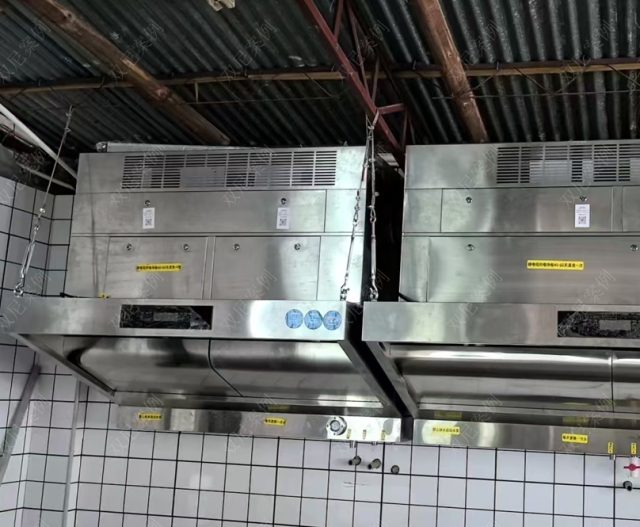
The equipment architecture on the quotation changes how much of this machinery you need. A ductless range hood family quotes as one tested assembly: capture canopy, electrostatic stage and carbon odour stage in a single cabinet, with no duct fabrication, no fire-stopping and no balancing line items to be priced by someone else. The buyer’s exposure is therefore concentrated in one line with one validity, and the approval cycle is shorter because there is no duct route to coordinate, which is precisely what keeps you inside a 60-90 day validity window instead of drifting past it.
A ducted ESP purifier package buys higher volume per cabinet at the cost of a longer quotation surface: the equipment price is one line, but ductwork fabrication, penetration and fire stopping, and air balancing sit outside it, priced by the installing contractor and exposed to their own validity and escalation. For a buyer structuring a ducted project, the question to ask is which package the escalation formula covers, because the site works are where multi-month delays do their damage.
Where the cookline moves, the mobile food carts range is the shortest price exposure in the industry: units ship assembled, commission at the pitch, and involve no site works at all, so a straightforward firm-price quote with a normal validity covers the whole purchase.
In our own range the light-fume work is covered by the N-series and the heavy frying and wok work by the ND-series, with an Odor Removal Tower where the discharge point sits close to a neighbour’s facade. Because these are tested assemblies quoting as single lines, the negotiation about validity and escalation is shorter than for a ducted package, and it is honest to say so: the architecture, not the clause, is what removes most of the price risk.
Ten Questions Before Accepting a Quotation
1. What date does the price expire, and does that date survive my approval cycle?
2. Are equipment, controls, packing, spares and freight separate lines?
3. Which currency settles the invoice, and is the rate stated?
4. Which surcharges may apply after acceptance, and what benchmark, threshold and share govern each?
5. Is the adjustment two-way, so a falling index cuts the price?
6. What happens to phase-two pricing, and under which formula?
7. Is the spares price list valid independently of the equipment quote?
8. Is freight a number or a basis, and who owns the booking risk?
9. Does the document contain a change-without-notice clause that annuls the validity?
10. If validity lapses, which route do we take: rebid, formula extension, or a written cap-and-share?
A quotation that answers all ten is not more expensive. It is a price with a memory, agreed while both sides were calm, which is the only kind that still holds when the approval cycle runs long and the inputs move. Price certainty is not a discount, it is a structure, and it is negotiated before the number is, not after.