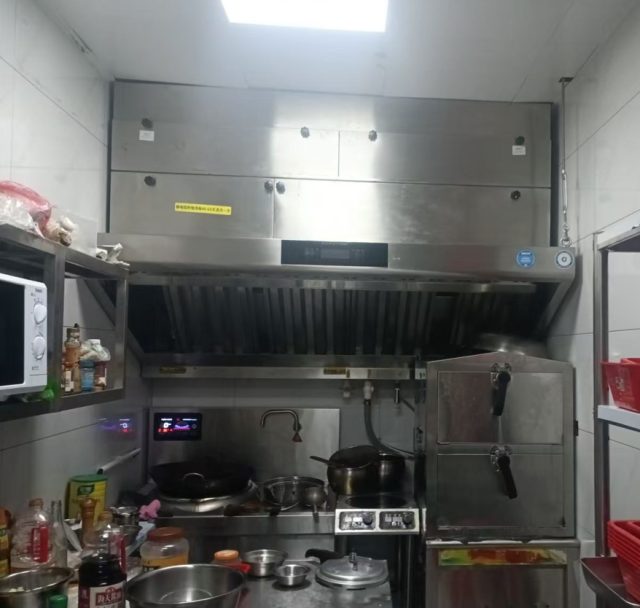
Most kitchen exhaust tenders treat the fire suppression package as a line item to be resolved on site. That is the most expensive possible way to buy it. The suppression system is not an accessory bolted onto a hood after commissioning: it is a certified assembly whose nozzle layout is calculated against the appliance line, whose shutdown interlock is wired into the fuel train, and whose service regime runs for the life of the kitchen. When nozzles, shutdown and service responsibilities are left floating, the result is predictable – a hood supplier who says suppression is not in scope, an installer who points back at the drawing, an authority that will not sign the occupancy file, and an insurer that loads the premium. This article is written for buyers who are already in the selection and negotiation stage: it sets out what a wet-chemical system actually does, the four interfaces where cost and blame accumulate, how to read a suppression quote line by line, and which contract clauses keep the system alive after handover.
Why Suppression Is a Procurement Decision, Not a Site Extra
Fire suppression enters the commercial kitchen project at the same moment the exhaust package does, because the two are physically inseparable. The nozzles sit inside the hood plenum and the duct; the detection line runs along the front of the canopy; the fuel shutdown valve sits in the gas train or the control panel of every electric appliance under the hood. Any decision about hood width, duct route, appliance layout or panel access therefore changes the suppression design – and any change made after the suppression system has been quoted and calculated invalidates it.
That is the core procurement point: a suppression quote is valid only for the appliance layout it was calculated against. Swap a two-burner range for a four-burner unit, add a wok station, or move the fryer bank by a metre, and the nozzle count and agent volume must be recalculated by the certified installer. Buyers who let the suppression package drift outside the main contract discover this late, when the installer re-quotes and the programme slips.
There is also a compliance asymmetry. The exhaust system can usually be commissioned, adjusted and re-tested if something is wrong. A suppression system that is wrongly configured cannot be adjusted – it either meets its listing and the authority’s requirement, or it does not exist as far as the approval file is concerned. In Metro Manila, for example, the Bureau of Fire’s inspection is a hard gate before a restaurant opens, and the suppression system is one of the items inspectors look for on any hooded cookline. In Germany, an insurer-driven VdS or FM approval frequently dictates the system brand.
What a Wet-Chemical System Actually Does
Nearly all modern kitchen suppression is wet chemical: a potassium-carbonate solution stored under pressure and discharged through dedicated nozzles when the detection line activates. The chemistry does two things at once. First, it saponifies burning grease – the alkali reacts with hot fats to form a soapy foam layer that seals the fuel surface from oxygen. Second, it cools the appliance and the surrounding steel below the temperature where re-ignition is likely. Both effects matter: a dry-agent or water-only approach either fails to seal the fuel or leaves hot surfaces that flash back as soon as the fuel flow resumes.
The system protects four zones, and a correct quote must show all four:
1. The appliance surfaces. One or more nozzles aimed at each fryer, griddle, range and charbroiler, positioned and angled per the system listing. This is the zone where the agent does its chemical work, and where the nozzle count is calculated against the appliance footprint.
2. The hood plenum and filters. Nozzles wash the interior of the canopy and the filter bank, where grease vapour condenses and where a flash fire spreads first. A nozzle layout that covers appliances but not the plenum is incomplete and will fail an inspector’s walk-through.
3. The duct. Nozzles at the collar and sometimes higher up the duct, because a duct fire spreads vertically and is invisible from the kitchen. This is the zone most often omitted in cheap quotes.
4. The fuel supply itself. Not a nozzle but a shutdown: a solenoid valve on the gas line, or shunt trips on the electric appliances, closing everything the moment the system discharges. Suppression without automatic fuel shutdown only buys time; with it, the fire is starved and held out.
Detection is usually a line of fusible links running under the canopy – metal links calibrated to part at a temperature matched to the appliance line below them. When a link parts, the tension in the detection line is released and the mechanical or electric actuator fires the agent cylinders. The link ratings are deliberately differentiated: a link over a low-temperature appliance like a fryer would nuisance-release if set for a charbroiler’s higher normal operating temperature. The installer calculates the ratings; the buyer’s job is to make sure the final appliance layout in the suppression calculation matches the kitchen that is actually built.
Discharge is automatic, but manual actuation is also required – a pull station placed on the escape route, typically near a door out of the kitchen. Confirm its location in the quote: a station mounted where staff cannot reach it while the fire is between them and the exit is a design failure an inspector will catch.
The Four Interfaces Where Cost and Blame Accumulate
Suppression problems almost always live at an interface between two scopes. Four of them account for most of the disputes.
Interface 1: hood and suppression hardware. The nozzles penetrate the hood plenum and duct, which means the hood fabricator must drill or fit the penetrations to the suppression drawing. If the hood is supplied by one party and the suppression by another, the drawings must be exchanged before fabrication – not on site. Every hole drilled in the wrong place is a hole that must be welded and re-certified, and a stainless canopy does not forgive improvisation.
Interface 2: fuel shutdown. The gas solenoid valve is installed in the gas train by the gas contractor, wired to the suppression control head by the suppression installer, and tested by whoever commissions the kitchen. Three scopes, one function. If the contract does not name who wires and who tests, the shutdown interlock is exactly the item that gets skipped and discovered during the fire inspection – the worst possible moment. The same applies to electric shunt trips on kitchen panels: the breaker modification is an electrician’s scope, the trigger is the suppression system’s.
Interface 3: alarm and building management. Discharge must alert the building – both to evacuate staff and, in most commercial premises, to release the door holders or start the smoke management sequence. The interface to the fire alarm panel (a monitored contact or relay) must be specified in both the suppression and the fire alarm scopes.
Interface 4: access for service. Fusible links, nozzles and the control head need periodic service, which means the duct access panels, the canopy panel hinges and the cylinder location must allow a technician to work. This is where suppression quietly shapes the exhaust design: access panels along the duct (at every horizontal turn and at intervals on vertical runs), clearance around the hood – the 457 mm working zone above a canopy that grease-duct standards already demand – and a cylinder cabinet that is not buried behind a fridge. A buyer who signs the exhaust drawings without the suppression drawing has signed an access problem.
Procurement rule of thumb: if a scope boundary between hood, suppression, gas and electrics is not written into one document, it is not a boundary – it is a future variation order. Ask for a single interface matrix before the deposit is paid.
Who Should Supply It: One Contract or Two
The first commercial decision is whether suppression is bought inside the exhaust package or as a separate award. Both are legitimate; they carry different risks.
Single source (hood and suppression from one contract). The hood fabricator coordinates penetrations and nozzle positions natively, the drawings are consistent, and there is one party accountable for the plenum-plus-nozzle assembly. Most ductless all-in-one hood suppliers and most major hood manufacturers offer a listed suppression option for exactly this reason. The buyer’s check is narrower: verify that the suppression system is genuinely part of the supplier’s certified package – with its own listing documentation, agent calculation and installer certification – and not a subcontract the supplier has quietly passed down without contract-back responsibility.
Split award (independent suppression installer). Common when a consultant or insurer specifies a particular system brand, or when the local authority prefers installers it already knows. The installation quality can be excellent, but the buyer must then own the interface work: exchange of shop drawings between hood and suppression before fabrication, a named party for wiring the shutdown, and a commissioning test that covers the interlock end to end.
Whichever route is taken, two verifications are non-negotiable. First, the installer must be certified by the system manufacturer – most wet-chemical listings require a manufacturer-trained installer, and an installation by an uncertified contractor voids the listing. Second, the agent calculation sheet – the document that counts nozzles and cylinder volume against the actual appliance layout – must be delivered as a contract deliverable, not left in the installer’s van.
Certification and Approval: What the Authority Will Ask
The certification question depends on the market, and buyers working across borders should check it per project rather than assuming.
In the United States market the reference is a UL 300 listing for the complete wet-chemical system – hood, nozzles, detection, agent and control as a tested assembly. That is the listing most manufacturer documentation is built around, and it is often quoted even outside North America simply because it is the most widely recognised test basis. It is worth being precise about what such a listing means: it certifies the suppression system as tested, not the kitchen, and the local authority decides what it accepts.
In Europe there is no single harmonised EN standard for kitchen suppression. Approval paths run through insurer requirements and national practice: VdS guidelines in Germany and much of central Europe, FM Approvals where the insurer demands them, and national fire authority practice elsewhere. The practical consequence for a buyer in Germany, Austria, Poland or further east is that the accepted system brand and the accepted installer are often named by the insurer or the local fire authority before the tender is written – ask early, because this can constrain the whole package.
In Southeast Asia the gate is usually the fire authority inspection rather than a product listing. The Philippines is the clearest example: the Bureau of Fire inspection covers the cookline, the suppression system where a hooded cookline requires one, the shutdown interlock and the records. Vietnamese and Thai practice similarly converge on authority inspection plus, increasingly, insurer-driven documentation for malls and hotels.
Across all three markets the document set is similar, and it belongs in the contract as deliverables: the system’s listing or approval certificate, the agent calculation for the installed layout, the installer’s manufacturer certification, the commissioning and shutdown test record, and the service schedule. A file missing any one of these is the difference between an approval and a re-inspection.
Reading a Suppression Quote Line by Line
A suppression quote can be compared across suppliers in minutes if the buyer checks the same ten items every time. Print this list into the tender:
1. Agent and listing. Wet chemical (potassium carbonate), with the listing certificate of the complete system attached – not just the agent. A quote without a listing reference for the assembled system is a red flag.
2. Coverage plan. A drawing showing nozzles per appliance, plenum coverage, filter coverage and duct nozzles, matched to the appliance schedule. If the appliance schedule in the quote does not match the kitchen’s, the quote is invalid.
3. Detection design. Fusible link ratings per appliance position and the detection line layout. This proves the installer actually calculated rather than copied a previous job.
4. Fuel shutdown. Named scope for the gas solenoid or electric shunt trips: who supplies the valve, who wires it, who tests it. The single most common gap in split-award projects.
5. Manual station. Location drawing, on the escape route.
6. Alarm interface. The monitored relay or contact to the building fire alarm, with the connecting scope named.
7. Cylinders and cabinet. Agent volume, cylinder count, cabinet dimensions and its position on the plan – check it does not consume service space or breach the kitchen’s escape width.
8. Access provisions. Any additional duct access panels the nozzle service regime requires, costed now rather than discovered at the first service visit.
9. Service package. The first service visits included, the interval thereafter, the fusible link replacement cycle, and a priced spares list (links, nozzle caps, actuator cartridges). Service pricing is where the lifetime cost actually lives.
10. Documentation deliverables. Calculation sheet, as-built layout, commissioning record, training record for kitchen staff – each as a named deliverable, each required before final payment.
Two suppliers quoting for the same kitchen can differ by a factor of two in price and still be honest quotes – because one includes duct nozzles, the shutdown wiring scope and a service package, and the other does not. The ten-line check makes that difference visible before the contract is signed, not after.
Ductless and Recirculating Kitchens: Suppression Still Applies
A recurring assumption in ductless projects – and it recurs in enquiries from Manila to London – is that removing the duct removes the fire problem and therefore the suppression requirement. It does not. The cookline still contains the same hot oil, the same grease vapour and the same ignition sources; a recirculating hood additionally contains a filtration stack that must not be allowed to become the fire path.
What changes is the shape of the package. A ductless all-in-one hood carries a smaller, integrated agent bank protecting the plenum and the appliances, with the same automatic fuel shutdown logic on the gas or electric supply. The carbon odour stage downstream of the ESP cell is combustible in principle, which is why the airflow discipline matters: the capture and face velocity the system was sized for – the 0.25 to 0.5 m/s band typical of light-fume canopies and 0.4 to 0.6 m/s for heavy-fume lines – is also what keeps hot vapour from saturating the carbon bed. A hood that runs with filters missing or with a starved airflow is a fire condition, not just an odour problem, and it is precisely the operating condition inspectors look for.
Buyers comparing ductless systems should therefore ask the same suppression questions of a ductless quote as of a ducted one: which zones are covered, what shutdown is included, who services it, and what the listing documentation says. A ductless hood supplied without any suppression provision is a procurement gap, not a saving – and several markets will simply not approve it.
Service Life and Running Cost
The purchase price of a suppression system is the small part of its lifetime cost. The service regime is the large part, and it is also what keeps the approval valid – an uninspected system drifts toward the condition insurers call maintenance deficiency, which is where claims get contested.
Most wet-chemical listings and service schedules converge on the same regime: a semiannual service by a manufacturer-certified technician, covering nozzle condition and caps, link condition, cylinder pressure, the control head and – the item most often skipped in practice – a functional test of the shutdown interlock. Fusible links sit on a scheduled replacement cycle, commonly between six and twelve months depending on the system and the appliance temperatures, and nozzle caps (which keep grease out of the orifices) are replaced as found. After any discharge the system needs full recharge: agent, cartridges and any parting links, before the kitchen restarts.
The running cost is therefore predictable and should be priced into the comparison: service visits per year, link sets per year or two, a recharge contingency, and the technician’s travel. For a multi-site operator, negotiating the service regime at purchase – one service partner, one spares list, one record format across all sites – is worth more than shaving the hardware price, because the record trail is what the fire authority and the insurer will ask for at renewal.
Acceptance: Testing the Shutdown, Not Just the Springs
Suppression acceptance is often reduced to a visual check and a pressure gauge reading. A proper acceptance test, tied to the payment milestone, proves the sequence end to end:
1. Trigger the detection line (electrically simulated or with a test link) and verify automatic discharge across all zones – appliances, plenum, duct.
2. Verify automatic fuel shutdown: the gas solenoid closes, every electric appliance under the hood trips, and manual reset is required before fuel returns. This is the test that prevents re-ignition; it must be witnessed, dated and recorded.
3. Verify the manual station actuates the system from its installed position.
4. Verify the alarm interface fires at the fire alarm panel.
5. Confirm the documentation pack: calculation sheet, as-built layout, listing certificates, installer certification, service schedule, staff training record.
The same logic applies to any later change. A new appliance under the hood is not just a kitchen decision – it re-rates the suppression calculation. Buyers should write a re-rating clause into the contract: any change to the appliance schedule triggers a free re-calculation by the suppression installer before the change goes live. Without the clause, operators quietly swap appliances for years, and the system silently stops matching the kitchen it protects.
How the Architecture Shapes the Suppression Package
The suppression conversation is easier or harder depending on the exhaust architecture, and this is where a buyer can legitimately shrink the problem.
A fully ducted system – canopy, grease duct, ESP purifier stage and centrifugal fan, as in the ducted ESP filter range – carries the largest suppression package because the duct itself joins the protected zones, and the duct access panels the nozzles require must be built into the duct run. It is the right architecture for heavy charcoal and high-volume cooklines in buildings that can accept a duct to roof, and the suppression design should be exchanged between the hood and duct fabricators before anything is welded.
A recirculating ductless system removes the duct from the protected set entirely: the agent bank covers appliances and plenum inside the hood, the shutdown interlock is the same, and the service regime is shorter because there is no duct nozzle to access. For the majority of restaurant, takeaway and food-court kitchens that cannot penetrate the fabric of the building, this is where the conversation with the supplier should start – the ductless range hood family from Souniny is engineered as a complete package precisely so that filtration, odour control and the suppression interface are designed together rather than negotiated later.
For the lightest footprints – street pitches, front-of-house live cooking, seasonal stalls – a mobile ventless cart carries its own contained cook zone, and the suppression question reduces to the cart’s own certification rather than a building-scale package; the ventless catering cart line covers this end of the spectrum. The engineering logic is constant across all three architectures: the smaller and more integrated the protected envelope, the fewer interfaces exist to leak cost and blame.
Concretely, for a heavy-fume ductless kitchen – the fried-chicken and char-grill profile that dominates enquiries in Southeast Asia – the closing package to negotiate is a hood that pairs a multi-stage electrostatic cell with a carbon odour stage, sized on the standard load basis of roughly 2,000 to 2,500 m3/h per metre of cookline or around 4,000 m3/h per burner, with the suppression zones, shutdown interlock and service schedule agreed inside the same contract. On our own line this is the territory of the ND-series heavy-fume all-in-one with the Odor Removal Tower downstream, stepping to the N-series for lighter frying and griddle loads – the same procurement checklist applies to whichever capacity the load calculation selects.
The engineering conclusion is simple to carry into the tender. Suppression is not a gadget mounted after the exhaust is bought; it is a certified assembly whose four interfaces – hood penetrations, fuel shutdown, alarm, service access – must each be named in the contract, whose appliance-layout calculation must be frozen and re-rated on change, and whose service trail is what keeps the authority’s approval and the insurer’s terms alive.