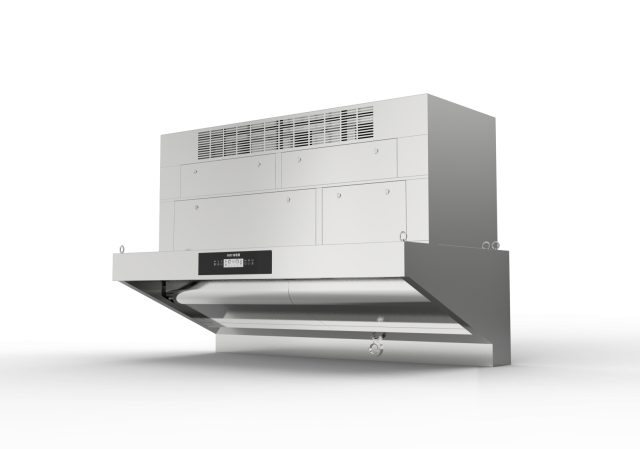
Every kitchen ventilation project is decided twice, and only one of the two decisions involves the air cleaner. The first decision is whether the cooking plume rises into the canopy at all. Capture failure and containment failure cost the same in money, complaints and insurance exposure, but they have different causes, and no amount of extra treatment downstream can repair them. This article is about that first decision: how appliance duty class, canopy geometry, room air motion and replacement air together decide whether a hood catches what the cookline throws at it, and how to read a hood that is quietly failing.
Two failures that share one name
Capture and containment are usually spoken as a single phrase. They are not the same thing, and separating them is often enough to locate the fault in an existing kitchen without touching a single grille.
Capture is what happens between the cooking surface and the entrance plane of the hood. It is the moment the thermal plume, carrying grease aerosol, moisture and volatile organic compounds upwards at one to two metres per second, is persuaded to travel inside the hood footprint rather than leaking sideways at cook height. A capture failure is visible at the pan: the plume leans, breaks up, or gets dragged horizontally before it reaches the filter bank.
Containment is what happens above the entrance plane. The plume has arrived, expanded and slowed, and now sits in the hood reservoir as a buoyant, rolling cloud. Containment holds that cloud inside the reservoir until extraction removes it. A containment failure appears at the front lip: the cloud rolls out under the leading edge and escapes into the room, often at a height the cook never notices but that every ceiling tile records.
A practical shortcut: escaping at the pan is a room-and-geometry problem; escaping at the front lip is an airflow-or-reservoir problem. Treating them as one problem is why many kitchens end up with an oversized hood that still smells.
Start with the appliance, not the room
The single most important input to hood sizing is not the floor area, the ceiling height or even the menu: it is the duty classification of the appliances under the canopy. Industry standards such as ASHRAE 154 and ASHRAE 154-ventilation tables used in North America, and the classification approach embedded in EN 16282 and VDI 2052 practice in Europe, all sort cooking appliances into bands that reflect how violently they release heat and pollutant.
Reading the four bands
Light duty. Equipment that mostly holds heat inside its own cabinet: electric and gas deck ovens, steamers, steam kettles, rice cookers, holding cabinets, warming drawers. Steam is the dominant emission, carrying comparatively little grease aerosol.
Medium duty. Equipment where the food surface is open to the room but the heat release is moderate and reasonably steady: tilting skillets and braising pans, flat griddles, open deep-fat fryers, combination oven-steamers, standard open-burner ranges with medium stock pots.
Heavy duty. Equipment that couples high radiant output with direct fat contact on an open surface: gas charbroilers and chain broilers, upright broilers and salamanders, wok ranges, some conveyor ovens working continuously, rotisseries without doors. These lines produce the grease aerosol and the smoke that define most complaint files.
Extra-heavy duty. Solid-fuel cooking: charcoal grills, wood-fired ovens and hearths, mesquite broilers. Here the pollutant load includes soot, polycyclic aromatic hydrocarbons and visible smoke, and the required capture velocity is highest of all.
Classifying every appliance is worth the half hour it takes, because the duty band sets the exhaust rate, and the exhaust rate sets everything else – duct size, fan duty, replacement air volume, noise, and ultimately the size of the treatment equipment. A cookline labelled “medium” that actually carries a heavy-duty charbroiler at one end is the most common source of a hood that seems correctly sized on paper and fails every evening service.
Classifications differ slightly between editions and jurisdictions, and some appliances – a rotisserie, a conveyor pizza oven, an induction wok – sit on a boundary. Where a boundary is unclear, classify up. Undersizing is loud and expensive to correct; oversizing by half a band costs only fan energy.
Face velocity: a symptom, not a setting
Face velocity is simply the exhaust flow divided by the open area of the hood entrance. For a wall-mounted canopy about 1.2 metres deep working at a typical medium-duty rate, face velocity lands in the region of 0.3 to 0.5 metres per second, roughly 60 to 100 feet per minute. Those numbers are not targets that a designer dials in; they are what falls out once the duty band has been converted into flow.
The reason practitioners still measure face velocity is diagnostic. A grid of nine or twelve readings across the entrance – taken with a calibrated vane or hot-wire anemometer, holding the probe square to the plane – tells you whether the reservoir is being fed evenly. A hood whose front row reads 0.45 m/s while the rear row reads 0.15 m/s is not well balanced; it is pulling most of its air from the kitchen rather than from the plume, and the rear burners are being under-served while the front ones are stealing the airflow.
Two families of rule of thumb dominate day-to-day sizing. North American practice commonly works from per-linear-foot tables, where a Type I hood over light-duty equipment might be rated near 200 cubic feet per minute per foot of hood length, rising to around 300 for medium, roughly 400 for heavy and approximately 550 for extra-heavy. Converted to metric for a 1.2 metre deep canopy that is roughly 1,100 to 3,100 cubic metres per hour per metre of hood length. Design offices in Europe and across much of Asia often work instead from a flat band of about 2,000 cubic metres per hour per metre of hood for a standard wall canopy, and nearer 2,500 for island or open display cooklines where air can approach from more than one direction.
Those two approaches are not in conflict: the flat band simply reflects that most real cooklines in dense urban markets sit on the medium-to-heavy boundary, with hoods that are deeper than the 1.2 metre reference or open on multiple sides. Whichever method is used, the listing supplied with the specific hood governs when the two disagree.
Overhang and end panels: geometry beats airflow
Where cooks work at the front of a range, the plume leaving a pan does not rise vertically for long. Anything that moves the ceiling air sideways – a person walking past, a server reaching across, a swinging door, an air curtain over a front-of-house pass – tilts the plume. Extra overhang buys tolerance against exactly that.
Most codes express a minimum overhang rather than an ideal one, commonly around 150 millimetres beyond the appliance on every open side, with larger values required for heavy and extra-heavy duty appliances. In practice, adding 150 millimetres of overhang frequently solves a spill problem that would otherwise demand thirty percent more exhaust flow – and it costs neither fan energy nor replacement air, which is why trained designers treat geometry as the first lever and airflow as the second.
End panels, too, are not decoration. A listed hood is tested with its own side skirts, and those panels are what let the front row achieve a workable velocity without entraining room air sideways. Removing an end panel for sight lines or for a plate shelf converts a contained hood into a leaky one. Where good visibility matters – a chef’s counter, a demonstration line, a display cookline – the answer is a listed configuration tested for that arrangement, not a shop-built canopy with the sides trimmed off.
Deeper is generally better than wider. Additional front-to-back depth increases reservoir volume, which dampens the rolling that causes lip spill and gives the cloud somewhere to sit during a surge – such as a pan flambed or a full basket lowered into the fryer.
Cross-drafts: the invisible spoiler
The most common cause of capture failure in otherwise well-sized kitchens is room air motion. The plume leaving a pan is buoyant but fragile; a lateral air stream of even 0.25 to 0.3 metres per second – the speed of a person walking briskly past the end of the line – is enough to deflect it out of the canopy.
The usual suspects are known and almost always present together. Ceiling supply diffusers discharging too close to the cookline. Slot diffusers aimed at the hood rather than at the occupied zone. A ceiling fan or a portable pedestal fan brought in on a hot afternoon, which is remarkably effective at destroying capture over an entire line. The door between kitchen and dining room standing open during service. A pass-through that doubles as a draught path. And the air curtain over a customer-facing station, drawing its own intake across the appliances below it.
A useful design rule that many ventilation codes echo: keep room air velocity in the plane of the hood entrance below roughly 0.25 metres per second, about 50 feet per minute. That single constraint dictates where diffusers may be placed, how far from the cookline any thrown jet may terminate, and why displacement-style supply at low velocity suits a kitchen better than a high-induction swirl diffuser located three metres away.
The same logic applies outside the building envelope. At a market stall, a temporary demonstration line or a terrace pass, wind replaces footfall as the offender. Side protection, a rear baffle and a lower′ apex; or better, capture close to the appliance – matter more there than any pump rating.
Replacement air: keeping the plume vertical
A hood can only remove what is available to it. When a kitchen runs strongly negative because replacement air has been undersized, extraction does work: the air finds another way in, through the door gaps, down the flue of the adjacent appliance, and across the face of the cook. The result is a plume that leans toward whichever leakage path is easiest, plus whistling doors and combustion appliances that cannot draft.
Modern practice replaces between roughly eighty and ninety percent of the exhausted volume mechanically, leaving the building slightly negative relative to the dining room so that odour migrates toward the kitchen rather than toward the guests. That remaining imbalance is deliberate – the point is never to pressurise a kitchen into a public space.
Where replacement air enters matters as much as how much. Dedicated perforated supply plenums integrated into the hood itself deliver air around the perimeter at low velocity, feeding the hood while barely disturbing the plume; poorly aimed ceiling diffusers do the opposite, short-circuiting supply straight into the extract and simultaneously starving the very appliances they were installed to serve. Detailed make-up air design deserves its own treatment; for this article the operative point is simpler – a starved hood cannot be fixed by adding treatment downstream.
What a listing actually certifies
A cook does not buy a duty classification, and neither should a specifier. The bridge between the two is the listing.
In North America, exhaust hoods intended for grease-producing appliances are evaluated under UL 710, and the airflow figures printed on a listed hood label are those at which the hood was tested to perform. Recirculating configurations – where cleaned air returns to the room rather than leaving through the roof – are evaluated under the UL 710B route, and that listing covers the treatment stages inside the hood, not just its capture geometry. NFPA 96 governs the removal path and its fire protection; where cleaned air returns to the room, codes generally require the assembly to be listed for recirculation and approved by the authority having jurisdiction before it is energised.
European projects reference the EN 16282 series for hoods, air handling and fire-protection components, Germany additionally works to VDI 2052 and the DIN 18869 series, the United Kingdom leans on DW/172 alongside DEFRA and Environment Agency guidance, and Australian projects are checked against AS 1668.2 and the National Construction Code. The common thread across all of them is that a recirculating arrangement must be recognised as such by the approval authority – the engineering quality of the filtration does not substitute for that recognition.
Independent of listing, there is a well-established method for proving that a hood does what its drawings claim: ASTM F1704, the standard test method for capture and containment performance of commercial kitchen exhaust ventilation systems. It uses a standardised aerosol challenge and defined thermal conditions to reveal spill. An F1704 result, or its equivalent under the relevant national standard, is the difference between a drawing that looks correct and a system that has been demonstrated to work.
Diagnosing a hood that is quietly failing
Most failing hoods never produce a maintenance ticket. They produce a symptom: a film on the ceiling tiles above the front bar, a “greasy” smell in the dining room twenty minutes after service begins, condensation streaks on a cold bulkhead, or a cook who complains that the heat is “coming at them” rather than going up.
Three cheap tests resolve almost every case:
The visual plume. A theatrical fog generator or a dedicated smoke pencil, held at pan height and moved slowly along the line, makes deflection obvious. Spill at the pan means capture; spill rolling at the lip means containment; spill that only appears when the oven door opens is a surge problem and needs reservoir depth, not more fan.
The velocity survey. A twelve-point grid across the entrance plane. Look for uniformity first and magnitude second. A hood whose readings vary more than about twenty percent across its face will fail regardless of its average.
The tape test. Low technology and still useful: light strips of tissue or tape hung from the hood lip. If they stream outward rather than hanging or drawing inward, air is leaving the reservoir at exactly the point you suspected.
Do all three under real conditions – oven doors open, dish machine running, doors propped, service in full swing. A hood commissioned on an empty kitchen with the make-up air off tells you nothing about Friday night.
Matching treatment depth to the duty class
Once the duty class and the required airflow are settled, the treatment train follows logically rather than being selected from a catalogue.
A condensate-rich light-duty stream – steamers, ovens, rice cookers – carries little grease aerosol and asks mainly for mist separation and odour polishing. A medium-duty line adds genuine grease aerosol and demands a stage that can hold sub-micron particulate. Heavy-duty work changes the character of the problem again: the aerosol arrives hot, dense and sticky, and if it reaches a fine filtration stage without prior separation it blinds that stage in weeks rather than months, whatever the stage is made of.
That is why recirculating designs pair an electrostatic precipitator cell with a pre-separation stage in front of it and an activated carbon stage behind it. The precipitator handles sub-micron particulate that a mesh would pass; the pre-stage keeps the bulk of the grease out of the cell; the carbon addresses the volatile fraction – the aldehydes and short-chain fatty acids responsible for the smell neighbours complain about – which no particulate filter can remove on its own.
In practice the heavier the duty band, the deeper that train needs to be, and the earlier physical separation should occur. For lines that run continuously at the heavy end, a water-wash first stage ahead of the electrostatic cell changes maintenance economics entirely: it captures the sticky bulk where it can be rinsed away rather than letting it bake onto collector plates, and it simultaneously drops the temperature of the stream entering downstream filtration. For genuinely extra-heavy cooking – charcoal, wood-fire, mesquite – the same reasoning argues for keeping a separation stage within arm’s reach of the appliance rather than at the far end of a long duct.
Two product families sit on either side of that decision. Recirculating configurations occupy most retrofit and leased-premise work, and the Souniny ductless range hood family covers the light-to-heavy bands with the electrostatic cell, the pre-stage and the carbon polish integrated above the cookline. Where the duty class is heavy enough that a heavy oil-fume unit is indicated, the ND-series puts a water-cycle section ahead of the cell; light and medium lines are better served by the N-series, which keeps the train simpler and the service interval longer. Where the building does have a usable roof path and a very high total volume to move, the decision flips to extraction with treatment in the duct, and the ducted ESP purifier range handles those higher flows with centrifugal fan support rather than an above-hood assembly.
When there is no useful space above the line
The last constraint is the one nobody budgets for: height. European heritage retrofits regularly deliver a finished clear height close to 2.4 metres, and changing that is either structurally difficult or prohibited on protected facades. A canopy plus a stacked treatment section plus the clearance to lift a pot simply does not fit.
The resolution is to split capture from treatment. A shallow canopy remains over the line, doing nothing but capture; the purification section moves into a floor-standing cabinet that sits behind the cookline, in a service corridor, in an adjacent plant room or on castors, and connects by a short duct. Width matters more than height in that layout, which is why compact cabinets built around a 520 millimetre body are the practical form factor – they fit service corridors and equipment recesses that a stacked canopy cannot enter, and they keep the vertical space above the hood free for lighting, sprinkler heads and the cook’s own headroom.
Aesthetic and commercial pressures push the same way from the other direction. When cooking is moved to the guest interface – chef’s counters, tasting menus, market residencies, festival pitches – the cookline is not only exposed to cross-draughts, it is intermittently mobile, and a fixed canopy over a fixed line may not be available at all. For genuinely demountable layouts, mobile food carts place capture and treatment together at the cooking surface, sidestepping both the canopy and the duct run. In fixed but height-constrained rooms, a Cabinet Purifier in a service recess, joined to the canopy by a short connection, preserves the split without occupying any vertical clearance above the appliances.
A practical sequence for specifiers
Work in one direction only, and resist the temptation to start at the equipment.
1. List every appliance and assign a duty band; classify boundary cases upward. 2. Convert that band to airflow using the governing method, then check against the hood manufacturer’s listed values. 3. Set geometry – overhang, end panels, reservoir depth – before adding flow. 4. Map supply diffusers and traffic paths so lateral room velocity at the entrance plane stays below about 0.25 m/s. 5. Size replacement air to roughly eighty to ninety percent, delivered low and away from the plume. 6. Commission with the room in service conditions, using a smoke trace and a velocity grid, and record the readings. 7. Only then select the treatment train, sized to the flow already established.
Step seven is where most projects begin, and that inversion is the reason a great deal of expensive equipment sits above cooklines that were never going to let their plume reach it.