A pizzeria sits in an awkward place on the equipment schedule. It is not a bakery, even though it runs ovens all day. It is not a fry kitchen, even though it usually owns at least one fryer. And it is not a grill house, even though a wood-fired dome looks like a fireplace. Because the menu crosses three different fume families, pizzerias are routinely handed a ventilation design copied from whichever trade the contractor knows best — and that is where the trouble starts.
Why Pizzeria Ventilation Gets Sized Wrong
A pizzeria can be a 40 m² neighbourhood counter with two deck ovens and a drinks fridge, or a 260-seat dining room with a wood-fired dome, a pasta line, a fryer bank and a dessert station. Both are called pizzeria. Their exhaust requirements differ by a factor of five. When the same generic canopy is specified for both, the small shop pays for capacity it will never use and the large room installs capture that cannot hold the plume at the busiest hour of Friday night.
The mismatch usually traces back to one of three assumptions: that pizza ovens produce no grease, that a wood-fired oven behaves like a gas oven, or that a pizza shop never needs more than light-duty equipment. Each assumption collapses at the first inspection or the first neighbour complaint.
Three Ovens, Three Different Fume Profiles
Deck and conveyor ovens
Deck ovens and conveyor ovens run at 250–350 °C. What leaves them is mostly radiant heat and water vapour, plus fine flour dust carried on the convection currents and a genuine but modest load of cheese fat. When a pizza tears and cheese lands on the stone, that fat flashes off as an aerosol. Multiply it by two hundred pizzas in an evening and the load is real, just not heavy — a light-to-medium fume class in the same band as a bakery with a hot line.
Flour dust is the ingredient that most owners overlook. It is a dry, sub-millimetre particulate that behaves completely differently from grease. Grease coats surfaces; flour builds a fine, insulating blanket inside the hood, on the baffle faces and inside any electrostatic cell that has no upstream mechanical protection. A pizzeria that measures its cleaning interval in quarters rather than weeks will find that blanket baked into a hard crust.
Wood-fired dome ovens
A wood-fired or pellet-fired dome is a different machine entirely. It burns solid fuel, so the exhaust stream carries visible smoke, polycyclic aromatic hydrocarbons, wood ash carried as fly particulate, carbon monoxide during the firing and reloading cycles, and a strong resinous odour that travels much further than the visible plume. Airflow demand is moderate, but capture must be positive and uninterrupted, because the flue of a dome oven releases continuously, not only when a pizza is loaded.
This is also the oven class that most often creates a legal problem rather than a comfort problem. Solid-fuel cooking equipment typically attracts closer scrutiny from fire authorities than gas or electric appliances, and the discharge point becomes a planning question as much as a mechanical one.
The rest of the line
Real pizzerias rarely stop at ovens. A typical menu adds a fryer for wings, chips or arancini; a pasta boiler that produces large volumes of steam; a sandwich or panini press; a salad prep area with no fume at all. Add a charcoal grill for a few meat items and the exhaust profile now includes the very category — visible smoke from charring fat — that pushes an installation into the heavy-fume class.
The practical lesson: write the ventilation brief from the menu line by line, not from the word “pizzeria”. Two shops two streets apart can belong in different equipment classes purely because one owns a fryer bank and a charcoal grill.
What Is Actually Leaving a Pizzeria Hood
Engineering pizza kitchen exhaust means engineering four pollutant families at once. Grease-laden vapour forms when cheese and oil atomise against hot surfaces; it is sticky, it condenses on the first cool surface it meets and it is the primary fire load inside a duct. Sub-micron particulate comes from combustion, from flour and from the carbonising edges of a fast bake, and it is the fraction that travels deepest into a person’s lungs and deepest into a neighbouring apartment. Odorous volatile organic compounds come from yeast fermentation, scorched crust, cheese proteins and, in a wood oven, wood resin and smoke. Finally there is heat — a two-deck oven releases a continuous radiant and convective load that a dining room full of guests sits next to.
These four families respond to different treatments. A baffle pre-filter handles grease droplets and stops them reaching the collection stage. An electrostatic cell removes the sub-micron particulate that passes the baffle. An activated carbon or catalytic odour stage deals with the gases that remain. Flow rate, hood capture geometry and make-up air decide whether any of that treatment ever sees the plume in the first place.
Duct or No Duct: This Decision Comes Before Product Choice
Nothing else about the design is settled until this question is. Where the building can support a full duct run — a straight, accessible, cleanable duct to a legal discharge point that the operator or landlord controls — the high-volume end of the equipment range is available. Heavy charcoal work and continuous solid-fuel smoke are best served by that architecture, and Souniny’s ducted ESP purifier range with a matched centrifugal fan is built for exactly that duty: high airflow, in-duct electrostatic precipitation, and a discharge that can be positioned to clear neighbouring windows and air intakes.
Where the building cannot support that run, the design has to change rather than be scaled down. A ductless recirculating hood purifies in place and returns cleaned air to the same room. In practice this is the situation most pizzerias actually face: a leased unit with no shaft, a mall tenancy with no discharge right, a converted shopfront in a protected facade, an upper-floor dining room above a residential flat. For these buildings Souniny’s ductless range hood family — the N-series for light fume and the ND-series for heavy fume, paired with an Odor Removal Tower — is the architecture the menu should be matched against.
Three conditions make a ductless installation work rather than merely fit. Capture must be positive across the full width of the cookline, so the canopy has to be sized to the plume, not to the ceiling joists. Air has to be able to return to the room, which means the make-up air path is designed rather than ignored. And the odour stage has to be specified for the local complaint risk — a pizza shop in a dense residential street needs a more aggressive odour stage than one inside an industrial estate.
Sizing a Pizzeria Hood by Menu, Not by Guesswork
The sizing rules that apply to any commercial kitchen apply here, and a pizzeria is where they earn their keep because the load varies so much between formats. The working baselines are straightforward. Allow roughly 2,000 m³/h of airflow for every metre of hood length, rising to about 2,500 m³/h per metre over an open or display cookline where the plume is not confined by side panels. For burner-based cooking allow about 4,000 m³/h per burner. A light-fume line of this kind typically settles in the region of 6,000 m³/h; gas equipment can be cross-checked by allowing roughly 800 m³/h for every 10,000 BTU/h of connected input.
Applied to a pizzeria, that produces recognisable shapes. A counter shop with two deck ovens behind a 1.8–2.0 m canopy and a single fryer needs a capture section of about 2.4 m and an airflow demand in the 5,000–6,000 m³/h band. A full-service room with a dome oven, a two-deck oven, a fryer bank, a pasta station and a chargrill is not one problem but three: the light-fume bake line, the medium-fume pasta and fry line, and the heavy-fume grill and solid-fuel zone. Each wants its own capture geometry and, in many kitchens, its own purification unit, so that a slow Tuesday does not require running the whole system at Friday-night capacity.
Never size a wood-fired oven from its flue diameter alone. The dome’s capture demand is driven by continuous smoke production during the firing cycle, and the odour stage has to be selected for the volume of gas passing the cell, not only for the particulate load.
What Ductless Purification Has to Do in a Pizza Kitchen
A ductless all-in-one hood has to accomplish in one cabinet what a ducted system spreads along ten metres of ductwork, and it has to do it without a chimney to dilute anything. That means separate, purposeful stages rather than a single filter. A stainless-steel baffle array knocks down the grease droplet fraction and — critically for a pizzeria — traps the flour dust before it reaches the electrical stage. The electrostatic section then charges and collects the sub-micron particulate that survives the baffle. HEPA-grade media polishes what remains, and the odour stage handles the gases that no mechanical filter can see.
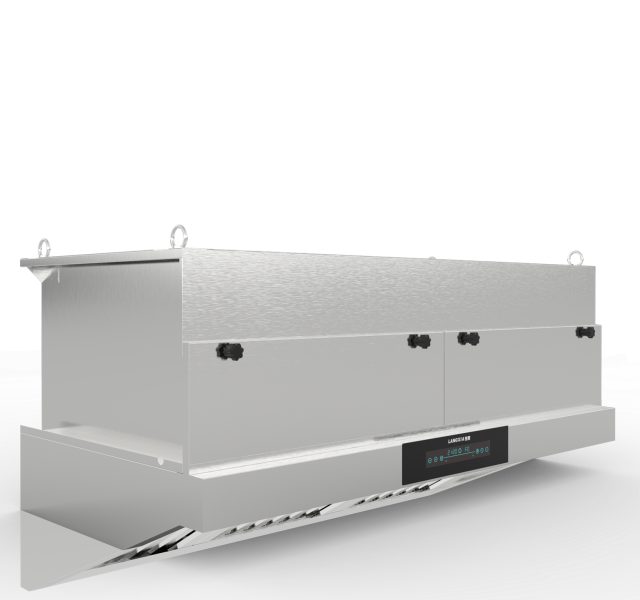
Souniny’s N-series ductless all-in-one hoods are aimed at the bake-line duty this article has described: gas and electric deck ovens, conveyor ovens, panini presses and light fryer work, with dry electrostatic precipitation followed by multi-stage HEPA filtration. They are built low — around 850 mm of body height — which matters in converted buildings where every centimetre between the oven top and the ceiling is contested. The ND-series takes over where the menu turns heavy: a fryer bank running continuously, a charcoal grill, a solid-fuel oven, or a menu built around fried starters. The ND-series adds a water-cycle stage, a medium-efficiency pre-filter and an H12 HEPA stage in a taller two-section body, and its electrostatic cells are designed for a 40–60 day cleaning interval under normal commercial duty.
Where the odour boundary is the binding constraint — a pizza shop under flats, on a restaurant strip, or facing a residential courtyard — the Odor Removal Tower is the component that buys the goodwill. Tower units in the W-series cover roughly 5,000–20,000 m³/h, and the odour section can be specified to remove up to 99.9% of the odour load, which is what turns a marginal planning application into a straightforward one.
Low-Ceiling and Heritage Pizzerias
Old European shopfronts are the hardest brief in this category. A converted Altbau or a protected facade in a heritage zone frequently leaves 2.4 m of clear height, and the same protection order that preserves the frontage also blocks a new rooftop penetration. A conventional stack — canopy, duct, purifier, fan, discharge — simply does not fit, and no amount of airflow calculation changes that.
The answer in these buildings is to split capture from purification. A shallow canopy captures over the oven; the purification cabinet stands on the floor behind the cookline, in a back-of-house recess, or in an adjoining plant room or cellar, joined by a short duct run. Souniny’s Cabinet Purifier units follow that pattern, and the compact GC10 and GC11 cabinets are specifically intended for it: 520 mm wide bodies, 1,000 m³/h and 2,000 m³/h of maximum airflow respectively, and a three-stage train of electrostatic field, HEPA and activated carbon. GC11, at 2,000 m³/h, is the unit the factory recommends for light-emission scenarios where headroom is the limiting factor — which describes a great many historic pizza shops.
Mobile and Pop-Up Pizza Service
Not every pizzeria has a fixed address. Wood-fired trailers, market stalls, festival pitches, mall promotions and hotel terrace pop-ups all cook in places where no duct exists and none can be created. This is a different equipment class again, because the unit has to move, run from a single-phase supply, and be safe in front of the public. Souniny’s CV-C mobile cart, with its tempered-glass hood and integrated purification, is the format built for that duty: a mobile cook station with a ventless hood, so the plume is captured and cleaned at the source with no discharge point to negotiate.
For operators who already have a fixed site and are adding a seasonal terrace or forecourt, mobile food carts let the same equipment be used in two places — one unit working the shop on weekdays and the market or festival at weekends. That flexibility is often the difference between a marginal and a viable second revenue stream.
Make-Up Air, Heat and the Dining Room
A ductless system returns purified air to the room, so the make-up air question changes shape. Instead of a pure replacement-air calculation, the designer now balances the recirculation loop against the room’s air-conditioning load. A two-deck oven plus a fryer plus a fully occupied dining room is a serious heat load, and there is a real risk that the ventilation system works exactly as specified while the room still feels wrong, because the cooling capacity was chosen before the equipment schedule was finalised.
Two practical points resolve most of it. First, treat the local extraction demand honestly — a small dedicated exhaust at the ovens is often worth keeping even in a ductless installation, provided code allows it, so that some of the heat leaves rather than circulating. Second, never place the return grille directly above a guest table or the pass. Cleaned air still carries a fraction of heat and humidity, and guests read that as a draught long before they read it as a temperature.
In smaller formats the make-up question usually disappears, because the dining room is large relative to the cookline and the door traffic supplies more outdoor air than the hood can consume. In a 25-seat room it reappears immediately.
Maintenance Rhythm for a Flour-and-Grease Kitchen
Pizzeria maintenance intervals cannot be copied from a fry kitchen or a bakery. Flour dust and grease form a mixture that dries hard and insulates. Where the two meet — on baffle faces, on the leading edge of an electrostatic cell and inside the pre-filter frame — deposits harden faster than either would alone, and a cell that insulates stops collecting instead of failing cleanly. The operator often notices nothing until an odour complaint or an inspection says otherwise.
A workable rhythm for a pizza kitchen is: daily rinse of the baffle faces, weekly removal and washing of the pre-filter, electrostatic cell cleaning on the 40–60 day cycle that the manufacturer specifies for normal commercial duty, and an odour-media check at least as often as the cell is cleaned. Where the menu includes a wood oven, the ash load shortens these intervals rather than lengthening them. HEPA media change is condition-based but should be logged from the day the unit is commissioned, so that the first change is a comparison rather than a guess.
Codes, Inspections and What Fire Officers Look For
Whatever the architecture, the inspection logic is consistent. Fire authorities — working from NFPA 96 in the United States, EN 16282-1 and its national companions in Europe, AS 1668.2 in Australia, and equivalent provisions under the International Mechanical Code elsewhere — have moved over the last decade from asking whether a hood exists to asking whether the whole exhaust path can be cleaned, verified and documented. In ducted installations that means access panels, and a cleaning record. In ductless and recirculating installations it means evidence that the equipment is rated for the application, that the filter stages are being serviced on schedule, and that a fire suppression strategy appropriate to the appliance class is in place. Solid-fuel ovens are treated separately in most jurisdictions and should be raised with the local authority early, because the answer sometimes affects the layout rather than only the equipment.
For a pizzeria, the single most useful pre-inspection habit is a written log covering capture checks, filter condition, cell cleaning and odour-media replacement. It converts a subjective argument about whether the kitchen smells into a record of maintenance performed.
Six Mistakes That Cost Pizzerias Money
First, specifying one hood and one purification unit for a menu that spans three fume classes. Second, treating a wood-fired oven as a gas oven and omitting the odour stage. Third, sizing capture to the ceiling rather than to the plume, so the outer edges of the cookline leak under load. Fourth, relying on grease filtration alone and letting flour dust reach the electrostatic cell. Fifth, buying for a leased building as though it were a freehold and discovering halfway through fit-out that there is no discharge right and no riser access. Sixth, commissioning without a maintenance plan, then discovering at inspection time that the cleaning interval was never realistic for a flour-and-grease duty.
Quick Selection Guide by Pizzeria Format
A neighbourhood counter with two deck ovens and light fryer work, no duct rights, tight headroom: a ductless all-in-one hood sized in the 5,000–6,000 m³/h band, or a split cabinet arrangement where clear height rules the stack out. A mid-sized restaurant with deck ovens, a pasta boiler and a fryer bank: separate capture for the bake line and the fry line, ductless purification on each, with a tower-style odour stage if neighbours are close. A full-service room with a wood-fired dome, chargrill and bar menu: dedicated heavy-fume capture and purification for the dome and grill, distinct treatment for the bake line, and an odour boundary designed rather than assumed. A mall tenancy: everything determined by the absence of a discharge point. A trailer, stall or terrace: a mobile cart from the outset.
The common thread is that the equipment decision is downstream of two questions — what the menu actually produces, and what the building actually allows. Answer both honestly before sizing anything and a pizzeria is a straightforward project. Skip either one and the kitchen gets the ventilation equivalent of a pizza cooked in a cold oven: it looks finished long before it is.