A theme park is one of the most demanding environments in all of commercial food service. Dozens of outlets operate behind a single gate — quick-service counters, themed sit-down restaurants, outdoor kiosks, parade-season snack vans, and pop-up beverage stalls — each generating its own mix of grease-laden vapor, smoke, and cooking odor. Unlike a conventional restaurant, a park rarely has the freedom to run ductwork through a protected facade, a landmark roof, or a below-grade service tunnel. The ventilation answer is therefore not “one big ESP system,” but a portfolio: ductless all-in-one units for fixed kitchens and ventless mobile carts for front-of-house and outdoor cooking.
Why Theme Parks Break the Standard Ducted Playbook
Most commercial kitchen ventilation assumes you can route a steel duct from the Commercial Range Hood up through the roof and discharge far from guests. Theme parks violate that assumption constantly. A castle-themed restaurant may sit under a protected silhouette where no rooftop penetration is permitted. A lakeside kiosk may have no ceiling cavity at all. A seasonal festival stall may be erected on pavement for eight weeks and then removed. In each case, running ductwork is impossible, slow, or simply uneconomic.
At the same time, parks concentrate people. Queues, outdoor seating, and photo spots sit meters from open grills. Odor that a street restaurant could vent upward becomes a guest-complaint issue the moment it drifts across a walkway. The ventilation system has to do more than capture grease — it has to return genuinely clean, deodorized air into the same space or into a guest-facing area.
Ductless All-in-One Systems for Fixed Themed Kitchens
For enclosed, structurally constrained kitchens, the N-series (light oil-fume all-in-one) and ND-series (heavy oil-fume all-in-one) units deliver “multiple purification without piping.” Capture air is pulled through a stainless steel electric field where an Electrostatic Precipitator charges and collects sub-micron particulate — the grease-laden vapor and smoke fractions that conventional baffle filters miss — and then passes through the Odor Removal Tower (the deodorizing box, using self-developed deodorizing technology with activated carbon) before the air is recirculated. No duct, no roof penetration, no external discharge permit.
Rule of thumb for parks: choose the N-series where the dominant load is light sautéing, frying, and beverage prep, and the ND-series where the outlet does heavy charbroiling, wok work, or deep-fat frying at volume. Both pair with the Odor Removal Tower whenever the kitchen sits near guest areas.
This architecture maps directly onto the constraints above. A fairy-tale restaurant with a fragile facade gets clean recirculated air with zero structural intrusion. A basement-level kitchen in a ride building gets purification without a path to the roof. And because there is no long duct to clean, the fire-safety and maintenance burden that NFPA 96 normally imposes on ducted systems is dramatically reduced.
Ventless Catering Carts for Outdoor & Front-of-House Cooking
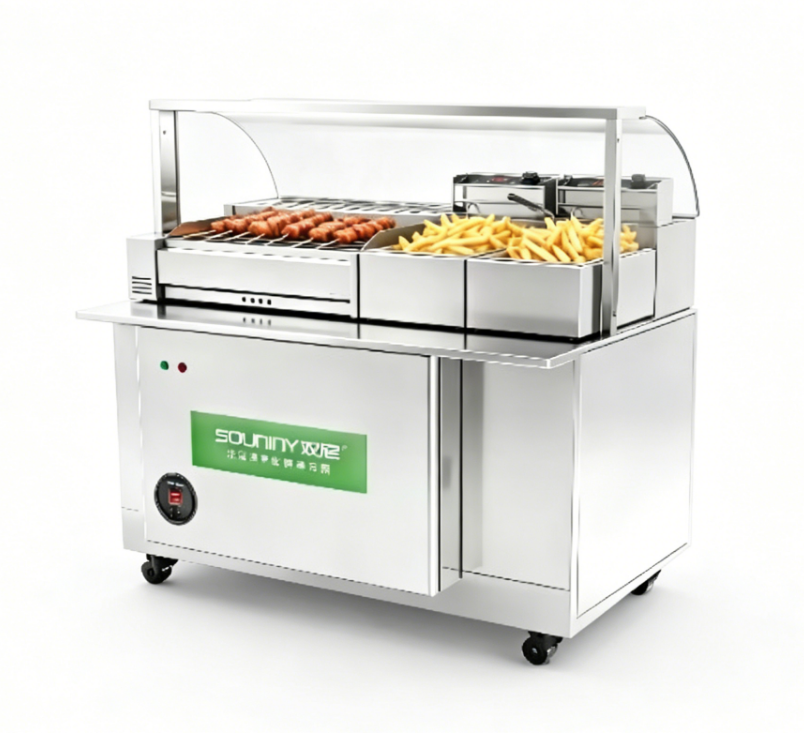
Where the park’s character is defined by visible cooking — a churro cart, a turkey-leg grill, a noodle station in a themed plaza — the CV-A, CV-B, and CV-C ventless catering vehicles are the right tool. These are front-of-house cooking purification systems: a mobile stainless-steel unit with an integrated capture hood, an electrostatic field, and a deodorizing stage built into a single footprint that rolls where the guests are. They embody the “Ventless Catering Vehicles” principle — live cooking, mobile design, corrosion-resistant and easy to clean — without any connection to building ductwork.
The three models let a park match capacity to footprint. CV-A suits a compact snack station; CV-B fits a mid-size grill or fryer with moderate throughput; CV-C handles a higher-volume live-cooking front of house. Because each is self-contained, a park can stage carts for a seasonal event, relocate them for a parade route, or withdraw them for maintenance without touching the building’s ventilation at all.
Odor and IAQ Control Near Guest Queues
Odor is the differentiator between a park that smells appetizing and one that draws complaints. Recirculating air must not simply be “less smoky” — it must be neutral. The Odor Removal Tower and the deodorizing stage inside the CV carts use activated-carbon and self-developed deodorizing technology to strip the volatile organic compounds and aromatic fractions from fried, grilled, and spiced foods. The result is air that can safely return to a dining terrace or a covered queue without carrying the kitchen with it.
This matters most at peak: a noon rush where every outlet fires at once, or a fireworks-night crowd where food kiosks run late. A portfolio of independent, localized units scales with the park — each kitchen and each cart carries its own purification headroom rather than competing for a shared duct’s capacity.
Standards and Compliance
Even ductless and ventless systems operate inside a regulatory frame. In the United States, NFPA 96 governs commercial kitchen exhaust and fire safety, the International Mechanical Code (IMC) sets ventilation rates, and UL 710B covers recirculating (ductless) hoods. In Europe, EN 16282 defines commercial kitchen ventilation and air-handling requirements, while ASHRAE 154 gives recommended outdoor-air rates. Australian sites follow AS 1668.2. A park operating across regions should specify equipment whose electrical, fire, and airflow characteristics are documented against the relevant standard — and should keep records of commissioning and cleaning for each unit, whether ducted or not.
Recirculating hoods must still meet the capture and efficiency expectations of the applicable code. Souniny’s ductless units are built around a stainless steel electric field and an intelligent high-voltage power supply, with purification efficiency documented for sub-micron particulate capture — the same performance basis inspectors expect from any commercial kitchen exhaust system.
Sizing and Deployment Across a Park
A practical park rollout treats ventilation as a distributed network rather than a central plant. Start by classifying each outlet:
- Themed enclosed restaurant, no duct path → N-series or ND-series + Odor Removal Tower, sized to the cooking line and expected peak covers-per-hour.
- Outdoor or front-of-house live cooking → CV-A / CV-B / CV-C ventless cart, matched to menu and throughput.
- Shared commissary or central prep → higher-volume ductless or, where a duct already exists, an ESP Purifier plus Centrifugal Fan backbone.
- Beverage and light-prep kiosks → compact ductless units or a Cabinet Purifier where space is tight.
Because every node is independent, deployment can proceed outlet by outlet, phasing capital spend with the operating calendar — a major advantage for a park that cannot shut the gates to renovate.
Maintenance at Attraction Scale
A park with forty purification nodes needs a maintenance model that does not collapse under its own logistics. Two features carry the load. First, self-cleaning ESP options and the Smart Water Tank approach reduce manual cell washing for high-volume nodes. Second, a scheduled service contract — tracking cell condition, carbon load, and power-supply health per unit — turns maintenance from reactive repair into planned downtime. The Distillery and Brewery taproom lessons from other venues apply directly: data-driven cleaning intervals, based on actual operating hours rather than a fixed calendar, keep every outlet compliant through the summer peak.
Choosing the Right Configuration
There is no single “theme park ventilation product.” The correct answer is a mix:
- Fixed kitchens with no duct path → N-series / ND-series + Odor Removal Tower (ductless, recirculating).
- Outdoor, seasonal, or front-of-house cooking → CV-A / CV-B / CV-C ventless carts.
- Existing duct infrastructure in a central kitchen → ESP Purifiers + Centrifugal Fan as the ducted backbone.
- Space-constrained prep → Cabinet Purifier or compact ductless units.
By leading with ductless all-in-one systems and ventless mobile carts, a park gets guest-proximity odor control, zero structural intrusion, and a deployment model that scales with the season — without trading away the fire-safety and efficiency discipline that any commercial kitchen exhaust system must hold.