Truck stops and travel plazas have evolved far beyond the fuel-and-snack model of decades past. Modern facilities along major highway corridors now operate full-service kitchens turning out fried chicken burgers, flame-grilled burgers, breakfast platters, and brewed coffee around the clock — serving long-haul truckers, road-trip families, and regional bus tours alike. The cooking loads are relentless: flat-top griddles searing bacon and burger patties at dawn, deep fryers cycling through baskets of chips and chicken all day, and charbroiler lanes laying down grill marks on steaks and sausages through the night shift. Each of these processes generates a thick cocktail of grease-laden vapor, sub-micron particulate, polycyclic aromatic hydrocarbons (PAHs), and volatile organic compounds (VOCs) that a standard exhaust hood alone cannot manage. Without dedicated grease and smoke purification, that contamination spreads across the dining area, clings to retail shelving, coats restroom surfaces, and eventually draws the attention of health inspectors and fire-code auditors.
Why Truck Stop Kitchens Need Purpose-Built Ventilation
The operational profile of a truck stop kitchen is unlike most standalone restaurants. A typical highway travel plaza may serve between 800 and 2,500 meals per day across a 24-hour cycle, with peak surges at dawn and dusk when convoys of lorries refuel and drivers take mandated rest breaks. The cooking battery behind that volume usually includes a flat-top griddle, a four-basket deep fryer, a charbroiler or clamshell grill, and a commercial microwave or conveyor oven for pre-prepped items. Every one of these appliances produces a distinct pollutant profile:
Flat-top griddles release aerosolized grease when bacon, sausages, and burger patties hit a 200-degree Celsius surface. The sudden vaporisation of fat creates a fine mist of sub-micron droplets that stays airborne for extended periods and penetrates standard mesh filters.
Deep fryers generate continuous plumes of heated oil vapor throughout the day. As frying oil degrades through repeated heating cycles, the vapor carries acrolein and other irritant compounds that irritate eyes and airways among kitchen staff working long split shifts.
Charbroilers produce the heaviest pollutant load of all. Dripping fat onto an open flame creates pyrolysed smoke loaded with PAHs and fine particulate matter — the same chemistry that makes flame-grilled food flavourful also makes it a serious indoor air quality concern in a confined truck stop kitchen.
The combination of round-the-clock operation, multiple high-grease cooking methods, and often limited ceiling clearance in prefabricated travel plaza buildings means that conventional ducted exhaust systems frequently fall short — both in capture performance and in ongoing maintenance practicality.
Ductless vs Ducted: The Truck Stop Structural Reality
Many travel plazas occupy prefabricated steel-framed buildings with suspended ceilings, shared HVAC trunking, and a retail floor plan that places the kitchen adjacent to convenience retail and restroom corridors rather than along an exterior wall. Running a full ducted exhaust system from a rear kitchen to the roof — often 15 to 25 metres of horizontal ductwork with multiple elbows — is structurally impractical and prohibitively expensive to retrofit. It also creates a grease-laden duct run that becomes a fire-safety liability under standards such as NFPA 96 and EN 16282, requiring quarterly professional cleaning of the full duct path.
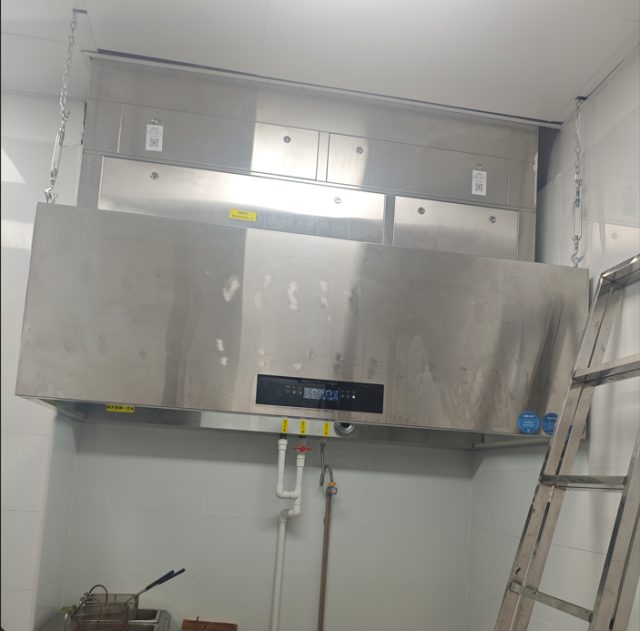
This is where the ductless approach fundamentally changes the equation. A ductless commercial range hood — specifically the SOUNINY ND-series heavy oil-fume all-in-one unit — captures grease and smoke directly at the source, processes it through an integrated electrostatic precipitator cell and multi-stage filtration system, and recirculates cleaned air back into the kitchen. No roof penetration. No horizontal ductwork. No grease-laden duct to clean. The unit mounts above the cooking battery exactly where a traditional exhaust canopy would sit, but instead of merely moving dirty air elsewhere, it eliminates the pollutants on-site.
The SOUNINY ND-series: Heavy-Duty Ductless Purification for High-Volume Grilling
For truck stops where the dominant cooking method involves charbroilers, flat-top griddles running at full capacity, and continuous deep-fryer cycles, the ND-series is the engineered solution. Built around a self-contained electrostatic precipitator (ESP) cell, the ND-series all-in-one range hood captures grease-laden vapor at the canopy edge, draws it through a stainless steel mechanical baffle pre-filter that strips the heaviest grease droplets, and then charges the remaining sub-micron particulate in a high-voltage ionisation field before collecting it on aluminium collector plates. The cleaned air passes through an activated carbon stage for VOC and odour reduction before being returned to the room.
This architecture means the ND-series handles the exact pollutant spectrum produced by truck stop kitchens:
- Grease aerosol from griddles and fryers — captured by the baffle pre-filter and ESP cell before it can coat surfaces or create slip hazards on tiled kitchen floors
- Smoke particulate from charbroilers — charged and collected on ESP plates at efficiencies exceeding 90 percent for sub-micron particles
- Volatile organic compounds from heated cooking oil — adsorbed by the integrated activated carbon stage
- Odour molecules that would otherwise drift into the retail convenience area and fuel court — neutralised before recirculation
For truck stop operators concerned about regulatory compliance, the ND-series electrostatic precipitator cell operates on the same physical principle recognised by kitchen ventilation standards worldwide — including UL 710B for grease-laden vapor removal and EN 16282 for commercial kitchen ventilation systems. The key operational advantage is that the entire purification train is self-contained within the hood housing, so there is no ductwork to inspect, no roof fan to maintain, and no make-up air system to balance against an external exhaust rate.
N-series for Lighter Service Stations and Satellite Kitchens
Not every location in a truck stop network operates a full heavy-grill kitchen. Smaller satellite service stations along secondary routes may run a simpler food program — breakfast sandwiches on a contact grill, panini presses, and a small convection oven for pre-baked goods. For these lighter cooking profiles, the SOUNINY N-series light oil-fume all-in-one range hood offers the same ductless architecture in a form factor scaled to lower grease volumes.
The N-series is engineered for kitchens where the primary pollutant is grease vapor from griddle work and light sauteing rather than heavy charbroiler smoke. It uses the same ESP cell technology as the ND-series but with a filtration capacity matched to lighter oil-fume loads, making it more compact and cost-effective for satellite kitchens, convenience store food corners, and travel plaza coffee stations. For operators managing a chain of locations with different cooking intensities, pairing ND-series units at flagship plazas with N-series units at smaller satellite stops standardises the ventilation approach across the network while right-sizing the equipment to each site’s actual load.
Odor Removal Tower: Solving the Long-Haul Odour Problem
A persistent complaint at truck stops and travel plazas is cooking odour migration. The same building that houses the kitchen also contains a convenience store with packaged snacks, a seated dining area, restroom facilities, and sometimes showers and rest lounges for drivers taking mandated breaks. When grease-laden vapor and cooking odour escape the kitchen zone — whether through a standard exhaust hood that only partially captures the plume, or through pressure differentials that push kitchen air into adjacent spaces — the entire facility acquires a lingering fried-food smell that degrades the customer experience and clings to retail packaging.
The SOUNINY Odor Removal Tower addresses this directly. Designed to pair with the N-series and ND-series ductless range hoods, the tower provides an additional stage of deep deodorisation through an advanced activated carbon and optional UV-C photolysis system. VOCs and odour-active compounds that pass through the hood’s primary carbon stage are further broken down in the tower, ensuring that the air recirculating back into the dining and retail zones is not merely filtered but genuinely deodorised. For facilities where the kitchen shares open-air circulation with the dining room — a common layout in modern travel plaza designs — the Odor Removal Tower is the critical bridge between grease capture and genuine air quality improvement.
ESP Purifiers for Ducted High-Volume Scenarios
Some travel plazas — particularly flagship locations at major highway interchanges with purpose-built kitchen facilities — do have existing ductwork and roof-level exhaust fans. For these ducted installations, the SOUNINY ESP Purifier line provides in-duct electrostatic precipitation rated for high airflow volumes. Installed as a section within the duct run between the canopy and the centrifugal fan, the ESP Purifier charges and collects grease particulate before it enters the ductwork, dramatically reducing the rate of grease accumulation inside the duct and at the roof discharge point.
In a truck stop context, this ducted ESP configuration is most appropriate when:
- The kitchen occupies a dedicated room with exterior wall access and a direct vertical duct run to the roof — minimising horizontal grease-laden ductwork
- Cooking volume is extremely high — multiple charbroilers and fryer banks running simultaneously across all shifts — exceeding the practical capacity of a single ductless hood
- Local building code or insurance requirements mandate a roof-discharging exhaust system rather than a recirculating one
In such cases, the ESP Purifier is paired with a SOUNINY Centrifugal Fan sized to the duct system’s airflow requirements. The centrifugal fan provides the static pressure needed to pull grease-laden air through the ESP cell, ductwork, and any roof-level discharge baffling. For truck stop operators, the advantage of the ducted ESP approach is that it concentrates grease removal in a single accessible in-duct unit rather than distributing it across multiple hood-mounted cells — simplifying maintenance in a facility that already manages fuel pumps, retail operations, and restroom facilities simultaneously.
24/7 Operation: Maintenance and Serviceability Considerations
Truck stops do not close. A kitchen that serves breakfast at 5 AM, lunch at noon, dinner at 7 PM, and late-night meals at 2 AM cannot afford ventilation downtime during peak service. This operational reality has direct implications for how the grease and smoke purification system is maintained.
For ductless ND-series and N-series installations, the ESP cell is designed for tool-free removal and dishwasher-safe cleaning. During a pre-scheduled maintenance window — typically during the lowest-traffic period between 3 AM and 5 AM — the kitchen manager slides out the ESP cell, rinses it in the three-compartment sink or runs it through the commercial dishwasher, and reinserts it. The entire cycle takes under 20 minutes per unit. For facilities with multiple hoods, cells can be cleaned on a staggered rotation so that at least one hood is always operational.
The mechanical baffle pre-filters — the first line of defence that captures the heaviest grease droplets — should be emptied and degreased daily. This is a five-minute task that significantly extends the service life of the ESP cell downstream. For truck stop operators who already run a daily kitchen cleaning regime for food safety compliance, adding pre-filter degreasing is a negligible additional step with substantial equipment-protection benefits.
Activated carbon stages in both the hood and the Odor Removal Tower require replacement on a schedule determined by cooking volume — typically every three to six months for a 24-hour truck stop kitchen. Carbon media that has reached saturation will no longer adsorb VOCs and odours, allowing these compounds to pass through into the recirculated air. Monitoring the return-air odour profile — a simple sensory check during the pre-dawn maintenance window — provides a practical indicator that carbon replacement is due.
Fire Safety and Insurance Implications
The fire risk profile of a truck stop kitchen is elevated by the sheer volume of grease-laden cooking and the continuous operating hours. Grease accumulation in ductwork is the leading cause of commercial kitchen fires — and in a facility that shares a building with a fuel court, a retail store carrying flammable packaged goods, and sleeping truckers in rest areas, the consequences of a grease fire spreading beyond the kitchen are severe.
Ductless systems offer an inherent fire-safety advantage: with no grease-laden ductwork running through the building structure, there is no hidden fuel load in ceiling voids or wall cavities. The ND-series and N-series capture and contain grease within the accessible hood housing, where it can be cleaned regularly. For ducted installations using ESP Purifiers, the in-duct electrostatic precipitation removes the majority of grease from the air stream before it enters the ductwork, dramatically reducing the rate of accumulation that would otherwise create a fire-spread pathway.
Under NFPA 96, kitchens using solid fuel cooking equipment or producing heavy grease-laden vapor must have the exhaust system inspected and cleaned at intervals determined by the type and volume of cooking — quarterly for high-volume operations. For ductless systems, this inspection focuses on the hood-mounted ESP cell and pre-filter, which are fully accessible without specialised duct-cleaning contractors. For ducted ESP installations, the reduced grease loading in the duct downstream of the precipitator means that professional duct inspections can be performed less frequently, and when they are required, the duct is demonstrably cleaner — a documented record that supports both insurance underwriting and fire marshal compliance.
Energy and Operating Cost Advantages of Ductless Systems
A conventional ducted exhaust system in a truck stop kitchen operates by continuously removing large volumes of conditioned air from the building and discharging it to atmosphere. The make-up air that replaces it — whether drawn through passive louvres or supplied by a dedicated make-up air unit — is either unconditioned outside air (which must be heated in winter or cooled in summer) or is itself a substantial energy consumer when it includes a heating and cooling coil. For a 24-hour operation, this energy penalty is compounded across every hour of every day.
Ductless ND-series and N-series range hoods recirculate the air they process. After the grease and smoke are removed, the cleaned, deodorised air returns to the kitchen at room temperature. The only air that leaves the building is the small amount of natural exfiltration that occurs in any structure. For a travel plaza in a cold-climate region — where heating make-up air for a 2,000-CFM exhaust fan can cost thousands per winter season in gas or electric utility charges — the ductless approach represents a direct and measurable energy saving. In hot-climate regions, the avoided cooling load produces equivalent savings during the air-conditioning season.
Additionally, the integrated centrifugal fans within the ND-series and N-series hoods are engineered for the specific airflow resistance of their filtration trains — meaning they are sized efficiently rather than oversized to overcome unknown duct friction as is common with conventional roof fans. This results in lower connected electrical load and quieter operation — a meaningful advantage in a facility where truckers may be sleeping in their cabs parked nearby.
Mobile Food Cart Solutions for Travel Plaza Forecourts
Beyond the main kitchen, many travel plazas operate supplementary food service points on the forecourt or in an outdoor sheltered area — particularly during peak summer travel seasons when a mobile grill station or a temporary food counter helps manage queue overflow from the indoor kitchen. The SOUNINY mobile food cart range provides self-contained, ventless cooking and purification for these applications:
- CV-A — a ventless hood cart with integrated ESP purification, suitable for front-of-house griddle work and live cooking demonstrations that draw foot traffic
- CV-B — a countertop cart format ideal for compact service points alongside the convenience store entrance, handling panini presses and contact grill tasks
- CV-C — a tempered glass cart offering full visibility of the cooking process, designed for higher-end travel plaza food courts where presentation matters
All three cart models share the same ductless ESP purification architecture as the ND-series and N-series fixed hoods, meaning the grease and smoke generated by on-cart cooking is captured and cleaned within the cart housing — no additional exhaust connection, no roof ductwork, and no additional make-up air load on the building HVAC system. For travel plaza operators who want to expand their food offering seasonally without construction, the carts can be wheeled out for the summer rush and stored during off-peak months.
Selecting the Right Configuration for a Truck Stop Network
For operators managing multiple travel plaza locations, the practical decision matrix is straightforward:
For flagship plazas with heavy charbroiler and fryer loads and existing ductwork: install in-duct ESP Purifiers paired with a correctly sized Centrifugal Fan. Add an Odor Removal Tower if the kitchen shares air space with retail or dining zones and odour migration is a documented complaint.
For standard travel plazas with a full-service kitchen but no existing ductwork or where duct retrofit is structurally impractical: install ND-series ductless range hoods above the griddle, fryer, and charbroiler zones. Add an Odor Removal Tower if the kitchen opens directly onto the dining area.
For satellite service stations with lighter food programs: install N-series ductless range hoods sized to the lighter cooking load. The same ductless architecture ensures consistent air quality management across the network without over-specifying equipment for sites that do not run heavy grilling.
For seasonal or supplementary forecourt food service: deploy CV-A, CV-B, or CV-C mobile carts as self-contained, mobile cooking and purification units that require no installation infrastructure.
Compliance and Standards Alignment
Truck stop and travel plaza kitchens operate under the same commercial food service regulations as any restaurant — and in many jurisdictions, they face additional scrutiny because they serve a transient, high-volume customer base across extended hours. The SOUNINY product range aligns with established kitchen ventilation and grease management standards:
- UL 710B — the standard for grease-laden vapor removal devices, applicable to the ESP cells in both the ductless range hoods and the in-duct ESP Purifiers
- NFPA 96 — the fire code standard for ventilation control of commercial cooking operations, governing grease accumulation management in both ducted and ductless configurations
- EN 16282 — the European standard for kitchen ventilation systems, relevant for travel plazas operating under EU jurisdiction where CE certification is a regulatory and commercial requirement
- IMC (International Mechanical Code) — the model code adopted by most North American jurisdictions, which recognises ductless (Type II recirculating) hoods as compliant alternatives to ducted systems when equipped with appropriate filtration
- ASHRAE 154 — the standard for kitchen ventilation design, which informs the sizing and placement of both ductless and ducted grease exhaust systems
For SOUNINY, the CE certification of the product range provides a specific advantage for travel plaza operators in European markets where highway service areas are often managed by national or regional transport authorities with stringent procurement requirements for certified equipment.
Conclusion: Engineered Ventilation for the Highway Kitchen
The modern truck stop and travel plaza kitchen is a demanding environment — high-volume, multi-method, round-the-clock cooking in a building that was often not originally designed to house a restaurant at all. Conventional ducted exhaust systems struggle with both the structural constraints of these buildings and the relentless grease loading of continuous service. The SOUNINY ductless approach — centred on the ND-series for heavy grilling and the N-series for lighter satellite kitchens, paired with Odor Removal Towers for comprehensive deodorisation, and supplemented by ESP Purifiers and Centrifugal Fans for the minority of sites with existing ductwork — offers a flexible, standards-compliant, and energy-efficient ventilation architecture that scales across an entire travel plaza network.
For operators who need to control grease, smoke, and odour in a facility that never closes — where the kitchen sits alongside fuel pumps, retail shelving, and resting truckers — the choice of ventilation technology is not merely an equipment decision. It is a commitment to air quality, fire safety, and customer experience that must perform reliably at 3 AM on a January motorway just as it does at noon in July. SOUNINY’s full-spectrum grease and smoke management solutions are engineered to deliver that reliability, shift after shift, season after season.