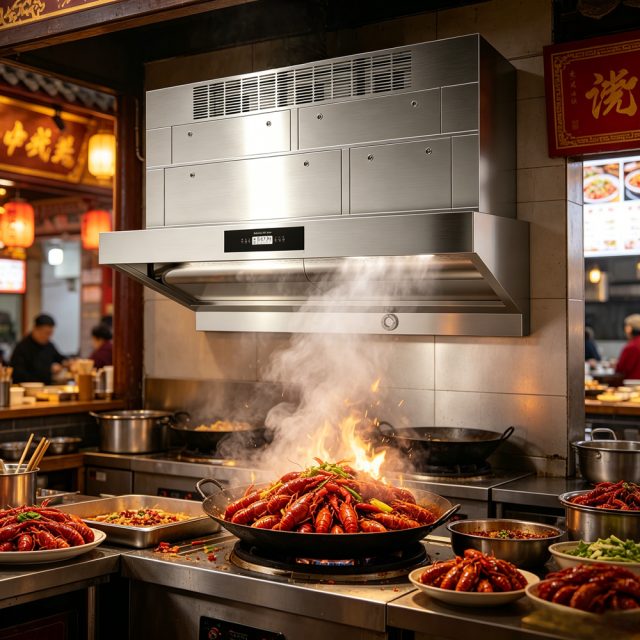
The United Arab Emirates regulates commercial kitchen ventilation through two authorities that must both be satisfied before a restaurant can trade, and it does so against a climate that makes ordinary ventilation design fail. Dubai Municipality controls food safety, hygiene and the fume ventilation system itself; Civil Defence controls fire suppression, detection and the duct that carries grease-laden vapour to the roof. Where the two regimes meet, the rules are unusually specific: a named technical guideline for hood cleaning, a duct material and fire-rating schedule, an exhaust rate in cubic metres per hour, and an explicit requirement for higher-grade treatment on heavy-grease lines. This guide sets out what the UAE framework actually demands of a kitchen exhaust system, and how ducted and ductless designs answer it.
Two Regulators, One Kitchen
A UAE kitchen project answers to more than one authority. Dubai Municipality (DM) governs the food business licence, hygiene, layout and the fume ventilation system, and it does so through the Dubai Food Code and a set of published technical guidelines. The most relevant for exhaust design is DM-HSD-GU46-KFPA2, issued under Dubai Local Order No. 61/1991, whose Section 4-6 on fume ventilation sets out the hood, duct, filter and cleaning requirements in dated, checkable terms. Dubai Civil Defence (DCD) governs fire risk under the UAE Fire and Life Safety Code, and it approves the fire suppression system, the duct’s fire rating and the materials used. Facilities inside free zones fall under Trakhees, whose building and safety codes generally mirror DM requirements and in some cases exceed them.
DM also regulates the kitchen as a space. The kitchen must occupy at least 40 % of the total restaurant area, or a minimum of about 300 square feet (roughly 28 square metres), whichever is larger. The plan must demonstrate a unidirectional raw-to-cooked workflow with no cross-traffic between clean and dirty zones, and equipment must be mounted on wheels or raised at least 150 mm off the floor so the space beneath can be cleaned. These are layout conditions, but they shape the exhaust design because they fix where the cookline sits and how much open hood edge is exposed to the room.
Grease Ducts: NFPA 96 Is the Only Accepted Standard
The single most important technical fact for UAE kitchen design is that NFPA 96 — the Standard for Ventilation Control and Fire Protection of Commercial Cooking Operations — is treated as the only accepted practice for constructing a kitchen grease duct. The UAE Fire and Life Safety Code does not leave duct design to local interpretation. Designers who arrive with a European duct specification must translate it into the NFPA 96 language the inspector expects.
Duct construction — galvanised steel of at least 1.2 mm, or stainless steel of at least 0.9 mm. The duct and its insulation must achieve a 120-minute fire-resistance rating. Materials must comply with ASTM E2336 or UL 2221. BS 476-24 is acceptable for smoke ducts but is not permitted for grease ducts.
Three dimensional rules follow directly. No combustible material may sit within about 457 mm (18 inches) of the duct. Clean-out access panels are required at every change of direction and at least every 3 metres along the run. And the kitchen duct must serve the kitchen alone — it may not be combined with the building’s general ventilation. Horizontal runs should be as short as possible and, where unavoidable, sloped so that liquid grease drains toward the hood or a collection point rather than pooling in the duct. The duct must vent directly to atmosphere, and conventional wisdom among UAE contractors is that fewer bends mean fewer grease traps and a lower fire risk.
The Hood Itself
UAE practice follows the international Type I and Type II classification. A Type I hood is required over equipment that produces grease-laden vapour — fryers, griddles, charbroilers, woks and similar appliances — and it carries grease filters and suppression compatibility. A Type II hood serves only steam and heat, such as steamers and ovens, and is not adequate for a high-grease station.
Dubai Municipality’s hood specification is explicit about construction. Hoods must be built from at least 18-gauge carbon steel or 20-gauge stainless steel, with seamless, liquid-tight welds so that grease cannot seep through joints. Grease filters must be mounted at approximately 45 degrees to the horizontal, with a drip tray sized to hold no more than about one gallon (roughly 3.8 litres) so that a full tray cannot overflow unnoticed. The hood must overhang the cooking equipment by at least 150 mm on the open sides, so the rising plume is captured rather than spilling into the kitchen. The exhaust fan must run at a minimum face velocity of about 2.5 m/s, and the system must include a timer that keeps the fan running for two hours after operations conclude — one of the most frequently missed requirements, and the one that leaves residual grease and heat in the duct overnight if it is.
Stack Height, Dispersion and Odour
Where the exhaust is discharged matters as much as how clean it is. Dubai Municipality guidance requires the exhaust stack to extend at least 1.5 metres above the highest point of the building, and contractors working in dense residential areas commonly target 2 metres above the nearest building to keep odour away from neighbouring villas and apartments. Stack height is not decoration: it determines whether the plume is carried away by wind or drawn back into windows, air intakes and courtyards by the negative-pressure eddy that hugs a facade.
Inside the kitchen, the system should maintain slight negative pressure relative to the dining area, so that cooking odour is contained rather than drifting into the guest space. That negative pressure must be achieved while still supplying enough conditioned fresh air for staff comfort and for gas appliance combustion — a balance that is easy to state and frequently got wrong, with kitchens that either leak odour into the restaurant or run so negative that doors are hard to open and burners run poorly.
Fire Suppression, Detection and the 2026 Changes
Civil Defence requirements have tightened recently, and any project designed before 2026 should be re-checked. Automatic fire suppression for a commercial kitchen must be a wet chemical (Class K) system meeting NFPA 17A and UL 300, and it is required for kitchens with three or more burners, with the agent quantity set by hood area. A manual pull station must be located within 5 metres of the cooking equipment.
For new restaurant installations in Dubai from 2026, the fire alarm must be an addressable system; conventional systems are no longer accepted. Detection in the kitchen uses heat detectors rather than smoke detectors, because cooking aerosols trigger smoke heads constantly and the resulting false alarms strip credibility from the whole system. Alarm sounders must reach at least 70 dB throughout the premises. Maintained emergency lighting with a minimum three-hour battery, and illuminated exit signage along escape routes, are also required, and the kitchen must connect to a Civil Defence-approved 24/7 smart monitoring station. Kitchens using LPG add gas detection with an automatic solenoid shut-off valve, which requires a separate Civil Defence approval and a pressure test certificate from a DCD-registered technician.
Heat, Humidity and Make-Up Air
Every cubic metre of exhaust air has to be replaced, and in the UAE the replacement air arrives at close to 42 °C in summer. Unconditioned make-up air is therefore not a neutral design choice — it is a direct assault on kitchen temperature and on staff safety. Compliant designs use a fresh air handling unit (FAHU) to pre-cool incoming air before it reaches the kitchen, and the supply is balanced against the extract so that the space holds the slight negative pressure the odour rules require without starving the appliance.
This is the point at which the UAE’s climate and its fire rules reinforce each other. A kitchen that has been pushed too negative to satisfy a weak extract system will fight its own doors, unsettle gas flames and draw hot, unfiltered air through every gap. Demand-controlled ventilation, which modulates fan speed to the actual cooking load, is one way to keep the pressure balance stable across a service that swings from a quiet afternoon to a packed evening.
Heavy Grease: Electrostatic Precipitators and Carbon
Here the UAE framework is more prescriptive than most. Dubai Municipality guidance states that for heavy-grease cooking — burgers, steaks and similar high-fat grilling and frying — the exhaust system must include an electrostatic precipitator (ESP) and activated carbon filters. The municipality does not merely permit staged treatment; it requires it on the lines that produce the most grease and odour.
The engineering reason is the two-phase pollutant model that governs good exhaust design everywhere. Cooking produces a particulate phase — grease aerosol, sub-micron smoke, and the fine organic droplets that carry most of the visible plume — and a gas phase, the volatile organic compounds responsible for odour. An electrostatic precipitator charges the particulate and collects it on grounded plates, removing the mass that would otherwise coat the duct and blind the odour media. Activated carbon then handles the remaining gas phase. Place carbon before the particulate stage and the pores clog within weeks, after which the system quietly becomes an odour source. Where the building can carry a duct to atmosphere, a ducted ESP purifier paired with a centrifugal fan is the standard high-volume arrangement for exactly this particulate-first duty.
Filter face area, residence time and airflow all have to be sized to the grease load rather than to the nominal hood width. A heavy-grease line under-sized on treatment will pass inspection on day one and fail the first neighbour complaint in month three.
Cleaning: Daily Duties and Professional Intervals
The UAE has its own cleaning regime, distinct from the general NFPA 96 frequency table, and operators are commonly surprised by how granular it is. Under DM-HSD-GU46-KFPA2 Section 4-6, the kitchen must clean cooker surfaces and hoods daily and empty and clean the oil and condensation channels and collectors daily. Grease filters must be removed and cleaned at least weekly. The duct interior surfaces and fan blades must be cleaned by a competent person on a regular basis, with the fan isolated and locked off first for safety.
Layered on top of the daily and weekly duties, NFPA 96 Table 11.4 sets the professional cleaning interval by cooking volume: monthly for solid-fuel cooking such as charcoal, wood or tandoor; quarterly for high-volume operations including 24-hour kitchens, charbroiling and wok stations; semi-annually for moderate-volume restaurants and hotel kitchens; and annually for low-volume, seasonal or small café operations. A qualified contractor assesses the actual cooking type and volume before assigning a tier. Grease traps are mandatory on all drainage from cooking areas before waste enters the main sewer.
Documentation is what turns cleaning into compliance. Before-and-after photographs, the contractor’s report and the cleaning log are the evidence an inspector or an insurer will ask for, and a grease fire in a duct with no cleaning record is a difficult claim to defend.
Free Zones and Cloud Kitchens
Two segments deserve separate attention. Free zones governed by Trakhees — Dubai South, JAFZA and similar — enforce codes that generally mirror Dubai Municipality but can add requirements, so a design approved for a mainland site is not automatically valid inside a free zone.
Cloud kitchens concentrate more cooking into less space than any other format. A single delivery-only unit may run several brands at once, pushing fryers, griddles and woks to continuous maximum output for long shifts, and it may share a riser or a rooftop plant area with neighbouring pods. The exhaust system must be sized for that worst case, not for a single calm menu. Because these kitchens have no dining area, the entire grease and odour load is concentrated in a compact room, making capture efficiency and treatment capacity the difference between a workable pod and a chronic complaint source.
Where Ductless Fits — the Honest Boundary
It would be misleading to present ductless ventilation as a general route around UAE requirements. For grease-laden cooking the framework expects the duct to vent directly to atmosphere, and NFPA 96 duct rules assume a duct exists. A ductless recirculating system is not a blanket exemption, and a heavy-grease restaurant cannot assume it will be accepted as a substitute for a compliant stack.
There are, however, real situations where a recirculating design is the workable answer, subject to authority approval in each case. Type II cooking that produces only steam and heat, below the thresholds that trigger the full grease regime, is one. Mall kiosks and grab-and-go units whose landlord prohibits new roof penetrations are another, because the alternative is no compliant kitchen at all. Temporary and event cooking, where a permanent duct would never be built, is a third. In all of these the recirculating unit must reproduce the same staged logic the code requires of a ducted system — grease separation first, fine particulate capture second, gas-phase odour control third — and it must be maintained with a documented schedule.
Where a design does go ductless, the unit is matched to the menu. A heavy-duty ductless range carries the larger airflow a fryer and griddle line needs; a lighter all-in-one is enough for steaming and assembly work; and a dedicated odour-removal stage extends the carbon interval where the menu is spice- or char-heavy. For kitchens where no compliant duct route exists, the ductless range hood family keeps capture and treatment at the cookline.
Mobile and Event Catering
The UAE’s event, hotel and beach-resort economy runs on temporary cooking. Food trucks, market stalls, hotel brunches and outdoor activations all cook on sites with no fixed exhaust infrastructure, yet they remain subject to hygiene and fire oversight. A self-contained ventless unit is the practical answer here: for temporary and front-of-house cooking, mobile ventless catering carts package capture and treatment into the unit itself. The operator still needs a power supply, extinguisher coverage, a cleaning routine and a venue confirmation that recirculation suits the menu, but no permanent building works are required — which is often the difference between a trading event and a cancelled one.
The Compliance File
Because the UAE regime is approval-driven, the file is as important as the hardware. A defensible record includes: the approved MEP drawings showing hood dimensions, duct routing and access panels; the Civil Defence approval for the suppression, detection and alarm system; the Dubai Municipality food safety permit; the 24/7 monitoring connection agreement; the gas pressure test certificate where LPG is used; the grease trap installation and maintenance record; the daily, weekly and professional cleaning logs with before-and-after photographs; and the commissioning data proving the exhaust fan meets its minimum velocity and the system holds the intended pressure balance. For a ductless installation, add the treatment-train specification, the filter and cell replacement schedule, and any third-party emissions check on the discharge.
Conclusion
UAE commercial kitchen ventilation is a dual-authority regime applied to a hot, dense and rapidly built environment. Dubai Municipality fixes the layout, the hood construction, the filter angle, the duct access and the cleaning calendar, and it requires electrostatic precipitation plus carbon on heavy-grease lines. Civil Defence fixes the duct’s fire rating, the suppression standard, the detection type and the monitoring connection. Around both runs a climate that turns make-up air into a cooling load and a regulatory culture that treats documentation as evidence. Ducted discharge to atmosphere remains the default and the expectation wherever grease-laden cooking occurs, and a staged particulate-first treatment train is what makes that duct safe and acceptable. Where no compliant duct route is possible — light-duty cooking, mall kiosks with no roof access, and temporary event sites — a recirculating system that reproduces the same treatment logic, approved case by case and maintained on a schedule, can deliver a compliant kitchen where a ducted one could not be built.