
Overview
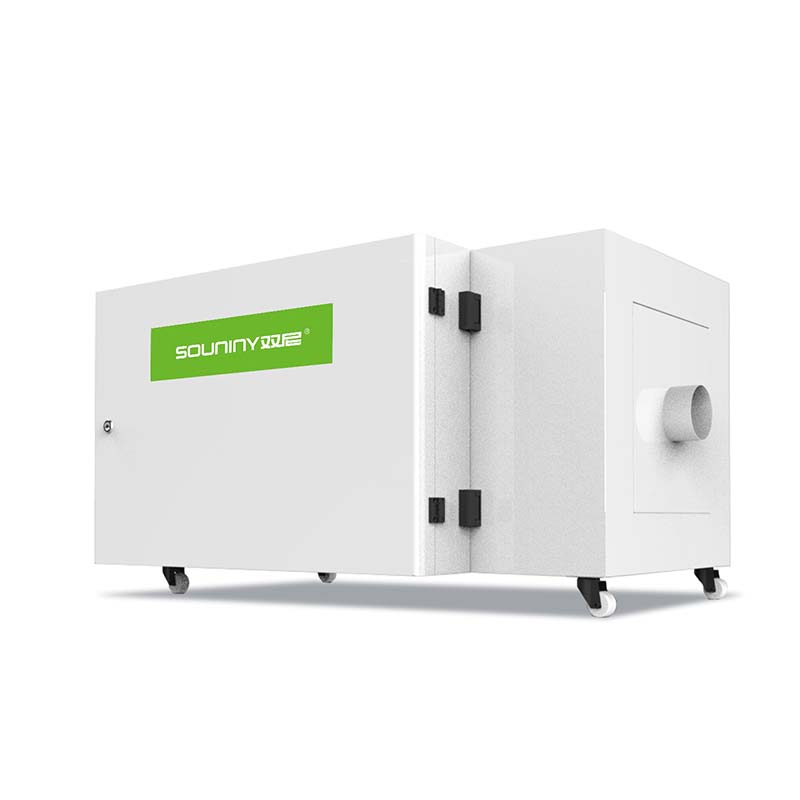
The coffee roasting purifier is engineered specifically for coffee bean roasting, not adapted from a general kitchen range hood. A three-stage composite path treats roasting smoke and the burnt, caramelised odour at the same time, cutting neighbour complaints at the source and making routine environmental inspections straightforward. The cabinet is carbon steel with a hammer-tone black or white finish, mounted on swivel castors, and offered in four models that cover everything from a single micro roasting station to a small roasting plant.
| What it treats | Roasting smoke and chaff particulate, plus the VOC-driven burnt odour that standard kitchen equipment leaves behind |
| How | Pre-filter mesh → stainless-steel ESP cell → HEPA + activated carbon odour module |
| Model range | KL-D-K10 / K20 / K30 / K40 — 800 to 1,500 m³/h |
What Roasting Exhaust Actually Contains
Roasting produces two different problems at once, which is why smoke-only equipment underperforms in a roastery:
- Particulate and chaff. Fine smoke particles and chaff fragments released in increasing volume through the roast, peaking around first and second crack.
- Gaseous odour. Volatile organic compounds carrying the burnt, acrid note that travels well beyond the roastery door and drives complaints.
- Heat and moisture. A load that varies through the roast cycle, so the extraction side needs to follow the curve rather than run at one fixed speed.
Treating the particulate alone clears the visible plume but leaves the smell. Treating the smell without capturing particulate loads the carbon far too quickly. The three-stage path exists to handle both in the right order.
Three-Stage Filtration
| Stage 1 — Pre-filter mesh | Intercepts coarse smoke particles and chaff, protecting the downstream stages from heavy loading |
| Stage 2 — Stainless-steel ESP cell | High-voltage ionisation captures fine particles down to 10 µm and finer; the cell is washable and reusable |
| Stage 3 — HEPA + activated carbon module | Filters particles down to 3 µm while the carbon adsorbs the VOCs responsible for the burnt odour |
Core Configuration
- In-house high-voltage power supply. Constant-voltage output with over-voltage protection, so capture stays stable across long roasting sessions instead of drifting as the cell loads.
- Patented 95 dry-press ceramic insulators. Resist oil and moisture ingress, which is the usual failure mode for insulators in a roasting environment.
- Variable-speed exhaust fan. Permanent-magnet motor with speed control, letting the operator match extraction to the roast stage instead of running flat out all day.
Key Selling Points
| Three-stage composite | Smoke removal and odour removal solved in one pass, not two separate machines |
| Washable ESP cell | Stainless-steel ESP cell is rinsed and reused — no recurring cell consumable cost |
| In-house power supply | Constant voltage with over-voltage protection for stable long-run operation |
| Patented ceramic insulators | 95 dry-press ceramic, oil-resistant, longer service life |
| Four models, exact match | 800 to 1,500 m³/h — sized to the roaster instead of over- or under-specifying |
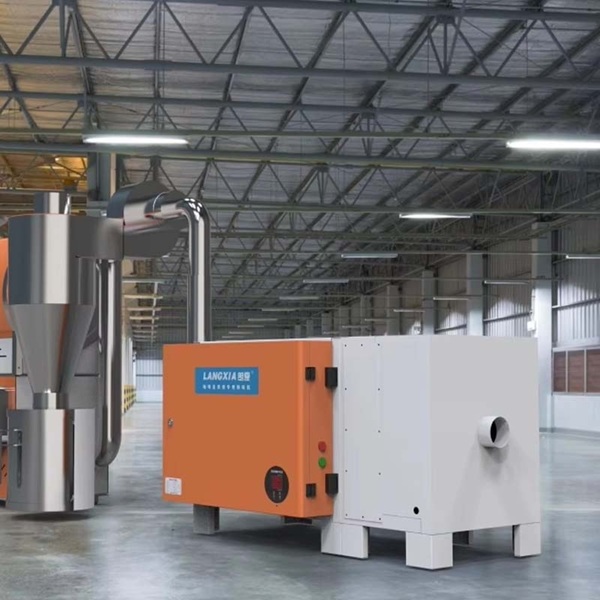
| Floor-standing, dual inlet | Connects straight to the roaster with no drilling and no ductwork modification |
Specifications
| Parameter | Value |
|---|---|
| Airflow range | 800 / 1,000 / 1,200 / 1,500 m³/h |
| Rated power | 300 / 400 / 600 / 700 W |
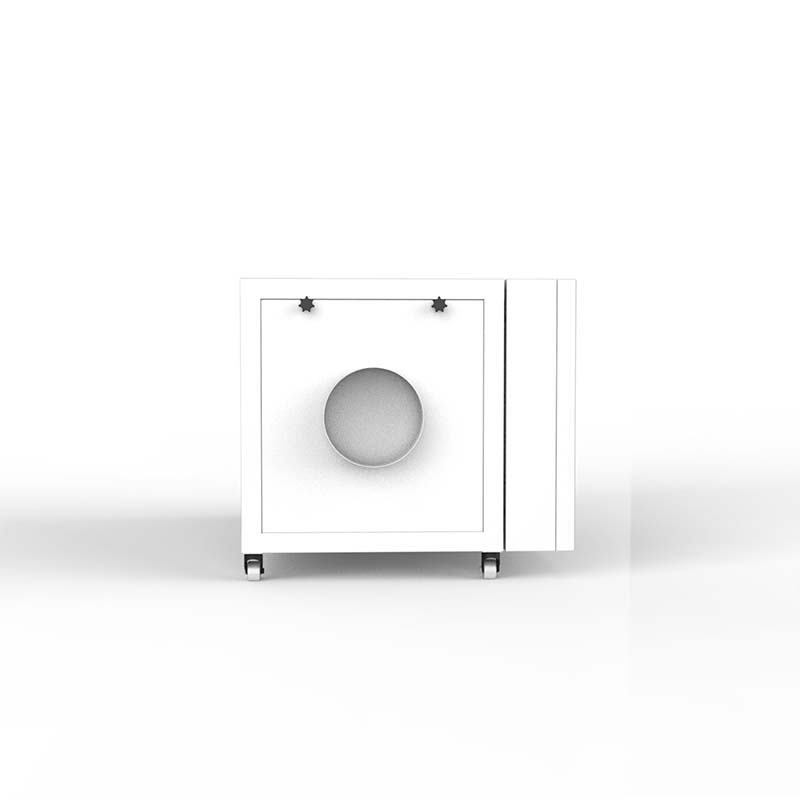
| Inlet | Dual inlet: φ95 mm + φ75 mm |
| Outlet | φ145 mm (K10, K20) / φ150 mm (K30) / φ200 mm (K40) |
| Power supply | 220 V / 50 Hz |
| Filtration stages | Pre-filter mesh → stainless-steel ESP cell → HEPA + activated carbon odour module |
| ESP cell | Stainless steel, washable and reusable |
| Insulators | Patented 95 dry-press ceramic, oil-resistant |
| Fan | Variable-speed, permanent-magnet motor |
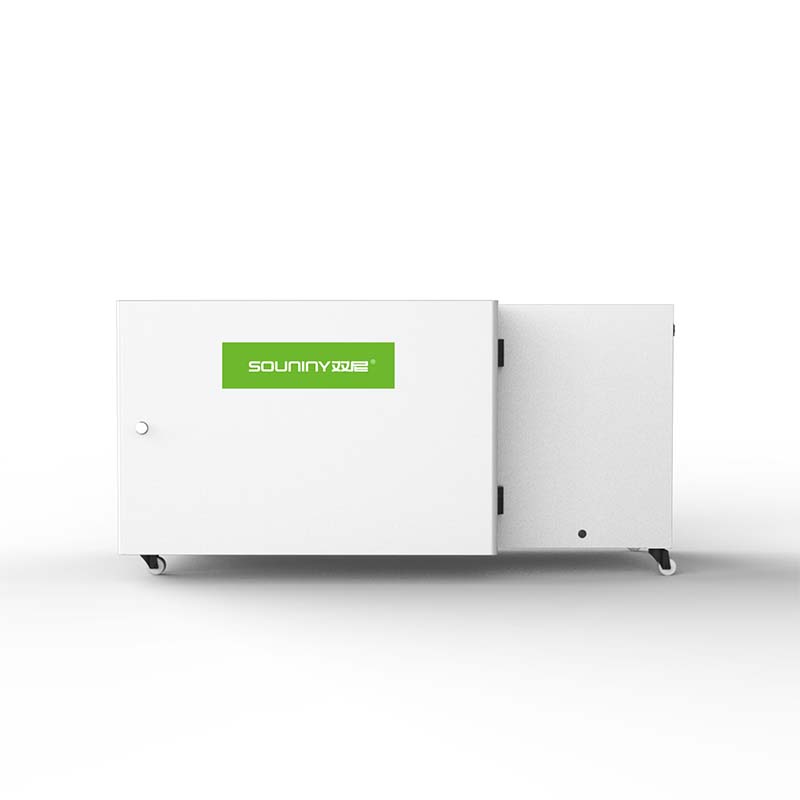
| Housing | Carbon steel, hammer-tone black or white finish |
| Mobility | Floor-standing on swivel castors |
| Certification | CE2 |
Specifications show the series configuration. Exact values vary by model and customization (voltage, flange, finish). Contact us for a model-specific datasheet.
Models and Selection
| Model | Airflow | Power | Outlet |
|---|---|---|---|
| KL-D-K10 | 800 m³/h | 300 W | φ145 mm |
| KL-D-K20 | 1,000 m³/h | 400 W | φ145 mm |
| KL-D-K30 | 1,200 m³/h | 600 W | φ150 mm |
| KL-D-K40 | 1,500 m³/h | 700 W | φ200 mm |
Select on the roaster’s own output: the purifier’s airflow should exceed the actual generated volume with margin left over. Small roasters suit K10 or K20, a mid-size roaster suits K30, and several roasters running in parallel suit K40.
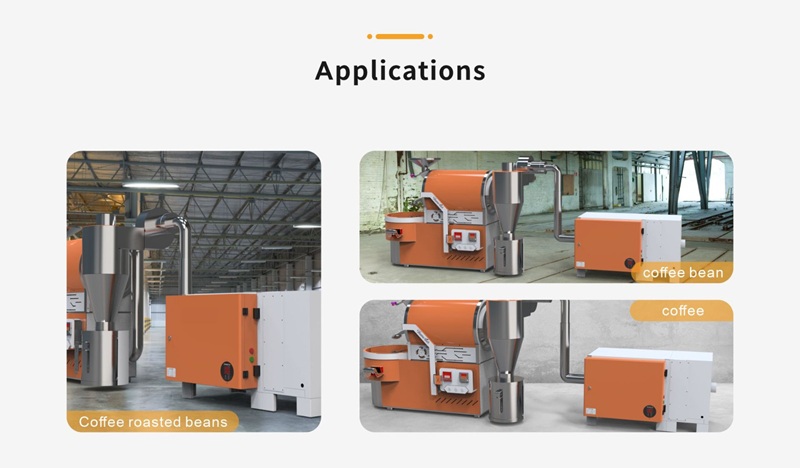
Where It Fits
- Specialty coffee roasting shops roasting on site behind the counter, where the customer area has to stay odour-free.
- Coffee roasting studios working in shared or mixed-use buildings with no dedicated flue.
- Small and mid-size roasting plants running repeated batches through the day.
- Roasting labs and training centres where batches change often and extraction must follow each profile.
Why Choose This Unit
- Built for coffee roasting specifically — not a general cooking-oil purifier repurposed for the job.
- ESP cell capture and carbon adsorption combined, so the odour is treated rather than merely diluted.
- Washable stainless-steel ESP cell keeps long-term running cost down.
- Four models sized to real roaster output, so no wasted airflow and no under-specification.
- Floor-standing on castors, connects to the roaster directly — no drilling, no ductwork alteration.