
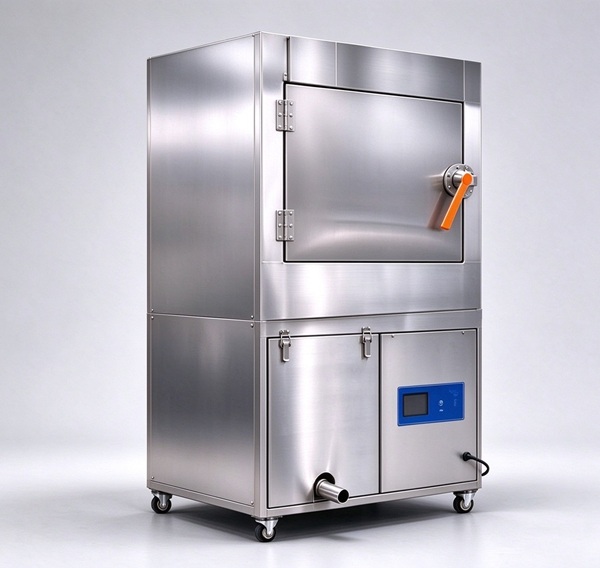
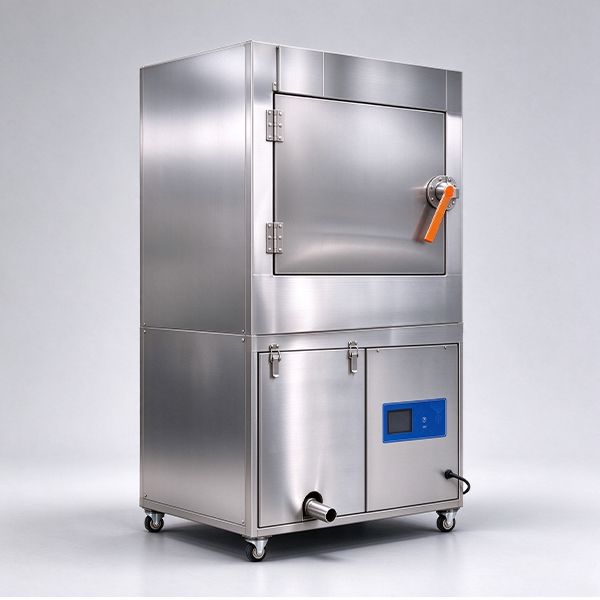
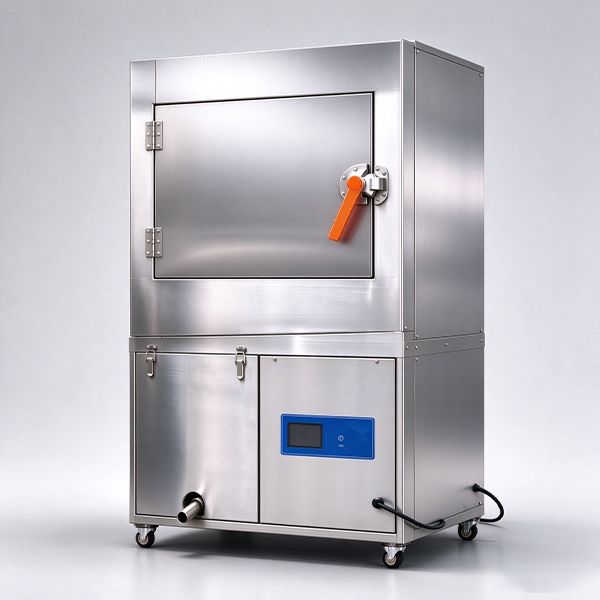
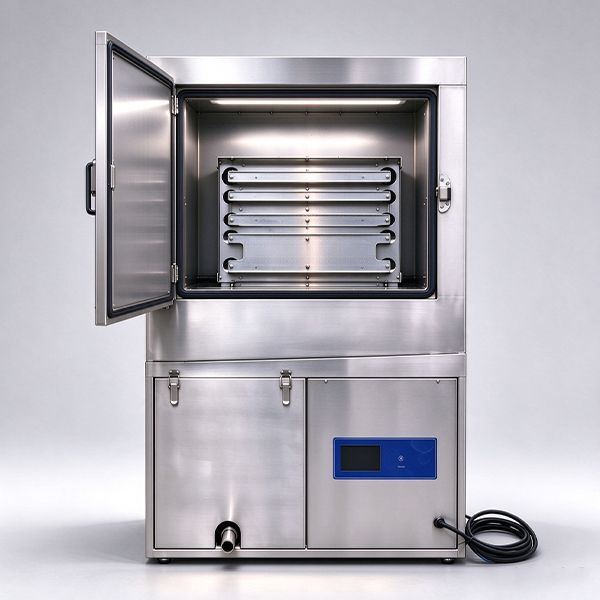
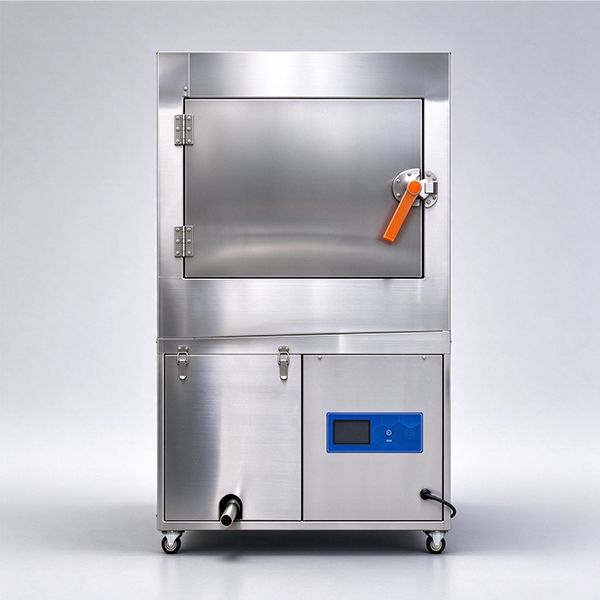
Overview
The ESP cell cleaning machine is built for one job: restoring commercial kitchen electrostatic precipitator cells to full capture performance. Grease builds up on the collector plates through normal service, efficiency falls off quietly, and the standard answer — a technician scrubbing plates by hand — is slow, inconsistent and unpleasant. This cabinet replaces that with a 360° rotating high-pressure spray: drop the removed ESP cell in, press start, and the cycle completes in about three minutes.
| Cleaning principle | 360° automatic rotating high-pressure spray, front and back of every plate plus the gaps between them |
| Cycle time | About 3 minutes per ESP cell |
| Maximum cell size | 1,000 mm |
| Wash temperature | 40–60 °C, settable |
| Supply | 220 V / 50 Hz single phase, 3 kW; automatic solenoid water fill |
The Problems It Replaces
Manual cell washing is the bottleneck in every ESP maintenance programme. Four issues recur across installations:
| Slow by hand | Plate spacing is tight and baked-on grease is hard; working plate by plate makes a single cell a long job and holds up whole maintenance rounds |
| Never fully clean | Brushing leaves blind spots in the gaps and bends, so efficiency barely recovers after the cell goes back in |
| Poor working conditions | Pungent detergent, oil spray and splash — hard on hands and on the surrounding area |
| Hard to standardise | Malls, school canteens and chains run many cells; manual cleaning gives inconsistent intervals and inconsistent results |
The cabinet answers all four with one process: cell in, one button, three minutes, same result every time.
Core Technology
360° rotating high-pressure spray
The spray arm rotates during the cycle and drives high-pressure jets across the front and back faces of the plates and into the gaps between them. There is no blind spot to brush by hand, and hardened grease is stripped off by the water rather than by abrasion — which is what allows the cell to recover its capture efficiency instead of merely looking cleaner.
Industrial touchscreen, three wash modes
Three programmes cover light, normal and heavy fouling, selected on the touchscreen according to how loaded the cell is. One-button start runs the fill, heat and spray sequence automatically, so a new operator can be productive on the first day.
Heated live-water washing
The wash temperature is settable between 40 °C and 60 °C. Warm water dissolves baked-on grease far faster than cold, which is what makes a three-minute cycle realistic on heavy-fouling cells — and it reduces the amount of detergent needed.
Three minutes per cell
Cells can be fed in one after another for batch work, so a service team can process a whole building’s cells in a single visit instead of scheduling repeat trips.
Low power and water use
The programme controls fill volume and spray duration, so the machine does not run water continuously the way a hand wash does. Total draw is 3 kW on ordinary 220 V mains.
Four safety protections
- Low water: stops automatically and prompts when the tank level is insufficient, protecting the pump from dry running.
- Over-temperature: heating stops if the water exceeds the limit.
- Over-pressure: protects the water circuit and pump if line pressure goes out of range.
- Phase loss: cuts power on supply abnormality to protect electrical components.
Specifications
| Parameter | Value |
|---|---|
| Dimensions (L × W × H) | 1,160 × 800 × 1,270 mm |
| Maximum cleaning size | 1,000 mm |
| Cycle time per ESP cell | Approx. 3 minutes |
| Power | 3 kW |
| Power supply | 220 V / 50 Hz |
| Main wash temperature | 40–60 °C, settable |
| Cleaning principle | 360° automatic rotating high-pressure spray |
| Water pump | 1 |
| Water fill | Automatic, solenoid valve |
| Inlet pressure | > 0.2 MPa |
| Tank capacity | 50 L |
| Screen | Industrial touchscreen |
| Wash modes | Three modes, one-button start |
| Housing | Stainless steel |
| Weight | 100 kg |
| Safety protection | Low water, over-temperature, over-pressure, phase loss |
| Certification | CE2 |
Stainless-steel cabinet on braked castors, so the unit can be positioned in a wash bay or back-of-house service area and moved when needed.
Wash Procedure
- Isolate the ESP cell, remove it from the purifier and let the loose oil drain off.
- Open the service door and load the cell flat inside the chamber, within the 1,000 mm maximum.
- Select the wash mode on the touchscreen and press start — the machine fills, heats and begins the rotating high-pressure spray automatically.
- After about three minutes the cycle stops on its own; remove the cell, let it dry, check cleanliness and refit.
- Drain the tank and clear the accumulated oil periodically to keep the water circuit flowing. Any fault is reported on the touchscreen and the machine stops itself.
Where It Fits
- ESP maintenance service companies washing cells pulled from restaurant and mall contracts in batches, raising throughput per site visit.
- Commercial complexes and food halls with many tenants and many purifiers, where property management centralises cell cleaning.
- School and institutional canteens cleaning their own cells on schedule instead of paying outside contractors and waiting for turnaround.
- Restaurant chains and central kitchens collecting cells from branches for standardised batch washing.
- Purifier manufacturers using it for pre-delivery cell cleaning, demonstrations and after-sales support.
Supply and Site Requirements
| Supplied | Complete unit: stainless-steel cabinet, 360° rotating spray system, water pump, 50 L tank, touchscreen control system |
| Site requirements | 220 V / 50 Hz supply, mains water inlet above 0.2 MPa, and a drain connection |
| Routine upkeep | Drain and clear the tank periodically; fault codes are shown on the touchscreen and handled per the service manual |