
Overview
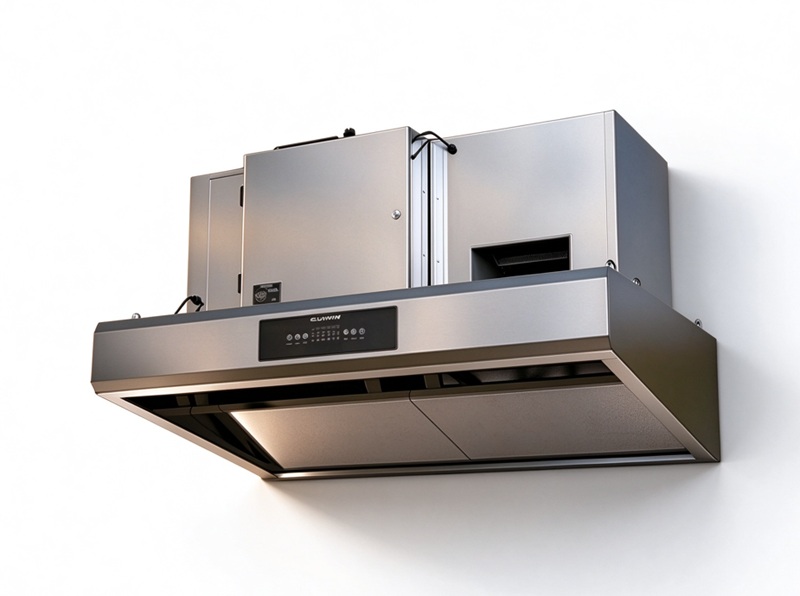
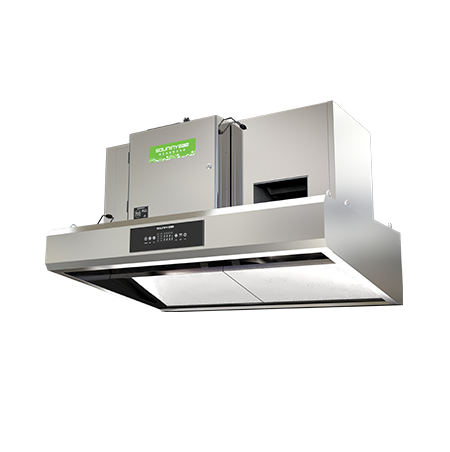
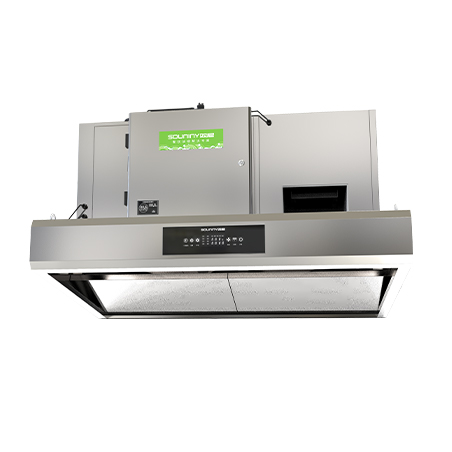
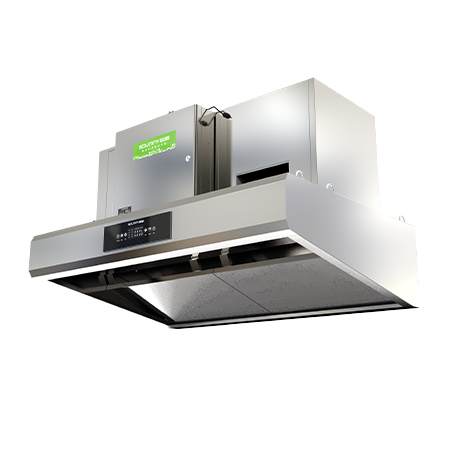
The Little Prince Series (KL-D-Y) is a fan-integrated kitchen fume purifier built for small and mid-size restaurants. The centrifugal fan, high-voltage ESP cell, high-voltage power supply, control system and collection hood are all built into one cabinet, so fumes pass through multi-stage purification inside the unit and are discharged outdoors at low level – the duct does not have to run up to the roof.
The conventional route is to buy a hood, a purifier, an external fan and ductwork separately from different suppliers, then match them on site. That is where the problems start: a fan that cannot pull through the ESP cell, duct runs too long to exhaust properly, and every supplier blaming the others. This unit is assembled and commissioned at the factory; it arrives as one machine, and once it is connected to power it exhausts, purifies and discharges to compliant levels in one step.
In one line: an exhaust-and-purification unit for small and mid-size food service, with outlet concentration down to 1.0 mg/m³ – no fumes in the kitchen, no complaints from neighbours, and emissions that pass inspection.
Three models are available – KL-D-Y16X (4,000 m³/h, 0.8 kW), KL-D-Y20X (5,000 m³/h, 1.5 kW) and KL-D-Y24X (5,500 m³/h, 1.8 kW) – with body lengths from 1.6 m to 2.4 m, covering light stir-fry, grilling, noodle shops and open display kitchens.
Core Technology
The strength of this unit is that every critical part is developed in-house – the ESP cell, the power supply, the insulators and the control system are designed, matched and commissioned by one engineering team rather than bought in and assembled. Item by item:
High-Voltage Ceramic Insulators
The insulator is the barrier between the high-voltage electrode and the metal housing. ESP Cell voltage runs into tens of kilovolts, so if insulation fails the result is leakage, arcing or even fire. The unit uses in-house ceramic insulators rather than standard plastic ones: high dielectric strength and heat resistance that does not age or track in a hot, greasy kitchen; a shape designed to keep oil off the insulating surface; and individual replacement, so a single failed insulator can be swapped without replacing the whole ESP cell.
Stainless-Steel Bipolar ESP cell, 12-Pass Forming
Particles are ionised, charged and collected on the plates as they pass through the ESP cell, so the plate workmanship sets both efficiency and service life. The plates are stainless steel formed in 12 precision passes: a larger collecting area than a flat plate, so particles stay longer and are captured more fully; consistent plate spacing for even discharge with no weak zones or dead corners; and stainless steel that resists oil corrosion – unlike aluminium it does not oxidise or distort, and it can be removed, washed and reused without rusting.
Pure-Copper Motor with a 385 mm High-Airflow Centrifugal Fan
A fan that cannot pull makes even the best ESP cell useless. The motor uses copper windings rather than aluminium, paired with a 385 mm impeller with 135 grid blades: airflow up to 5,500 m³/h from a single unit, enough for heavy-grease grilling and frying; flow resistance below 5%, so the same motor power moves air more freely and uses less electricity; a motor rated to 180 °C for continuous duty next to the cooking line; and low noise, because fan, ESP cell and power supply are matched as one assembly rather than bolted together on site.
In-House High-Voltage Power Supply with Eight Protections
An unstable supply means an unstable ESP cell, and inadequate protection means arc faults and fire. The digital constant-voltage supply is built in-house around a control chip: adaptive stepped output with constant-voltage control that raises voltage automatically as the ESP cell loads up, so efficiency holds as the unit gets dirty; soft start to keep a surge off the ESP cell at switch-on; eight protection layers – high-voltage short circuit, transformer over-temperature, overload, arc suppression, open circuit and more – to remove the risk of arcing; and an IoT interface with an optional 4G module for automatic fault reporting and remote monitoring.
Control System Developed In-House
Parameters are matched as one set, so there is no case of a bought-in supply failing to drive an in-house ESP cell. Fan start and stop, ESP cell voltage and display status are controlled together – one button starts the whole unit. When several units are assembled side by side, each is controlled independently, so only the units actually needed are running.
3.5-Inch Digital Display
A circular digital display on the front shows high-voltage output and current in real time, so whether the unit is running correctly and whether the ESP cell needs washing can be read straight off the screen. It carries automatic reminders for contamination level and cleaning interval – no reliance on judgement, just wash when prompted, which avoids the efficiency drop that comes from an over-dirty ESP cell.
Three-Stage Purification
Fumes rising from the cooking line pass through three stages inside the cabinet:
- Dynamic oil-mist separator: centrifugal separation throws the large oil droplets out first and collects them in one place, taking load off the ESP cell behind it.
- Bipolar high-efficiency ESP cell: high-voltage ionisation charges the fine particles and collects them – the main stage for smoke removal.
- Post-treatment: an optional UV deodorising lamp removes residual cooking odour.
Together the three stages give a purification efficiency of 95% or better, with outlet concentration down to 1.0 mg/m³.
Five-Way Air Discharge
The outlet can be set to the front, top, back, left or right to suit the exhaust conditions of each shop: back discharge straight out of a window where there is an external wall; a short top run where there is housing above; side discharge into a side alley; or a short front duct where nothing else works. The duct never has to run up to the roof, so low-rise buildings and shops whose property manager will not allow roof ducting can still install.
Key Selling Points
- One unit replaces a whole system – less installation, less coordination: the conventional system means buying a hood, purifier, fan and ductwork from four suppliers that do not match on site. Here the fan, ESP cell, power supply, controls and hood are integrated into one stainless-steel body and commissioned at the factory. The customer deals with one manufacturer, and after-sales responsibility is clear.
- Low-level outdoor discharge – no duct up the building: many older shops sit in tall buildings, the property manager will not allow ductwork changes, or a street-front unit has no route to the roof. The built-in fan has the power to discharge outdoors at low level after purification, with five-way outlet direction to suit the site – no duct modification and no negotiation with property management.
- Outlet concentration of 1.0 mg/m³, aligned with the incoming standard: the current national standard is 2.0 mg/m³ and the draft revision tightens it to 1.0 mg/m³, so equipment bought to the old figure may need replacing within two years. Multi-stage purification holds the outlet at 1.0 mg/m³ or better with 95% or better efficiency, meeting both the current limit and the expected revised one.
- Stainless ESP cell and ceramic insulators – durable, easy to service: a standard aluminium ESP cell oxidises and distorts within half a year and is awkward to wash; plastic insulators age and leak in oily conditions. Here the ESP cell is stainless steel formed in 12 passes and can be stripped and washed repeatedly, the insulators are high-voltage ceramic that resists oil and heat, and the screen prompts the cleaning interval so the timing is never guesswork.
- Pure-copper motor and high airflow – no drop-off under heavy grease: grill and frying shops generate heavy fume loads, and many small units look adequate on paper but cannot pull once the burners are on. With a copper motor and a 385 mm impeller, a single unit reaches 5,500 m³/h and the motor is rated to 180 °C, so it holds up through long hours of heavy grease without burning out.
- Core parts developed in-house – a matched, stable machine: assembled units often mix a supply from one maker with an ESP cell from another, so the parameters do not match and both efficiency and reliability suffer. With ESP cell, supply, insulators and controls developed by one team to one parameter set, plus eight protection layers and automatic fault identification, the unit runs stably and after-sales support is straightforward.
Applications by Food Format
| Food Format | Fume Characteristics | Recommended Model |
|---|---|---|
| Stir-fry / fast food / rice bowls | Medium fume, 1-2 burners, concentrated at lunch and dinner peaks | KL-D-Y16X (4,000 m³/h); 1.6 m body suits small shops |
| Noodles / malatang / hotpot | Lighter fume, but heavy steam and odour | KL-D-Y16X / Y20X; add the UV lamp to reduce complaints from neighbours |
| Grilling / frying / fried chicken | Heavy grease, dense oil mist, high temperature – the hardest to treat | KL-D-Y20X / Y24X (5,000-5,500 m³/h); copper motor and multi-stage purification |
| Sichuan / Hunan style cooking | High fume volume, frequent wok bursts, strong chilli and pepper smell | KL-D-Y20X (5,000 m³/h); bipolar ESP cell with UV deodorising |
| Open display kitchens | Fumes face the customer directly; presentation and smell both matter | KL-D-Y20X / Y24X; high airflow captures fast, no visible smoke or smell at the counter |
| Food courts / snack streets | Dense stalls, restricted exhaust, odour passing between units | KL-D-Y16X / Y20X; modular assembly matched to stall length |
Application Scenarios
- Street-front Shops and Community Units: residents live directly above, so drifting cooking smell is the fastest route to a complaint. Low-level discharge with high-efficiency purification settles it.
- Lower-floor Restaurant Space in Malls and Complexes: property managers restrict duct routes and will not allow drilling to the roof. Five-way discharge lets the unit vent close by with no duct modification.
- Open-kitchen Restaurants and Buffets: guests can see into the kitchen, so escaping fumes affect the dining experience directly. High airflow captures the plume and keeps the open area clean and bright.
- Snack Streets and Food Courts: small stalls with heavy fume, packed side by side and sharing smell. Each stall purifies and discharges independently, cutting cross-complaints.
- Older Shopfront Refits: existing ductwork is aged and badly routed. An integrated unit removes the need for a roof duct, so the refit stays a small job.
Specifications
| Parameter | Value |
|---|---|
| Purification Efficiency | ≥ 95% |
| Outlet Concentration | ≤ 1.0 mg/m³ |
| Airflow | 4,000 – 5,500 m³/h (model dependent) |
| Fan Power | 0.8 – 1.8 kW (model dependent) |
| Motor Temperature Rating | 180 °C |
| Flow Resistance | < 5% |
| Purification Stages | Dynamic oil-mist separator + bipolar ESP cell + optional UV |
| Outlet Direction | Five-way: front, top, back, left, right |
| Body Material | SUS201 stainless steel (SUS304 to order) |
| Options | UV deodorising lamp, LED flame-proof lighting, 4G IoT module |
Model Range
| Model | Fan Power | Airflow | Oil Separators | Dimensions L×W×H (mm) | Outlet (mm) | Burners |
|---|---|---|---|---|---|---|
| KL-D-Y16X | 0.8 kW | 4,000 m³/h | 3 | 1600 × 1100/1300 × 945 | 300 × 300 | 1-2 |
| KL-D-Y20X | 1.5 kW | 5,000 m³/h | 4 | 2000 × 1100/1300 × 945 | 300 × 400 | 2-3 |
| KL-D-Y24X | 1.8 kW | 5,500 m³/h | 5 | 2400 × 1100/1300 × 945 | 300 × 400 | 3-4 |
Figures are taken from the official product specification sheet; the shipped configuration of each unit is final.