
Overview
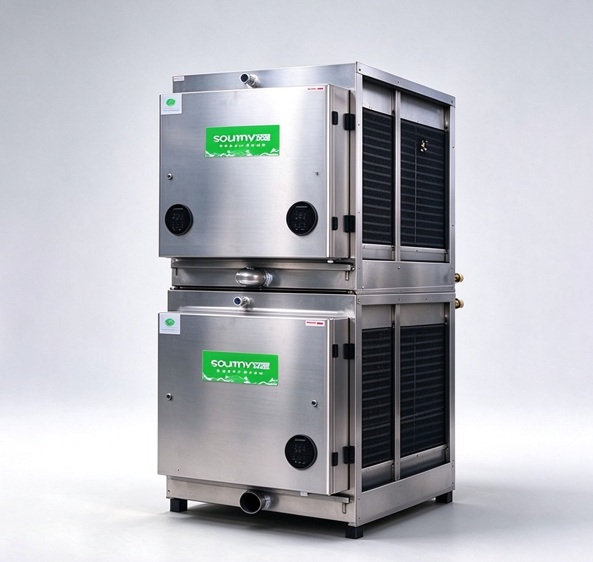
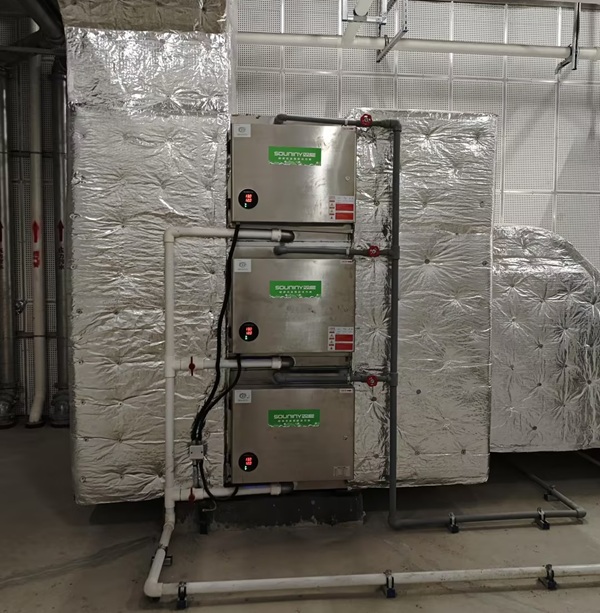
The KL-D-Q Series is a fully automatic self-cleaning electrostatic precipitator supplied with an external washing main unit, built for high fume loads – large canteens, corporate and school dining halls, central kitchens and commercial complexes. Three years in development, it integrates four systems in one package: multi-stage electrostatic purification, hydraulic self-rotating spray washing, intelligent PLC control, and oil-water separation with automatic drainage. Purification, equipment washing and grease collection all run automatically.
The whole machine is stainless steel. There is no need to dismantle the unit or wash the ESP cells by hand; operation stays stable over long service, environmental inspections are easier to pass, and running cost falls sharply. The specification set is complete enough to be quoted directly against tender and procurement technical clauses, which makes the range a first choice for public-building projects and centralised exhaust works in commercial complexes.
Problems It Solves
Conventional electrostatic units carry three standing burdens:
- Manual cleaning is expensive: the ESP cell must be periodically dismantled and hand-washed, which closes the kitchen for hours and brings a professional cleaning charge every cycle – a substantial running cost over the years.
- Efficiency decays between washes: grease keeps building up on the collector plates. Left uncleaned, efficiency drops, emissions drift over the limit, and the site carries the risk of failed spot checks and enforced rectification.
- Upkeep is hard to manage: wash intervals are a matter of judgement, multi-unit projects need someone dedicated to chasing them, and the schedule slips.
The KL-D-Q answers all three at the source with hydraulic self-cleaning: the unit sprays its own ESP cell clean on a set cycle, with no dismantling and no operator. Purification stays high, the risk of exceeding emission limits falls, and maintenance labour drops by more than 80% – installed once, then left alone.
Core Technology
Hydraulic Self-Rotating Spray Washing – the Core Differentiator
The unit carries an extended 650 mm hydraulic self-rotating spray arm. There is no motor and no gear train: the arm is driven purely by the reaction force of the washing water, so the structure is minimal, wear-free, resistant to jamming, and effectively maintenance-free with a low failure rate.
- 360° full-coverage washing: the arm uses a uniform tangential inclined-hole design and turns at constant speed once water flows, sweeping the full working area of the ESP cell with its long reach – both faces of every plate, no dead corners.
- Anti-clog nozzles: Φ2.2 mm spray holes take clean water or a detergent-hot-water mix, dissolving heavy cured grease on the plate surfaces quickly.
- Stainless rotary joint: a graphite-PTFE anti-corrosion seal withstands oil, acid and alkali, turning at high frequency over long service without leaking or seizing.
Two washing modes are supported:
- Scheduled washing: the cycle is freely set from 1 to 15 days and can run automatically after closing time at night – suited to regular restaurants and canteens.
- One-touch manual washing: started from the touch panel, for sites that want an extra deep clean now and then.
The complete automatic cycle runs without any human intervention: shutdown and static discharge → automatic water inlet → automatic detergent dosing → 360° high-pressure rotating spray → wastewater discharge → fan drying and reset. Truly unattended operation.
Multi-Stage Electrostatic Purification, Stable Over the Long Term
- Equalising pre-filter: intercepts large oil mist, dust and debris and evens out the inlet air speed, avoiding turbulent flow across the ESP cell.
- High-density ESP cell: 0.4-1.0 mm stainless steel, one-piece press-formed with a 12-pass bending process for a reinforced structure; micron-scale fume particles are ionised and captured under high voltage.
- Performance: purification efficiency of 98% or better with odour removal above 60%, meeting GB 18483-2001 (Emission Standard of Cooking Fume), suitable for low-level discharge.
Electrical Safety
- Sixth-generation closed-loop digital constant-voltage power supply: stable voltage output that copes with complex site power conditions.
- Residual static discharge at shutdown: stored charge is released automatically when the unit stops, removing the shock hazard during inspection.
- 0.05-second cut-off: protection trips within 0.05 s on short circuit, leakage or arcing.
- High-frequency ceramic insulators: waterproof, oil-proof and heat-resistant, preventing tracking, leakage and breakdown.
Oil-Water Separation and Drainage
A sloped sump at the bottom of the chamber gathers the oily wash water automatically after each cycle, and a standard DN50 (2-inch) drain port carries it away in a fixed direction. Daily upkeep is limited to opening the door now and then to inspect and clear the collection area – no dismantling, no scraping, no wiping the plates.
All-Stainless Body
Shell, chamber, air ducts and spray piping are all stainless steel, one-piece bent and fully welded – corrosion-resistant, heat-resistant and rust-proof for long service in fume and moisture. The whole machine is rated IP65, sealing spray water and vapour away from the circuits, and the modular construction lets the filter screen, ESP cell and spray arm be removed independently for service.
Intelligent Visible Management
A 7-inch industrial touch screen shows the live status of the fan, high-voltage supply and washing pump, supports one-touch washing and fault-code alarms, and is simple to operate. An IoT module is optional for remote monitoring and data analysis. Safety mechanisms include fault self-diagnosis, water-shortage protection, pump-failure protection, chamber overflow alarm, and overload and short-circuit protection.
Automatic Washing vs Manual Cleaning
| Item | KL-D-Q Automatic Self-Cleaning | Conventional Manual Dismantling |
|---|---|---|
| Washing time | Runs automatically at night, outside trading hours; a cycle takes around ten-odd minutes | Kitchen closes, unit is dismantled, hours are lost |
| Labour cost | No dedicated operator; saves more than 80% of maintenance labour | Professional crew on site every time, a service fee each cycle |
| Washing result | 360° sweep with no dead corners; stubborn grease fully dissolved; high purification efficiency maintained continuously | Dead corners and incomplete rinsing; handling knocks can damage the ESP cell |
| Equipment wear | No repeated dismantling; ESP cell and unit service life extended | Repeated assembly distorts the ESP cell and breaks insulators |
| Compliance risk | Efficiency stays high; the risk of exceeding limits at spot checks is reduced | Wash intervals slip, grease accumulates, emissions exceed limits, fines and rectification follow |
Specifications
| Model | Airflow | ESP Cell Configuration | Dimensions L×W×H (mm) | Inlet / Outlet Flange (mm) | Cabinet |
|---|---|---|---|---|---|
| KL-D-Q60 | 6,000 m³/h | 2 ESP cells | 970 × 870 × 850 | 520 × 750 | Single-layer |
| KL-D-Q80 | 8,000 m³/h | 2 ESP cells | 970 × 870 × 850 | 720 × 750 | Single-layer |
| KL-D-Q160 | 16,000 m³/h | 4 ESP cells | 1580 × 970 × 850 | 1330 × 600 | Single-layer |
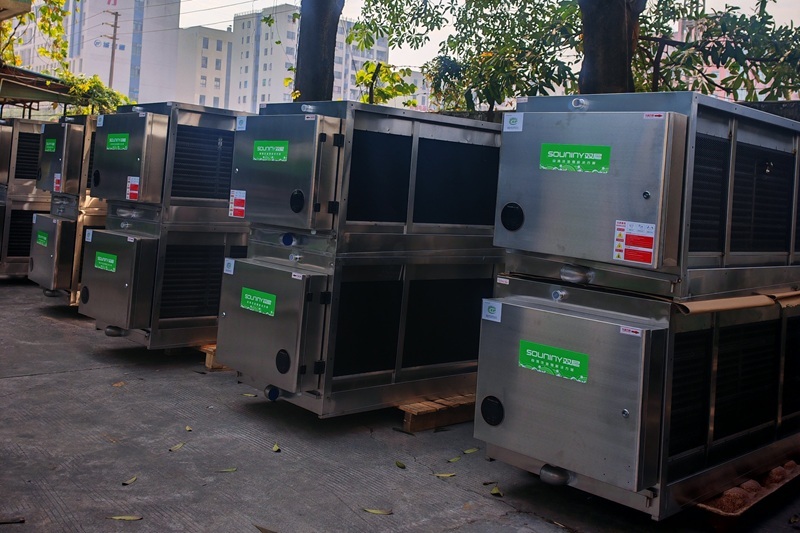
| KL-D-Q200 | 20,000 m³/h | 4 ESP cells | 1020 × 970 × 1700 | 870 × 1600 | Double-stack |
| KL-D-Q240 | 24,000 m³/h | 8 ESP cells | 1170 × 970 × 1700 | 930 × 1450 | Double-stack |
| KL-D-Q320 | 32,000 m³/h | 8 ESP cells | 1580 × 970 × 1700 | 1330 × 1450 | Double-stack |
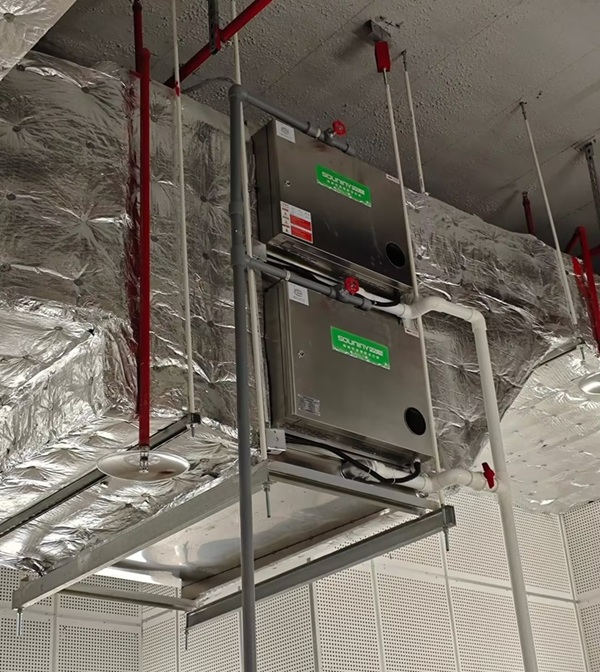
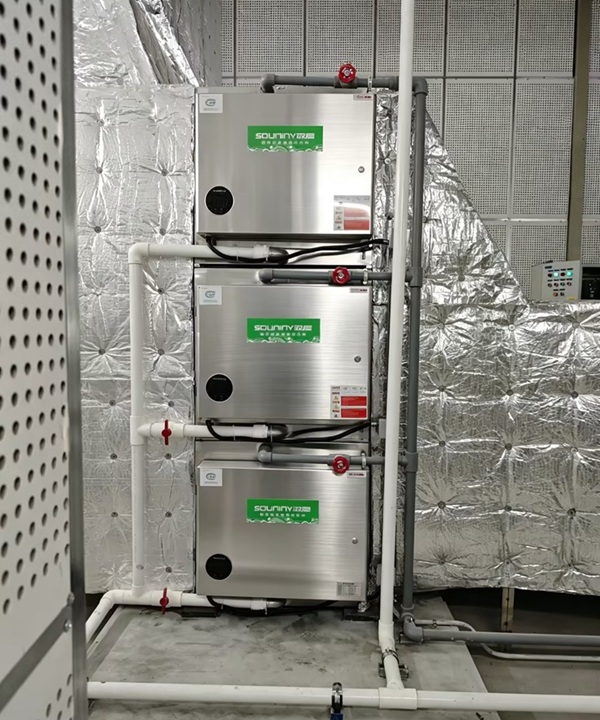
External washing main unit (supplied with every unit): 980 × 990 × 850 mm, integrating the washing pump, water storage tank and control system, running in link with the purification main unit. Dimensions are taken from CAD engineering drawings; the body is stainless steel throughout; flanges are standard duct-coupling connections. Floor-standing and ceiling-suspended installation are both supported, and non-standard sizes can be customised.
General Parameters
| Parameter | Value |
|---|---|
| Purification Efficiency | ≥ 98% |
| Odour Removal | ≥ 60% |
| Emission Standard | GB 18483-2001, suitable for low-level discharge |
| Airflow Range | 6,000 – 32,000 m³/h (six models) |
| Spray Arm | 650 mm hydraulic self-rotating, Φ2.2 mm anti-clog nozzles, no motor or gears |
| Wash Cycle | Scheduled 1-15 days (overnight running supported) or one-touch manual |
| Power Supply | Sixth-generation closed-loop digital constant-voltage; 0.05 s cut-off on short circuit, leakage or arcing |
| Protection Rating | IP65 |
| Control | 7-inch industrial touch screen; fault self-diagnosis; optional IoT remote monitoring |
| Drainage | Sloped sump, DN50 (2-inch) drain port |
| Body Material | Stainless steel, one-piece bent and fully welded |
| Installation | Floor-standing or ceiling-suspended; non-standard sizes to order |
| Certification | CE certified |
Selection Guide
| Site Type | Recommended Models | Note |
|---|---|---|
| Small and mid-size restaurants | KL-D-Q60 / Q80 | Single-kitchen exhaust with matched airflow |
| Mid-size canteens and clustered stalls | KL-D-Q160 / Q200 | School and corporate canteens, food courts |
| Large canteens and central kitchens | KL-D-Q240 | Large school and corporate dining complexes |
| Commercial complexes, centralised exhaust | KL-D-Q320 | Multi-tenant central kitchens, complex food courts |
Typical applications: corporate and school canteens, large dining halls, commercial complexes, food courts and central kitchens; heavy-grease kitchens in Chinese restaurants, Sichuan and Hunan kitchens, hotpot and barbecue restaurants; oil-mist treatment in food processing; suited to both new kitchens and refits of older ones.
Application References
- Food-court centralised exhaust in a commercial complex: many tenants on one exhaust system with a widely fluctuating fume load. A KL-D-Q320 was set to wash automatically at night by trading schedule; efficiency has stayed stable, tenant kitchens never close for cleaning, and property management runs the whole system centrally.
- School canteen: concentrated wok bursts at lunch peaks and a high fume concentration. KL-D-Q160/Q200 units run scheduled overnight washing, hold high purification efficiency long term, meet the canteen exhaust requirements, and cut the backlog of maintenance work for the logistics team.
- Corporate canteen: a government-enterprise dining complex chose the KL-D-Q240 with its external washing main unit, running unattended with no dedicated maintenance staff; discharge has stayed compliant over the long term and annual running cost is down.
The references above are typical application scenarios; named project cases and installation photographs are available from the commercial team on request.
Supply and Installation
What Is Supplied
- KL-D-Q purification main unit, complete: stainless cabinet, ESP cell, self-cleaning spray system and high-voltage power assembly.
- External washing main unit with washing pump, water storage tank and control system.
- Installation manual and electrical schematics.
- Factory inspection report and technical parameter documents.
Installation Notes
- Install in the exhaust duct system, preferably upstream of the fan.
- Connect a mains water inlet and a drain on site – both are required for the self-cleaning function.
- Set the automatic wash cycle; the unit completes the spray wash on schedule by itself.
- Day-to-day upkeep is limited to clearing the grease collection area; the ESP cell does not need frequent dismantling.
- Electrical connections should be made by a licensed electrician following the wiring manual.